Interfaith

IN APRIL, REPRESENTATIVES from 57 nations met in Santa Marta, Colombia, shattering bureaucratic climate change gridlock to forge a “coalition of the willing“ for a just transition beyond the use of fossil fuels. Together, they moved past the question of if we should abandon fossil fuels; the gathering in Santa Marta focused entirely on how. Global climate leadership is being rewritten, forged through a rare convergence of political courage and multifaith prophetic witness.
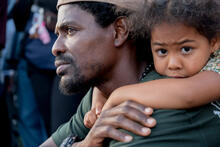
On May 18, two teenagers shot and killed three people in a coordinated attack on the Islamic Center of San Diego, which also houses a school. At the time of the shooting, there were 140 schoolchildren inside the center. Community members said that the three men who were killed—Amin Abdullah, Mansour Kaziha, and Nadir Awad—sacrificed their lives to protect the children. Subsequent investigations have found that the two gunmen left behind anti-Muslim, anti-Black, anti-women, and antisemitic writings.
In the wake of the shooting, it can feel easy to give in to despair as we witness yet another shocking act of violence against marginalized religious communities in the United States. But this is not a time for despair. Instead, it is a time for action. For Christians wondering what to do, here are five things you can do now to support Muslim communities and fight Islamophobia in your community.
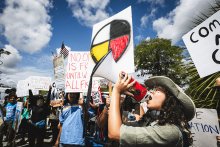
They’re out there, deep in the Florida Everglades every Sunday evening—rain or shine—holding signs, singing songs, and praying.
Since it opened at the beginning of July, Florida’s migrant detention center dubbed "Alligator Alcatraz" has sparked a slew of controversy surrounding its existence, including multiple lawsuits from environmental and civil rights groups seeking to shutter the detention camp.
With pending legal challenges and now a government shutdown, the future of the controversial facility remains uncertain.
But one thing has been constant: Florida faith leaders have shown up week-after-week throughout it all.

For the ninth year in a row, Sojourners honors Women’s History Month with an article highlighting revolutionary women shaping the church. This year’s list includes theologians, filmmakers, illustrators, musicians, pastors, and academics. Our nominees engage in diverse work, but these women are united through a fearless pursuit of justice. They lead through empathy. They build community. They fight against rising tides of hopelessness in our world with messages of radical and inclusive love.

As we officially enter the season of primaries, advertising campaigns, and debates, faith communities are as central to the election process as they ever have been. Even with the nationwide decline in religiosity and trust in institutions, religious leaders and congregations are central community builders for millions of people in the U.S.
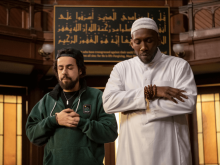
Ramy is a Hulu series wrestling with deep questions of faith from Muslim 20-something son of Egyptian immigrants. The show follows Ramy Hassan, played by comedian Ramy Youssef, as he navigates the tensions of dīn and dunyā — religion and the world. Transcending the clichés of blind religiosity, terrorist sympathies, and the social ignorance stereotypically associated with Arab and Muslim American life, Ramy shows us the messy work of finding our own way in the world between halal (permissible) and haram (not permissible).
TO THE LEFT of a buffalo photograph on my wall, a rosary hangs from a thumbtack. Frequently, my eyes linger there. It came to me a couple of years ago on my birthday as part of a gift from my mother — looped through the ribbon of a wrapped box that contained a tea set. When I held the rosary before my face, I found it curious. My mother explained that it had been my late father’s, and that it was one of his most prized possessions. I was a little stunned because I had never seen it before. It was a gift, my mom continued, made by his grandmother who died two years before I was born. Now, it had come to me.
My great-grandmother’s parents were part of a group of 25 Red River Métis families who settled on Spring Creek in central Montana in 1879, an area now known as Lewistown. They, like all the tribes of the region, were pursuing the final dwindling herds of buffalo. It was a tumultuous time to be Indigenous, with settlers flooding the landscape from all points east and gobbling up land, whether it had been promised to Indians or not.
The origins of my Métis people can be found in the late 1600s, and likely earlier, when the first European traders first began establishing trading posts in the Red River Valley. This region, named for the mighty Red River of the North, is centered at what is now Winnipeg, Manitoba, and extends into today’s Minnesota and North Dakota. These early Europeans, mostly from France — with some coming from Scotland, Wales, and England — married into the Indigenous people already inhabiting the region: Cree people and Ojibwe people. From these unions sprang descendants who created their own unique, mixed-culture people — the Métis.
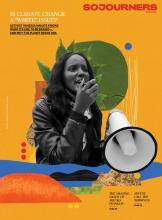
Activist Vanessa Nakate on Jesus, erasure, and the climate crisis in the Horn of Africa.
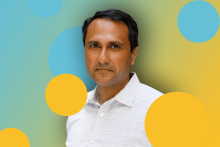
In his new book, We Need to Build, Patel seeks to inspire others to build with him instead of just criticizing policies and structures they dislike. The book draws on Patel’s work with Interfaith America and considers what we can learn from good (and bad) institutions across the globe.

Joel Lohr, the president of soon-to-not-be “Hartford Seminary” sat with Sojourners’ assistant news editor Mitchell Atencio in late September to explain why the school is changing its name and what that change says about the future of theological education — and the church — in the United States.

When Rev. Ann Helmke, who leads San Antonio’s Faith-Based Initiative, invited Kemp to sign an interfaith pledge to publicly take the COVID-19 vaccine, he was quick to say yes. Part of the pledge involves sharing a selfie of the vaccination process on social media. “The importance of people of faith speaking to their congregations, their constituency, their area of influence, cannot be overstated,” said Kemp, who received his first vaccine dose on Dec. 18 and shared a photo of it on Facebook.
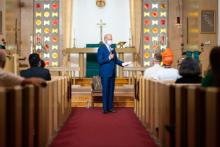
Before winning the election, Biden touted endorsements from more than 1,600 faith leaders, the largest number for a Democratic candidate in modern history. The noteable outreach could be attributed partially to President Donald Trump’s relationship with religious conservatives. The increasing visibility of religious leaders in progressive politics also provided an opportunity. However, when looking for a catalyst to the campaign’s faith outreach, experts in faith and politics point to Joe Biden himself.
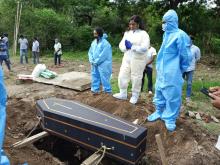
Death does not scare Sagai Nair. She lowers the deceased into coffin boxes, carries them by foot to the graveyard with five other volunteers, uses a shovel to dig six feet inside the earth, and recites verses from the Bible for the grieving families. After paying her last respects, she burns her protective gear, sanitizes herself, and prepares for the next burial. In a coronavirus hotspot, 47-year-old Nair is the only woman in India burying the dead—a traditionally male-dominated occupation.

How will progressive Christians react to rising anti-Semitism in this pandemic?

In years past, I’ve invited my non-Muslim friends and community members to visit my mosque for interfaith Iftars. These were opportunities to discuss similarities in fasting across Muslim, Christian, and Jewish traditions, as well as chances to share food and friendship. Now, these interfaith events are impossible. But there are still ways to come together in friendship and solidarity for Muslims during COVID-19 Ramadan.
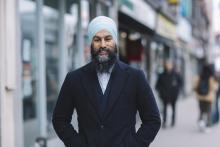
Jagmeet Singh is leader of Canada’s New Democratic Party. His campaign to become the country’s next prime minister made international news — in part because of his progressive politics, and in part because of his appearance as a practicing Sikh. In 2019, Singh became the first racial and religious minority to lead a major political party in Canadian history. He remains one of the highest-ranking politicians and most prominent faces in Canada.
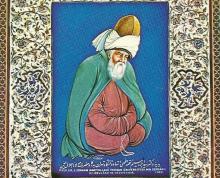
Today, the United States and Iran are two countries on the precipice of war with ruling elites who quote Rumi.

Bolsonaro is forming alliances and shaping policies according to conservative evangelical religion.
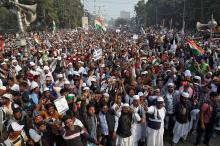
The recent protests might have been precipitated by the Citizenship Amendment Act, but they are the culmination of long-held grievances.

Francis of Assisi met Sultan Malik Al-Kamil 800 years ago.