Christianity
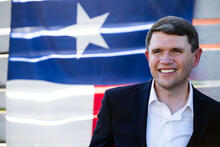
In a 2023 sermon, Texas Democratic Senate candidate James Talarico called Christian nationalism “a cancer on our religion” and denounced Republicans for trying to transform America into a “Christian theocracy.”
Yet, at the same time, Talarico—a Presbyterian seminary student—has made his Christian faith a core message of his campaign. He mentions biblical teachings like “love thy neighbor” when discussing partisan division. He talks about the angel Gabriel appearing to Mary as a model for consent and a justification for abortion rights.
To some, these positions may seem to be in tension. If you oppose Christian theocracy, how can you use Christian theology to justify your political positions in the public sphere? When Christian beliefs are presented as the moral arbiter of politics, isn’t that the definition of Christian nationalism?
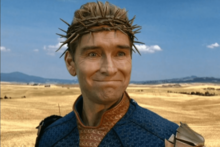
Amazon Prime’s The Boys wrapped up its fifth and final season last week, and its overarching theme was: faith. After becoming the de facto CEO of Vought and president of the United States, antagonist Homelander—a narcissistic Superman foil, wrapped in the American flag and played to perfection by Antony Starr—still isn’t satisfied.
Craving what he’s craved since lab birth—unconditional love and devotion with no expectation of anything in return—he declares himself a god and uses Vought’s media machinery to convince the American public of his divinity. Guided by visions of his former boss, Madelyn Stillwell—a Mary-esque mother-figure who, before he murdered her in Season One, used to breastfeed him—he ultimately decides to kill (“cleanse”) anyone who doesn’t “in their heart of hearts” believe in his divinity.
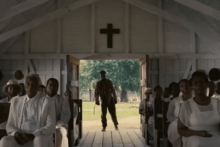
In January, Ryan Coogler’s Sinners made history in becoming the Oscars’ all time most-nominated film with 16 total nominations, resurfacing discourse on the film’s many merits: a deep storyline filled with layers of meaning, stellar cinematography and acting, and a breathtaking soundtrack and score. What is truly unique about this movie, however, is how it criticizes Christianity from an anti-imperialist perspective. Sinners displays the importance of resisting the false religious binaries of sacred and demonic that victims of imperialism have had forced upon them for far too long.
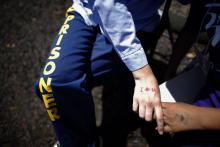
At Lane Murray, where I’m incarcerated, a bureaucratic rule creates a peculiar dilemma for someone like me who finds truth and solace in both Christianity and Buddhism. The prison system demands I choose just one, but my soul refuses to be so neatly categorized. We’re also only allowed to change our religious affiliation once every six months. As if divine inspiration could ever follow an administrative calendar.

I had been doing therapy for a decade with little results, but things really began to change when I started meditating.

Was Robert E. Lee, the infamous confederate general who went to war to defend slaveocracy in the South, a Christian? The answer to this question may seem obvious: Yes. Lee was an Episcopalian who was called a “humble, earnest Christian” by a minister who was his contemporary. But some Christians may recoil at the idea that someone they see as clearly at odds with Jesus’ call to “release the captives,” would be considered a Christian.
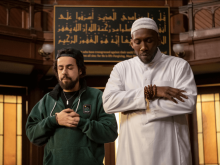
Ramy is a Hulu series wrestling with deep questions of faith from Muslim 20-something son of Egyptian immigrants. The show follows Ramy Hassan, played by comedian Ramy Youssef, as he navigates the tensions of dīn and dunyā — religion and the world. Transcending the clichés of blind religiosity, terrorist sympathies, and the social ignorance stereotypically associated with Arab and Muslim American life, Ramy shows us the messy work of finding our own way in the world between halal (permissible) and haram (not permissible).

For the past six years, Sojourners has celebrated Women’s History Month by sharing a list of Christian women who are bringing us hope and inspiring us to action. This year’s group includes pastors and poets, abolitionists and mothers, liturgists and storytellers; women who question authority, disrupt unjust systems, set boundaries, reimagine what’s possible, and pray.

Spider-Man: No Way Home is the end of a lot of things. It's the end of the (first) Marvel Cinematic Universe Spider-Man trilogy. It’s the end of a lot of speculation about how the multiverse will play into the MCU’s future (since the Loki TV show broke it open). But it also signals the end of the MCU’s innocence — and by extension, superhero movies in general. Spider-Man: No Way Home insists that true heroism looks markedly different from what superhero movies have offered thus far.
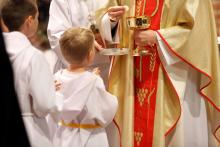
My first memory of receiving Christ is forever entangled with a social faux pas that caused me stress and pain.
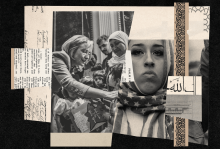
EXCEPT FOR ABRAHAM LINCOLN and Thomas Jefferson, every president of the United States was or is a professing Christian.
Only in the case of John F. Kennedy, it seems, has a president’s Christian faith counted against him in the opinion of a significant number of citizens, and in Kennedy’s case it was because he was Catholic rather than Protestant. The Christian belief of public officials in any branch of national, state, or local government hardly ever raises concern among the U.S. public. But the opposite is true when it comes to Muslim officials.
Many conservative Americans say they fear that the U.S. will become a nation influenced by Islamic tenets instead of Christian ones. Commentators on Fox News often express alarm about sharia (Islamic law). Jeanine Pirro, host of the network’s Justice with Jeanine Pirro, accused Rep. Ilhan Omar, D-Minn., a Muslim woman of Somali descent, of supporting Islamic rule in the United States. Omar and Rep. Rashida Tlaib of Michigan are the only two Muslim women ever elected to Congress, and two of the three Muslims ever to serve in the U.S. legislature; Twitter users criticized Omar for wearing a hijab and Tlaib for wearing, at her congressional swearing-in, a traditional Palestinian dress called a thobe, made by her mother. Another Fox News host, Pete Hegseth, said that, based on how Tlaib “talked about President Trump having a hate agenda, I could, therefore, look at her and say that she has a Hamas agenda.” The Associated Press had to debunk the claim that Tlaib’s thobe was a “symbol of Hamas terrorists,” a sign that many Americans may have believed it to be true.
The alienation and hate go even further. A Florida Republican politician said in a fundraising email that falsely claimed that Omar worked for the nation of Qatar, “We should hang these traitors where they stand.” Another man called Omar’s office and said he would “put a bullet in her skull.” Following the Jan. 6 insurrection at the U.S. Capitol, when lawmakers were still in the building trying to certify President Joe Biden’s election, Tlaib discussed on the House floor her constant fear due to the death threats she regularly receives.
“I worry,” she said, “every day.”
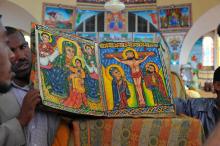
As a Tigrayan and a Christian, I want to know why my fellow Christians who claim to worship the Prince of Peace have engaged in legitimizing violence and death. How do you start with the theology of the gospels — which teaches us to love our enemies, to be peacemakers and to suffer with those who suffer — and end up with a theology that endorses war, rejoices in massacres and destruction, and brands critics as sub-human? Tigrayans are created in the image of God.

If you’ve heard white evangelical pundits lately, you’ll know there’s a dangerous “new” enemy threatening U.S. Christianity. If left unchecked, they say, this enemy will wreak havoc on traditional values and transform our entire nation into atheists. What is this growing enemy of evangelicals? Democratic socialism.
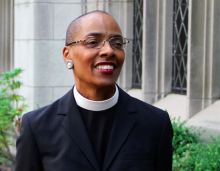
One of the reasons I liked going to church was because I loved hearing stories about Jesus. One of the most compelling, yet saddest, stories I heard was about his manger birth. As a little girl, I simply could not understand how people could allow a baby to be born in a cold barn, in a manger. I cried every time we sang, “Away in a manger, no crib for a bed. The little Lord Jesus Lay down His sweet head.” Every time I heard that hymn, I was reminded of the little girl and boy I had seen on that rainy evening. Somehow, I instinctively knew that there was a connection between Jesus’ manger birth and their inner-city life.
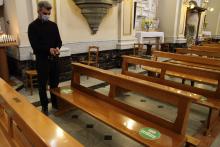
2. Do we understand how church life is inherently different than other expressions of civic life?
While many of the businesses that have stayed open, or are being authorized to reopen, are inherently transactional, what happens in churches in inherently social and relational. We eat together; we sing together; we embrace one another; we care for one another’s children. These familiar patterns have been ingrained in us through years of meeting together, and will be challenging for many to shake even when we know the risk and have a plan in place.
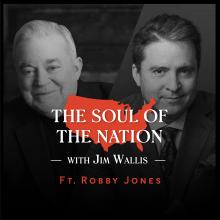
Robert P. Jones, CEO and Founder of the Public Religion Research Institute (PRRI) and a leading scholar and commentator on religion, culture, and politics, speaks with Rev. Jim Wallis on the importance of polling in the presidential election season and the impact of COVID-19 on the perceptions of people of faith.
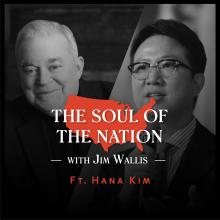
Rev. Jim Wallis talks with Myungsung Church's lead pastor Rev. Hana Kim about South Korea's response to COVID-19 and the moral, ethical, and religious imperative we have to help the most vulnerable as Jesus commands, many of whom are more at-risk during this global crisis.
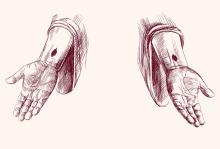
But the church peddles ableist ideas in devious ways: It proclaims to be pro-life but mirrors the world’s messaging that productivity and health are drivers of worth. It weaponizes prayer as a foot-soldier in its ableist theology, reducing God to a slimy vending machine churning out miracles upon request. It limits our imaginations for how abundant life should look, confining prosperity and happiness to a singular mode of living.
3. Their Calling Was to Lay Hands on the Sick. Then Came the Coronavirus.
How the pandemic transformed the lives and ministry of eight Manhattan priests, and what their example can teach the rest of us.
4. Christian ethics and the dilemma of triage during a pandemic
In the current COVID-19 pandemic, medical staff are making triage decisions about who will be saved by artificial ventilation and who will be allowed to die.

How strange that to love our neighbor we must abstain from interacting with them in the flesh. Maintain social distance, and for the love of God, don’t go to Grandma’s house. These are all wise admonitions, but is that it? Is that the extent of what it means to love our neighbors in the age of COVID-19? Might the call to a Maundy Thursday depth of love ask a bit more of us?