Opinion
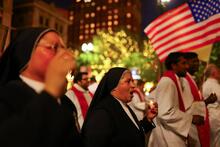
At the beginning of the second Trump administration, a homemade yard sign appeared in my neighborhood. It quoted the German Protestant pastor Martin Niemöller’s “First They Came” poem. Promoting both empathy and political action, Niemöller’s poem has become rightly omnipresent as Trumpism and its Christofascist base are arguably the most successful fascist movement since Nazi Germany. Lesser known than the poem is Niemöller’s journey into the antifascist spirit that inspired it.
Niemöller’s gradual turn against Hitler began only after the church’s autonomy was threatened in the Nazis’ attempt to establish the Reich Church. Before 1934, he voted for the Nazis numerous times, led a Freikorps unit during the Weimar Republic, joyfully greeted Hitler’s rise, and even sent his autobiography to Nazi Minister of Propaganda Joseph Goebbels with a personal note that it was written in the “spirit of the Third Reich.” In his role in the Confessing Church, he was againstHitler, but kept the ultranationalism and antisemitism that led him to support the Nazis in the first place. His imprisonment wasn’t enough to shake off his fascist proclivities—he still volunteered for the war effort from Sachsenhausen concentration camp. It took the defeat of Germany and a direct confrontation with his own complicity after the war, for him to reject fascism.
I need to level with you: The 2026 midterms are not a normal election.
Faith groups like Sojourners have long talked about the importance of elections. I have written about elections extensively in the past. But this year is different.
Specifically, there is a great risk that the Trump administration and its allies will attempt to disrupt or deny the election results; these attempts could very well succeed if we don’t act—or if they create enough chaos and fear to deter people from voting. It’s critical that Christians commit to pushing back on these attempts with faith-inspired activism—not just up to Election Day, but all the way through the seating of a new Congress on Jan. 3.

I’m at the point where I’m a bit at a loss for what to say about Palestine. It has been three years since the on Israel on October 7, 2023, when Hamas killed more than 1,100 Israelis and abducted another 251 people.
That date also marks the beginning of the genocide in Gaza, which continues despite the ceasefire. More than 70,000 Palestinians have been killed by the state of Israel. Palestinians are losing faith in nonviolent resistance, and I honestly can’t blame them. Settlers and their allies in government are determined to annex the entire West Bank, and Israeli politicians are openly imagining a world where Palestinians are no longer in Palestine. The word “bleak” does not even begin to describe the situation in Israel/Palestine—a situation that is only made worse by the U.S. continuing to provide military aid to Israel. Perhaps “catastrophe” is a better word.
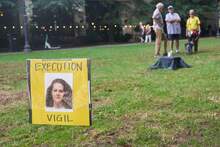
The recent botched attempted executions of Christa Pike and Tony Carruthers in Tennessee have laid bare what it is we are doing in my state in the name of justice—and people of faith are horrified by it.

I was 20 years old before I told anyone else in my life that I had gender dysphoria. Or, as I said back then, “all these gender feelings.”
It wasn’t that I didn’t want to tell anyone. Throughout many different seasons of my childhood and teen years, I’d tried to write letters and speeches to tell my parents and friends what I’d been experiencing. From what I’d absorbed in media, though, “coming out” was a dramatic proclamation. My understanding was that it meant you were confidently displaying your “true self” to the world—being “brave,” letting your flag fly, making a grand statement that said, “I’m here, this is me, and you’ve gotta deal with it.” To be sure, many people do not think about coming out this way—and in the years since that time, I’ve been moved by countless examples of coming out that occurred in gentler, more intimate ways. But that was what I had internalized then.

“You need to wait for people to catch up,” the pastor said.
It was 2015, and I was visiting the church offices to talk with this pastor about changing parts of the liturgy to make it more inclusive for genderqueer parishioners in this open and affirming congregation. The well-meaning pastor’s response hung heavy in the church office. Over the first few years of my coming out as transgender in a Christian church, pastoral staff and close friends tried to be the community I needed them to be. But I needed more than this cisgender community was able to offer. Months later, the same pastor and I cried together as we concluded that I would find the all-encompassing, life-giving support I needed elsewhere.

In the months leading up to the U.S. midterm elections and in the shadow of today’s headline-dominating Christian Right, a lost gospel is getting a new hearing. In red states across the country, devout Christians running for office on the Democratic ticket are making the case, as Jesus himself once put it, that “The laborer deserves to be paid” (Luke 10:7).

“You know what happens if you don’t vote?” President Donald Trump asked the crowd gathered at the Republican midterm convention in Dallas. “You go to hell!”

The Emperor Constantine, who in the fourth century made Christianity an instrument of Roman imperial cohesion, valued Christianity for its capacity to unite an empire under his authority. For many oppressed Christians, this use of Christianity to build empires still exists today, yet in a different form. Today, empire-building is deployed through the language of protecting what many call “Western civilization.” And it is an empire-building strategy that has brought many Christians together across the religious lines that once divided them—Roman Catholic, Protestant, and even “cultural Christians”—as a new ecumenical movement.
Scholars like Leonard A. Schuette call this political ideology “Western Civilizationism.” In this ideology, the primary unit of belonging is not the nation, the state, or the country, but a broader Western civilization: “the West is defined by a specific geographic territory, a shared ancestry, and Christianity.” For adherents of Western Civilizationism, Christianity is a crucial component for organizing a civilization’s culture and values. Any threat to their version of Christianity must be considered a threat to the West itself.

Annie Dillard, one of the greatest American writers, considered her own first book on writing a failure. At least, she called it “dull” and told an interviewer that she “never should have published it.”

Thinking about writing an opinion piece for Sojourners? Great! We're always looking for new voices.

In a 2023 sermon, Texas Democratic Senate candidate James Talarico called Christian nationalism “a cancer on our religion” and denounced Republicans for trying to transform America into a “Christian theocracy.”
Yet, at the same time, Talarico—a Presbyterian seminary student—has made his Christian faith a core message of his campaign. He mentions biblical teachings like “love thy neighbor” when discussing partisan division. He talks about the angel Gabriel appearing to Mary as a model for consent and a justification for abortion rights.
To some, these positions may seem to be in tension. If you oppose Christian theocracy, how can you use Christian theology to justify your political positions in the public sphere? When Christian beliefs are presented as the moral arbiter of politics, isn’t that the definition of Christian nationalism?

Most people remember exactly where they were on the morning of Sept. 11, 2001. I was in Nairobi, Kenya, a full day removed from the moment everyone else calls “that morning.”

This September is filled with calls to collectively remember. It was one year ago, on Sept. 10, that conservative activist and Turning Point USA co-founder Charlie Kirk was killed at Utah Valley University. September 11, of course, marks 25 years since the attack on the World Trade Center towers in New York City.
Amid these invitations to remember, I have wondered what it means, in this place and moment, to remember rightly. There is no doubt we remember these events. Yet, our memories differ. As the Catholic theologian Jean-Luc Marion writes, “Once things have happened, there remain only words.”

The late, great Wendell Berry found me at a unique time in my life: I was in the early stages of transitioning between genders.
Up until that point, part of me had always assumed that I wouldn’t connect with Berry’s writing because the people who recommended it to me were usually vaguely conservative men who wanted to live self-sufficient agrarian lifestyles. These people certainly had softer sensibilities than the more overtly militaristic conservatives I knew, but nonetheless, it sometimes felt that their idyllic worldviews and theologies didn’t have much room for people like me.

Churches are obsessed with doors. Churches bless these doors, paint them red, hold them open, photograph them, and put welcome signs on them. We tell the frightened person, the estranged child, the gay man, the addict, the doubter, the refugee, the person who has been made to feel impossible: Come in; there is a place for you here.
I believe in that sentence. But to the end of that greeting we should add: “and you can leave whenever you want.”

A synthetic chorus has taken root across so much of the online world that it is getting difficult to tell the difference between human voices and manufactured ones. With the 2026 midterm elections approaching, the incentive to flood public spaces with manufactured consensus will only grow. In an age of astroturf-filled message boards, I would argue that the greater danger is the impulse to hunt for bots. Astroturfing is an activity performed by a person or a group in order to generate the surface texture of reasonable speech, but to do so in a way that overwhelms the ordinary human capacity to slow down and make appropriate judgments.
The result is a culture of interpretation that begins with triage, where we read less for meaning and more for signs of inauthenticity; where the first question is whether the voice in front of us is even a person. Hunting for bots trains us to view the world with an extra amount of suspicion; a suspicion that deepens our collective alienation. Jesus’ parable about the weeds among the wheat offers our culture an important lesson in how to press toward face-to-face interactions that will make neighborliness possible again.

On Jan. 24, 2025, U.S. Border Patrol stopped Samuel Tunick at the Hartsfield-Jackson Airport in Atlanta and demanded to search his phone. Tunick was part of the “Defend the Atlanta Forest” movement in Atlanta, opposed to the development of a police training center dubbed “Cop City.” He has been charged with a felony for giving a customs officer a duress passcode that deleted the contents of his phone when the officer entered it. Not only is the case chilling because of the aggressive nature of the prosecution, but also because the federal government wants to assume characteristics that are typically reserved for God.
The point of government surveillance is not merely to know everything, but to fundamentally change what we do.

In the fall of 2013, my family drove from the city of Boston to Greenville, S.C. We visited Charleston, S.C., where Confederate flags could still be seen at government buildings and all over Fort Sumter. As I walked through the city in the humid southern heat, I thought about the negative aspects of white culture in the South—racism, misogyny, and homophobia. I continued thinking about those things as we pulled into the school my parents chose for me: Bob Jones University. A little less than a mile away, at a Jack in the Box, I had stepped into the restroom to trade my shorts and tank top for a tan maxi dress and sweater, well aware my knees and shoulders would not be a tolerated sight at the ultra-fundamentalist university. Besides knowing about the dress code, I went in unprepared for the dynamic cultural shift I was about to experience.

I’ve noticed a new trend among evangelical Christians: They’ve been recording themselves as they preach on airplanes. In each video, the evangelist rises with the chime of the seatbelt sign to address the whole plane. “You know, San Diego is known for the beautiful landscapes, right? And the perfect weather?” says one woman named Whitney Lynn in a video she posted to TikTok. “But I want to tell you who is so perfect and so beautiful, better than anything in this life, is knowing Jesus Christ personally as Lord and Savior.” Smiling from ear to ear, the evangelist returns to their seat knowing that they stood up for the gospel and did their part for God’s kingdom.