Culture Watch

WITHIN A YEAR, two blockbuster films have featured fugitives who seek refuge in a surprising place: a convent of religious women. In Paul Thomas Anderson’s One Battle After Another, the daughter of a revolutionary hides out with the fictional Sisters of the Brave Beaver. In Stephen Speilberg’s sci-fi thriller Disclosure Day, a government whistleblower carrying stolen information about alien life takes shelter at the monastery of St. Clare of the Dawn.
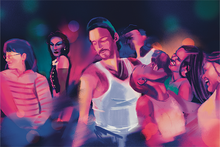
THIS YEAR’S TRIBECA Film Festival featured an intriguing pair of documentaries about gay life in small towns, one released 20 years ago and one brand-new. Together the two of them offer unexpected vistas of hope and community.
The 2006 documentary Small Town Gay Bar (available for free on YouTube) follows the story of several gay bars in and around Shannon, Miss., near Elvis Presley’s hometown. It’s immediately clear that, for queer residents in this town of less than 1,500, the gay bars provide a shelter and a lifeline in an otherwise bleak and often scary existence. “You walk in and you walk into family,” says one patron. “If there wasn’t a gay bar there wouldn’t be any kind of community,” says another.

ACROSS SOCIAL MEDIA you’ll find sped-up videos of people sitting and doing nothing. They settle in alone, with no phones, and simply sit with their thoughts. The figures in these videos are trying to retrain their attention spans. After years of mindlessly scrolling through social media, they now film themselves, clasping their hands, tapping their thumbs, closing their eyes.
In The Sirens’ Call: How Attention Became the World’s Most Endangered Resource, author and political commentator Chris Hayes argues that technology firms are deliberately chipping away at our ability to focus. He details how our attention spans and value systems have been reoriented and commodified for financial gain. Attention “is the foundation for nearly all we do,” he writes, “from the relationships we build to the way we act as workers, consumers, and citizens.”
Our attention is precious and we need to protect it, to draw it close. As inherently curious individuals, the deep dive of doom-scrolling harms us. It cuts to the deepest part of us, the inquisitive part, which can’t contend with the infinite content overload of social media.
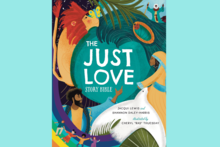
I don’t want to exaggerate, but my family are sort of kids’ Bible specialists. We’ve been through a fair many, both for independent reading for our 8-year-old daughter and for the family reading time we share every night. That’s why I greeted The Just Love Story Bible (Beaming Books) by Jacqui Lewis and Shannon Daley-Harris, with illustrations by Cheryl “Ras” Thuesday, with excitement—it offered just the sort of justice-centered telling of scripture that my wife and I are trying to expose our daughter to.
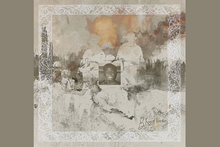
“REMEMBER, LIFE DOES not have to end with suffering,” writes Janjay Lowe in an Instagram caption promoting his latest album Bloodline. Performing under the moniker Mon Rovîa, the Chattanooga-based folk singer’s debut is a chillingly tender body of work. Tapping into the storytelling of his lineage through the sounds of his adoptive home, every strum, chord progression, and harmony is a cultural exchange.
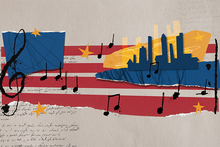
“In This Time of Great Reflection” is a hymn that lifts up the theme of the Puritan John Winthrop’s 1630 sermon, “A Model of Christian Charity.” Winthrop talked about the Massachusetts Bay Colony as “a city on a hill,” referencing Jesus’ image from the Sermon on the Mount in Matthew 5:14. In his use of this phrase, Winthrop wasn’t giving a sermon about American exceptionalism, as some later historical figures have suggested. As historian Daniel T. Rodgers explains in As a City on a Hill: The Story of America’s Most Famous Lay Sermon, Winthrop was actually delivering a warning: The eyes of the world would be on Massachusetts Bay to see if the colony would morally succeed in being loving, just, humble, good, neighborly, and kind.
This hymn is a prayer that, as we reflect on our nation’s 250th anniversary, we will strive to be a morally responsible and community-building people; that we will repent of our sins and become as loving and humble as God is calling us to be.
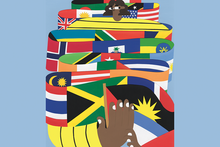
A FEW YEARS ago, when I served as an elder at a largely Black Caribbean Seventh-day Adventist church, I grew tired of seeing the U.S. flag at the front of our sanctuary. So, one Saturday after service, I decided to move it to a back room. It only rarely returned. (Imitate at your own risk.)
This was not unprecedented behavior for me. In 2004, as a new sixth-grade student at my local SDA school, I learned that my teacher, wanting to instill respect for the U.S. flag, would have our class hoist and lower the flag at the beginning and end of each school day. I, however, wanted it to be known that the flag was just a piece of cloth—one that absolutely was allowed to touch the ground. And then, with an overconfident 11-year-old’s flair, I would demonstrate. This earned my immigrant parents a phone call from a classmate’s concerned parent. I was correctly told to stop my shenanigans.

IN A STRIKING photo from August 2015, three kayakers on the Animas River near Durango, Colo., float in a plume of mustard-yellow water. They happened to be on the river the same morning that Environmental Protection Agency workers accidentally ruptured a retaining wall at the abandoned Gold King Mine upstream, sending 3 million gallons of wastewater contaminated with metals into southern Colorado’s rivers. According to the House Committee on Natural Resources, “EPA’s disaster dumped hundreds of tons of pollutants into a river that flows across four states—affecting farmers, treatment systems for safe drinking water and livelihoods, but no one has been punished.”

AS ANTI-GOVERNMENT protests in 2025 erupted in Indonesia, Nepal, the Philippines, Morocco, Madagascar, France, and the U.S., observers and journalists noticed demonstrators flying an unusual flag. The “Jolly Roger”—a white skull and crossbones on a black field—wearing a distinctive yellow hat was instantly recognizable to fans of Japanese anime culture. This flag belongs to the fictional Straw Hat Pirates from One Piece, a Japanese manga by Eiichiro Oda. This particular shonen (“youth”) graphic novel series has become a global symbol of revolution, resistance, and hope against government oppression and corruption among young protesters.
First published in 1997, One Piece, with more than 500 million copies sold, is the most popular manga in the world. It has spun off more than 1,100 animated episodes and a live-action Netflix adaptation and continues—three decades on—to run in Shonen Jump, Japan’s influential weekly manga anthology.
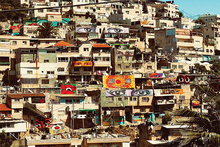
ON A HILL in occupied East Jerusalem, there’s a large mural of brown-green eyes: They are the eyes of the blind man who consented to be healed by Jesus at the Pool of Siloam, known by many locals today as Silwan pool. Silwan is a Palestinian village just outside the Old City. Painted by Palestinian artist Sliman Mansour, the eyes gaze at the pool where the biblical figure gained sight, now surrounded by soldiers with guns. He gazes at the rubble of demolished homes, surveillance cameras, children walking to school. Do you see? I felt this biblical ancestor asking me, the question hanging ripe in the tangled-wire air. Do you see?

CLEO SOL STANDS center stage at New York’s Radio City Music Hall. It’s March 2025. Her flowing red ball gown doesn’t detract from her grounding presence. Her forehead glistens under the warm beams. My arms are outstretched and tears stream down my face. The room swells as Sol and her backing vocalists sing these words in the song “Build Me Up”:
“Am I invisible? / I’m not invincible”
After the show, I see three young Black people holding hands in a circle. “We’ve gone to church, y’all,” one says, the other two friends guffawing while slapping her shoulders. That’s how it felt, a mass witnessing of divine intervention.
Sol and I were both born in London, yet there we were, thousands of miles across the Atlantic, sharing space with a community whose history is not our own. Her music made strangers kin, and it made me, a Black British woman, feel at home not through place, but through sound. That spiritual high faded soon after I left the venue. An unhoused Black man was sleeping on a bench in the subway carriage, untroubled by the shakes and screeches as the train descended into Brooklyn. We passengers were also unperturbed, giving him at most a quick glance before staring at our phones.

EARLY IN THE musical Saturday Church, the endearing teenage protagonist Ulysses prays to God. His father has died, his mother is always working, and his church community keeps pushing him to be less effeminate. “I’m in here, a prisoner of all my thoughts,” Ulysses sings. “Can anybody help?”
Onto the stage—wearing a long wig, a shimmering dress, and knee-length boots—steps “Black Jesus.” “Are there any queens in the house?” they sing to the room, before proceeding to do a dance number in the style of queer Black and Latino ball culture. “I come in many forms,” they tell Ulysses. “But this is my favorite.”
Black Jesus is one of several biblically inspired characters and events to have recently debuted in new musicals in New York. And while their plots vary widely, each has mined the Bible in ways that offer fresh resources for the Christian imagination.
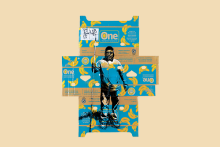
A FEW SUNDAYS ago, my partner Greg and I made a pot of chili for our community’s weekly dinner. The New York Times recipe said to add orange juice to the chili, letting it simmer and froth among the chopped onion, garlic, and butter. Then we mixed in the thick, tangy sauce from adobo chili peppers with black beans and sweet potatoes and corn, zipped with lime juice. It was rich, spicy, generous—brightened with the sun.
Lately I’ve had fun trying to write about food, playing with how I’d describe a certain taste, smell, or texture. I’ve been inspired by reading M.F.K. Fisher, who wrote essays about food starting in the late 1930s. She wrote gorgeous prose embedded with care for the human heart, for its loneliness and sadness and hope. In her 1937 essay “Borderland,” she writes about how each of us has our own private food pleasure—hers was warming sections of a tangerine on a radiator in the winter, which she describes while watching soldiers in Strasbourg march along the Rhine, the horrors of war closing in.

IN A PERENNIALLY timely 2014 article about the lessons she learned from her experience with trauma, Catherine Woodiwiss wrote, “Trauma is a disfiguring, lonely time even when surrounded in love; to suffer through trauma alone is unbearable.” We need people around us when we’re suffering, if only to know that they’re there to call on when we need something.
When my trauma and anxiety journey started in 2016, I quickly learned that putting up a front of “Everything’s fine!” only made things worse. It was humbling to admit I needed support. It was empowering to realize people wanted to help. I knew that someday, when I felt better (and I would feel better), I would return the favor.
The film Sorry, Baby, from writer-director Eva Victor, is the most accurate depiction I’ve seen of how trauma stays in your mind and body and what it takes to reach a place of stability. After Victor’s character, Agnes, experiences sexual assault, she relies on the help of close friends and a neighbor, and a stranger’s kindness, to help her through the three-year period that follows.
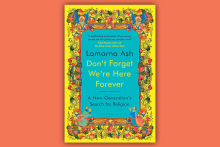
MY FIRST EXPOSURE to writer Lamorna Ash was the thumbnail image for an interview on YouTube, giant text emblazoning her face with the words “The Case for Christianity.” I must admit, I was skeptical. Granted, I am a Christian who has certainly “made the case” for the profound reality of Jesus of Nazareth now and again—but recently, apologetic arguments and “hardened atheist turned Christian” testimonials have left a sour taste in my mouth.
Perhaps it’s the way that media in that sphere tends to be loaded with culture warrior “Christian Apologist DESTROYS Atheist Snowflake” language. Maybe it’s that, frequently, the case for Christianity actually tends to be the case for Western dominance, whiteness, and heteronormativity. Or maybe it’s even simpler than that: Often, the sheer dogmatic certainty with which these “convert influencers” tend to speak just doesn’t feel honest. Either way, as a queer believer, the genre usually feels out of step with my daily walk.
Nevertheless, I decided to give this particular interview a listen—and Lamorna Ash was nothing like what I’d anticipated. A young and openly queer British woman with a lyrical voice and a heart for Palestine and trans people? This was not the person I’d traditionally expected to make the “case for Christianity.”

COLOR HAS LONG fascinated me. I spend days or weeks debating color choices for knitting and art projects. As a kid, I loved mail-order catalogues for their distinctively named palettes. My shelves teemed with books containing facts about color — names for various shades, how ancient pigments were made (crushed insects, plant extracts, and sea snail secretions), and the meanings of colors in different cultures. Highly conscious of racial differences, I found this last topic compelling. I would match my favorite color that week (it changed constantly) to the meanings provided and see where my tastes aligned.
While I recall few details — such as white is a color for mourning in Japan — what I remember, unfailingly, is absence. Each time I enacted this color-play-as-identification, I imagined my way into a past, land, and set of values other than my own. Because, as with most Western maps of world cultures then and now, the cultural diversity of Africa and Afro-diasporic peoples was not represented.
Imani Perry’s latest book shows this absence to be a speaking one.

PICTURE THIS: A man they call Soccer Moses is descending a set of stadium stairs, parting not the Red Sea but a crowd of Nashville soccer junkies. As he reaches the bottom of the stairs, he puts on a Gibson guitar and performs a celebratory riff, which is a tradition for the Nashville Soccer Club, a Major League Soccer team. As Soccer Moses shreds his guitar, fans surround him and wave signs, scarves, and a Pride flag. One of the many differences between the biblical Moses and Soccer Moses is evident in this scene. Biblical Moses sought to prevent revelry (Exodus 32:18-19); Soccer Moses lives to promote it.
Soccer Moses is the unofficial team mascot for Nashville SC. Why, if Nashville SC is not connected to religion in any way, has a zealous fan taken it upon himself to dress up like Moses and become the team’s unofficial ambassador? Well, to understand that you first need to know the identity of the man donning the wig, fake beard, and flowing garments.
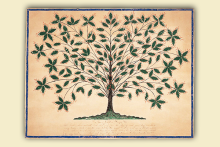
“ON EARTH AS it is in heaven,” wasn’t simply a prayer for the Shakers, a small Protestant sect that practiced communal living and peaked in the mid-19th century: It was the bedrock of their lives. In the mid-1800s, Shaker Sarah Bates depicted this collision of heaven with earth in “Wings of Holy Wisdom, Wings of the Heavenly Father.” In cobalt and inky blues, she drew churning stars and slivered moons, holy scrolls and books cracked open by birds, God’s hand reaching through dark heavens, trumpets and swords among unfurling flowers.
The United Society of Believers in Christ’s Second Coming originated in England in 1747 and were guided to America in 1774 by Mother Ann Lee, an illiterate factory worker who became the community’s charismatic leader. Their ecstatic dancing during worship led some to call them “shaking Quakers,” later shortened to “Shakers.” Lee preached ideals such as pacifism and gender and racial equality, and in the new communities in America, she introduced celibacy and no private property. Lee was persecuted and imprisoned for her beliefs, and among many Shakers, she was considered the second coming of Christ in female form.
From about 1837 to 1857, some Shakers began receiving images and messages — many believed to come from Holy Mother Wisdom, who the Shakers saw as the “personified feminine” aspect of God along with the “Almighty Father” as the masculine personification, art historian Sally Promey wrote in her book Spiritual Spectacles. Some people believed the messages came from departed loved ones, and they recorded them in paintings, dances, songs, drawings, and spirit writings, in which a scribe would capture characters and designs that looked like words and letters but whose meaning was unknown — kind of like a “visual equiva-lent for speaking in tongues,” Promey wrote. This period was known as the Era of Manifestations or “Mother’s Work.”
The “gift drawings” of that era burst with geometrical shapes, holy symbols, and heaps of color. The creators of the gift drawings called themselves “instruments,” not artists, and most were women and young people — typically “the least powerful members of Shaker society,” Promey wrote.
UPON READING THE news that the U.S. deported hundreds of migrants to El Salvador, I felt ill. Neri José Alvarado Borges had studied psychology and worked in a bakery. Luis Carlos José Marcano Silva is a barber with the face of Jesus tattooed on his stomach. As the daughter of an immigrant, I wept, thinking of their fear and families’ grief. In the face of a government that thrives on cruelty, we need resources that help us preserve our human capacities for hope, courage, and compassion.
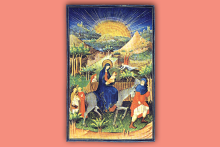
Recently, I’ve found comfort in paintings from books of hours, a form of prayer book popularized in Europe in the 1200s to make contemplation simpler for the laity. These paintings, known as “illuminations,” are distinctive and, according to the Metropolitan Museum of Art’s Wendy Alpern Stein, include “some of the greatest paintings and drawings of the late Middle Ages and early Renaissance.”
Once the most published texts of their time, books of hours were often bespoke, commissioned by monarchs and aristocrats and crafted by luminary artists of the day. Each unique book of hours contains a liturgical calendar, gospel excerpts and psalms, and “The Hours of the Virgin,” which Stein calls “the heart” of the form, “a series of prayers and praise for the Virgin Mary [recited] at the eight canonical hours.” The books were made and written by hand. The illuminations include beautiful borders, often of botanical elements like ivy or flowers that decorate the edges of each page. Passages of text begin with an ornately decorated and framed capital letter. And the illustrations that complement the prayers and readings are drawn with vibrant colors and metals like gold and silver.
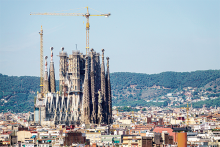
WHEN ANTONI GAUDÍ became the chief architect for Barcelona’s Sagrada Família Basilica in fall 1883, he had no illusions that he would live to see its completion. “There is no reason to regret that I cannot finish the church,” he said. “I will grow old, but others will come after me. What must always be conserved is the spirit of the work, but its life has to depend on the generations it is handed down to.”
After 142 years of construction, Gaudí’s masterpiece is slated to be finally completed in 2026, 100 years after Gaudí’s death. The finished basilica will have three distinct facades, only one of which was completed in Gaudí’s lifetime, and 18 towers — 12 for the apostles, four for the evangelists, one for the Virgin Mary, and the tallest and most central tower for Jesus. When you look at the Barcelona skyline from Park Güell, where the architect lived for almost 20 years, the basilica soars above the rest of the city, clothed in scaffolding. From far away, the cone-shaped, sand-colored spires look like intricate, naturally occurring stalagmites, reaching toward the heavens.
Gaudí’s iconic style — lots of curves, a heavy use of mosaic, and motifs from nature and Catalonia — was an extension of the broader artistic movement of Modernisme, the Catalonian cousin of Art Nouveau. Even though some of the visual language of the Sagrada Família had precedent in buildings such as the Castell dels Tres Dragons or the Palau de la Música Catalana, both by Lluís Domènech i Montaner, the basilica was still controversial. George Orwell once said that the Sagrada Família was “one of the most hideous buildings in the world,” and lamented that it hadn’t been destroyed during the Spanish Civil War. But more than a century later, Gaudí is widely recognized as an artistic genius, and his works have UNESCO World Heritage site status.
There are no exact right angles in the Sagrada Família’s design because Gaudí believed right angles didn’t occur in nature. Instead, you will find the spiral of a shell, the honeycomb structure of a beehive, the branches of a tree, and the unique curvature of a leaf. He also pioneered the mosaic technique known as trencadís, where pieces of ceramic or glass were broken into irregular shapes and applied to the surface of a form.