How can we do this? This article from Sojourners, written by a fitness coach, is a little bit strident, maybe, but it speaks of the need for churches to consider our task of making disciples more seriously, and then “get to work” doing it, instead of just talking about it.
Faith
Kenneth Tanner 2-07-2014

Abstract smoke image, grace illustration, Amnartk / Shutterstock.com
One sort of Christian believes taking Eucharist weekly saves her. Another Christian believes his confession of Jesus Christ as Lord saves him. Still another looks to his Baptism. Another to her participation in the body of Christ. One to his repentance. And another to her care for the sick, the hungry, the prisoner, and the poor.
We elevate one belief or practice over another, then divide ourselves as Christ followers by the priority we set when, in fact, all of these are taught as saving by Christ, who alone is our salvation.
Christ saves me, not the accuracy and purity of my beliefs. Christ saves me, not my works. Christ saves me, not the measure of my adherence to a doctrine or practice.
When all is said and done, many Christians tend to look to their habits, their faith, and their perseverance when it comes to salvation rather than to the work, belief, and faithfulness of Christ in us, over us, under us, and through us.
2-05-2014
Campolo and other progressive evangelicals like Ron Sider and Jim Wallis have taught evangelicals how to speak the language of social justice, said David Swartz, a history professor at Asbury University and author of the book “Moral Minority: The Evangelical Left in an Age of Conservatism.”
2-05-2014
Dae Joong Yoon, executive director of the National Korean American Education Consortium was one of the three core fasters. The Fast for Families tent was on the mall for one month, from November to December. Yoon, as well as advocates Eliseo Medina, Christian Avila and Lisa Sharon Harper, participated in a water-only fast for 22 days.
2-04-2014
Corey is a two-time graduate of Gordon-Conwell Theological Seminary with Master’s degrees in Theology and World Missions. He is currently a Doctor of Missiology student at Fuller Seminary. Besides his personal blog at Formerly Fundie, he has been featured by Sojourners, and has appeared on HuffPost Live.
2-04-2014
It’s a tired trope that evangelicals only recently began caring about “social justice,” a buzzword that carries connotations of political activism and “the social gospel.” In fact, orthodox Christians have long recognized in Scripture a call to defend and uphold the dignity and well being of all persons, especially the poor and powerless. Take, for example, John Wesley, who led prison reform and abolitionists movements in 18th-century England. More recently, evangelical leaders like Ron Sider and Jim Wallis have promoted Christian engagement in anti-war, environmental, and immigration causes, while facing suspicion of falling prey to partisan politics. At the local church level, sex trafficking, fair trade, and clean water campaigns are trendy ways today for lay Christians to fight social ills, even if that means simply clicking a “Like” button.
2-04-2014
As a sophomore at Calvin College, I began hearing a refrain from classmates who had shed their evangelical heritage like a bulky fur coat at the start of spring. "Evangelicals only care about abortion and gay marriage," they sighed, parroting headlines of the time. It was 2004, and the "values vote" had apparently secured George W. Bush's reelection. We rushed to show that no, really, we cared about poverty and social justice too (unaware that Jim Wallis, Ron Sider, and others had been saying this since before we existed).
2-04-2014
The sad part is one article in Sojourners suggested that they were burned out by the culture wars.[5] This may be the unchurched generation, because they sick of the culture wars.
Danny Duncan Collum 2-04-2014

(merthuroglu / Shutterstock)
I’VE BEEN thinking a lot lately about technological obsolescence. This isn’t because I’m a classroom teacher and professional writer—two occupations widely expected to meet the fate of John Henry. My musings have mainly been prompted by the hours I just spent weeding through my family’s extensive collection of cassette tapes. From 1992 to about 2005, my wife, Polly, and I made a sizeable investment in that doomed medium, mostly in the form of children’s audiobooks and home-school educational programs that our kids (now ages 14 to 21) have outgrown. We still have three functioning cassette players in our house, but then we still have a 22-year-old tube television, too. I don’t expect that anyone who has young children today would be willing to take on our collection of cassettes. Even Goodwill may refuse them.
Some things, like the cassette tape, deserve to become obsolete. They were always an inferior product. But, all the logic of the market economy to the contrary, newer is not always, or even usually, better.
That’s why it’s been heartening to witness, in the past year or so, the beginning of a small backlash against our forced march toward a future that is all-digital, all the time. The first sign of a revolt was the return of the vinyl record. Of course, I held on to my vinyl through all the transitions of the past 30 years, and we’ve always had a functioning turntable in the house. But now it is my 21-year-old son who actually buys vinyl. Of course, my son also has an iPod and does most of his listening through headphones, like the rest of his peers. But he and thousands of other young music buffs have learned that vinyl delivers a better sound than any of the digital formats currently on the consumer market.
Julie Polter 2-04-2014
Faith and Reform
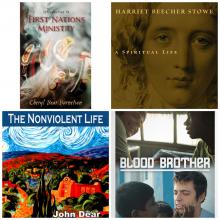
Writer and social reform Harriet Beecher Stowe’s controversial 1852 novel Uncle Tom’s Cabin brought many people to the anti-slavery movement. In Harriet Beecher Stowe: A Spiritual Life, biographer Nancy Koester illuminates the shifting role and expression of faith in Stowe’s personal and public life and work. Wm. B. Eerdmans
Falling into Love
A few years ago a young man named Rocky Braat left Pittsburgh to wander India; he’s ended up working for years in an orphanage for HIV-positive children there. His friend, filmmaker Steve Hoover, went to explore why. The result is a Sundance-award-winning documentary, Blood Brother. www.bloodbrotherfilm.com
José Humphreys 2-04-2014
AS AN EVANGELICAL pastor of a multiethnic church in New York City, I often find myself at the intersection of lively discussions about race. These conversations almost inevitably lead to a familiar question: What does the church do now? Maybe stated another way, “How do we work toward the dream of the beloved community?” This is why I find Edward Gilbreath’s Birmingham Revolution: Martin Luther King Jr.’s Epic Challenge to the Church to be a timely and necessary read.
While many books have been written on Dr. King and civil rights, Birmingham Revolution places King’s faith at the foreground of the writing. This is an important distinctive as King has often been co-opted, by conservative and liberal agendas alike. Yet history cannot deny that prayerful action, and a gospel that took seriously the social dimensions of human life, were at the very heart of King’s theology.
Birmingham Revolution hones in on the year 1963—a time when the Southern Christian Leadership Conference took the civil rights efforts into the bowels of structural racism. Brown vs. Board of Education had provided an important Supreme Court victory in 1954, but many forms of local resistance to desegregation prevailed in the South.
To compound the drama, many advocates in Alabama, both black and white, believed further progress should happen through legal means. They had a misplaced confidence that local structures would uphold federal law, despite the continued presence of the KKK and other such groups. Gilbreath explains Birmingham’s defining moment not only in confronting segregation, but also in challenging the subtler, unwittingly complicit voice of the moderate.
Charita Ford 1-31-2014
AS I ATTENDED seminary in my native Chicago, I heard about one senseless death after another. A six-month-old baby shot multiple times with an assault weapon; a young black girl, with promise and a future, caught in the crossfire—all casualties of gang violence.
This violence is further evidence to me that our theology is needed on the streets. A theology that can impact the crisis facing the black community must be relevant to the black community. Theology can never be disengaged from the history of black people, the “isms” that have oppressed us, and the struggles that have birthed our progress. “Relevancy,” for theology, means moving beyond the academy and the church and into the streets, where it becomes our thinking faith in action.
Does our theology have anything to say to African-American gang girls? The formation of girl gangs is rooted in the numerous social ills affecting many urban African-American communities. By taking our theology to the streets, we can offer African-American gang girls an alternative hope and future. Four theological frameworks can aid in that task.
First, a practical theology—thinking faith in action—that models Jesus’ ministry to the marginalized can reach these girls with the message of God’s compassion, peace, and hope by offering a positive relational sisterhood that can replace gang life.
Jim Wallis 1-30-2014

(jokerpro / Shutterstock)
“GOD CREATED the world and we created borders.”
That obvious recognition was shared at a recent consultation in Quito, Ecuador, between North American and Latin American churches on “Faith, Economy, and Migration.” Felipe Adolf, president of the Latin American Council of Churches, shared that conclusion on how issues of migration and reform are global and not just local.
It’s very easy to see the problems confronting our nation and feel as though the challenges facing the rest of the world are simply too much to bear. Continuing poverty and unemployment, discrimination of all kinds, and wars and rumors of wars fill our newsfeeds, papers, and TV screens. But it’s naïve and narrow to think this way. Many of the threats we face are global in nature and don’t know any boundaries. Through our economies and consumption habits, media, travels and migrations, and for Christians in particular our faith, we are inextricably connected with men and women around the world. It’s always been important, but now especially so, to think globally when it comes to faith and justice.
Sojourners has a long history of doing this very thing. We started as a little group of two kinds of people—those who had grown up conservative evangelicals and were deeply frustrated with the lack of attention to issues of justice and peace, and those who had just come to faith from the student movements and counterculture of the 1960s and ’70s. We met at Trinity Evangelical Divinity School and began to study and pray through the scriptures about injustice, war, and poverty. The Vietnam War was raging, and we were looking for a biblical understanding of the events of our time.
Suzanne Ross 1-28-2014

Boundary illustration, Bohbeh/ Shutterstock.com
In his New York Times column, “ Alone, Yet Not Alone,” David Brooks laments the “strong vein of hostility against orthodox religious believers in America today, especially among the young.” Even more disturbing for Brooks is that in his experience, the opinion of young people is too often justified. He observes that religious believers can be “judgmental,” “hypocritical,” “old-fashioned,” and “out of touch,” and he wonders why that’s so. Brooks, who is Jewish, knows that the Judeo-Christian tradition reveals a God who desires mercy and not sacrifice, who calls us toward a radical love that includes our enemies. As evidence of the core of orthodox belief, he offers two giants of the Judeo-Christian tradition, Rabbi Abraham Heschel and Augustine, who give testimony to lives of compassion and love inspired by devotion to the biblical God. Lives that tolerate ambiguity and uncertainty as essential components rather than disqualifiers of faith.
So what gives? Why do religious believers spend so much energy reinforcing their (our – I’m one of those orthodox believers) borders, building thicker and higher dividing walls designed to keep out the underserving, the sinners whom not even God can love? Just who is kept out varies widely, but it seems religious people are utterly convinced that they are on the inside with God. No doubt about it. Musing on this sad fact, Brooks comments:
There must be something legalistic in the human makeup, because cold, rigid, unambiguous, unparadoxical belief is common, especially considering how fervently the Scriptures oppose it.
Brooks is on to something here – there is something rooted in our “human makeup” that the Scriptures fervently oppose, but it is not legalism per se.
Evan Dolive 1-27-2014

Child in the park, Dragon Images / Shutterstock.com
We don’t give children enough credit. They are infinitely smarter than we think. Children figure out things that most adults have trouble comprehending. I truly believe that my daughter came out of the womb knowing how to operate an iPad. She gets that finger swiping and she can navigate the world of apps and photos with more precision and understanding that people 20 times her age.
In the Gospel of Mark, we find these words of Jesus: “ I assure you that whoever doesn’t welcome God’s kingdom like a child will never enter it.” (Mark 10:15--Common English Bible). This verse is referenced when someone speaks that followers of Christ should have “faith like a child.” Generally, this is defined as “simple faith” or “faith without question.” This, however, is a misguided understanding.
Kelli Woodford 1-27-2014

Silhouette of man in front of sunset, Galyna Andrushko / Shutterstock.com
Last year, I wrote about my journey from forcing joy to finding that love is what is everlasting, not joy — that we sometimes hear and believe that Jesus only lives in the places of our lives where we recognize him with joy. But that that is not true.
And so, almost as an afterthought, I've been thinking lately of other ideals that Christians hold as truth, somehow in the process giving a lifeless principle more weight than a Living Christ who reveals himself beyond what can be wrapped up with words and smacked with a theological bow.
Like the concept of Presence.
We know and rest our restless hearts in the idea that Jesus is with us always, lo, even unto the very end of the age. A God who never leaves us or forsakes us. And this is good. We sing songs and pray prayers and feel goose bumps and know that it is true … at least in those moments.
But what about the God who seems to be known by God’s absence as much as by God’s presence? What happens when we don't feel God’s proximity uninterrupted?
Joe Kay 1-27-2014

Chick breaking out of a shell, S-F / Shutterstock.com
Have you ever watched a chick break out of its shell?
My first experience with hatching was at the poultry barn at the Indiana State Fair. The building is the temporary home for hundreds of chickens, ducks, geese, and pigeons each summer. And they make quite a ruckus. There’s a constant din of crowing and honking and cooing and whatever other adjectives you care to apply. Colorful feathers drift through the air.
As you walk through the front door, there’s a protected case for baby birds that have just hatched. And there’s an incubator full of eggs that are slowly being pecked and pushed apart by the little ones inside.
If you have some time, you can stand and watch a miracle unfold, peck by peck.
It takes hours for the chick to work its way out of the shell, sometimes an entire day. A 4-H volunteer sits by the incubator and records each chick’s progress during the exhausting escape from the shell into the greater world.
The chick has spent its entire life in its protective shell. But now, the nourishment of the yolk is all used up. The chick no longer fits comfortably inside the oval confine. It has no clue what lies outside the shell, but it knows instinctively that it has to break out or it will die.
Is that a good analogy for what we experience in our lives? Do we often find ourselves breaking out of shells?
Kara Lofton 1-22-2014

Courtesy of Little, Brown, and Company
What if what you thought were advantages were actually disadvantages? And what you thought were disadvantages ended up being what actually makes people successful?
So embarks best-selling author Malcolm Gladwell of Blink, The Tipping Point, Outliers, and What the Dog Saw in his new book: David and Goliath. In the same clear, concise style that made his other books so intriguing, Gladwell challenges yet another widespread assumption — that being the underdog tends to make one an underdog forever.
Instead he argues that being the underdog can give one the upper hand. In his signature approach, Gladwell supports his hypothesis with a series of narratives, from the classic case of David and Goliath to the forgiveness one Canadian Mennonite woman was able to work towards after her daughter was murdered. Like his previous books, David and Goliath is both entertaining and thought provoking and obliges readers reflect over their lives and reconsider personal “disadvantages” that actually required them to learn skills they otherwise might not have had.
Stephen Mattson 1-22-2014
Holding hands, Mats Bergström / Shutterstock.com
Beyond the realm of churches, religious blogs, and bible colleges, nobody really cares about theology. What does matter is the way you treat other people.
Within Christendom, we’re often taught the exact opposite: that doctrines, traditions, theologies, and distinct beliefs are the only things that do matter. It’s what separates churches, denominations, theologians, and those who are “saved” and “unsaved.”
Historically, Christians have been tempted to categorize the Bible into numerous sets of beliefs that are either inspired or heretical, good or bad, right or wrong — with no room for doubt or questioning or uncertainty.
It’s easy to get caught up in theorizing about God, but within our everyday lives reality is what matters most to the people around us. Theorizing only becomes important once it becomes relevant and practical and applicable to our lives.
When I'm sick, and you bring me a meal, I don't care whether you're a Calvinist or Arminian
Mark Sandlin 1-21-2014

Man shouting, pio3 / Shutterstock.com
If any list has been overdone in the Christian blogging world, it's this list.
Just about every Christian blogger has done one, and if they haven't, they've thought about it and then thought better of it – because just about every Christian blogger has done one. (See what I did there?)
And yet, here we are.
You. Me. And my list of things Christians shouldn't say. Hmmmm – must be God's will. (And I just realized this list should have had 11 things on it. Oh, well. I have no doubt that it's on one of the lists out there!)