Art
The destruction and looting of art and historical sites in Syria is "the worst cultural disaster since the Second World War,” according to anthropologist Brian L. Daniels.
The human losses are devastating: At least 210,000 people have died in the ongoing battle between the Assad regime and the Syrian rebels. ISIS has joined the violence and exploited the instability in the country, taking control of large parts of northern and eastern Syria.
And now, in the unofficial war over Syria’s cultural heritage, art is the main casualty. As of September 2014, five out of six of Syria’s Word Heritage sites had been destroyed including Aleppo’s 12th century Umayyad mosque.
ISIS’ ruthless participation in the Syrian conflict only increases the danger to Syrian art and history: In ISIS controlled Mosul, Iraq, art, music, and history have been removed from school curriculum. In February, ISIS released a video of its fighters smashing ancient statues and artifacts in the Mosul museum in an effort to weed out “heresy,” prompting the UNESCO Director-General to call for an emergency meeting with the Security Council to advocate for the “protection of Iraq’s cultural heritage as an integral element for the country’s security.”
WHEN I FIRST arrived in a western district of Georgia, on the shores of the Black Sea, in 2004, I met a group of young people walking along the muddy dirt road to school. They were walking slowly, linking arms and talking and laughing together. Like teenagers anywhere, the young people were happy to talk about their own lives: tensions with parents, boredom at school, friends, and anticipation of the future.
The girls that I spoke with also mentioned their fears of being abducted for marriage.
Surprisingly, in this modern era, the abduction of girls for marriage was still considered common and acceptable. In rural Georgia, if a young man fancied a young woman, he arranged with his friends to have her abducted as she walked home from school. If she was held overnight away from her home (and often raped), her chaste reputation was lost, and she had no choice but to leave school, marry him, and move in with his family. Honor demanded it.
In rural Georgian high schools, rumors flew about who was about to be kidnapped, or who was thinking of kidnapping someone. Boys thought it was romantic and a test of bravery and manhood. Almost all the boys we spoke with said they would help a friend abduct a girl if requested, and many said they felt pressured by their friends to abduct girls. It was seen as a way of proving yourself a man, a true Georgian man.
Most girls were afraid of being abducted, but some girls I spoke with had mixed feelings, wondering if they could manage to elope with their boyfriends using a traditional kidnapping story as the cover to overcome their parents’ disapproval.
FRANCISCAN BROTHER ROBERT LENTZ is a contradictory blend of traditional and tradition-challenging. That same surprising mix could be said to typify his contemporary approach to the ancient art of iconography.
Brother Robert’s work adorns cathedrals, churches, and homes of many faiths, though his name may not ring a bell, even among his fans.
But describe his icons of Martin Luther King Jr. or César Chávez, his portrayals of Jesus as black, Korean, and Navajo, and his non-Christian subjects including Mohandas Gandhi and the Sufi mystic Rumi, and the response may be “Oh, yes! I have one of those.”
Icons—religious paintings used as aids in Christian prayer—have been called a “doorway into the kingdom of heaven.” Brother Robert’s icons are striking, often for the contemporary twists in classically structured images, such as the army canteen held by St. Toribio Romo, a 20th century Mexican priest who is revered as the patron of migrants crossing the border. His Chávez image carries a copy of the Constitution and wears a sweatshirt with the United Farmworkers logo. “Icons may contain anachronisms,” he said, “when there is a great truth at stake.”
Brother Robert’s work—and his life—seem often to focus on such anachronisms in pursuit of truth. At 67, he is a Roman Catholic Franciscan brother in the New York-based Holy Name Province, living and working in a studio created for him in the order’s seminary near Washington, D.C. A religious brother is not a priest, though he lives by the vows of poverty, chastity, and obedience and dedicates his life to charitable service. It’s Brother Robert’s second stretch as a Franciscan, the order founded by St. Francis of Assisi. But it’s his third stint in religious life, having also come close to ordination as a priest in the Russian Orthodox Church Outside of Russia.
The French composer Claude Debussy once said, "Music is the space between the notes." His compositions were a part of Impressionism in music, a movement in the late 19th and early 20th centuries that focused on suggestion and atmosphere and favored short forms of music like nocturnes, arabesques, and preludes. This movement was a correction of the excesses of the Romantic period, where the focus was on strong emotion and the depiction of stories and the favor was toward long forms of music like symphonies and concertos.
MUSIC IS OFTEN regarded and consumed as something that fills a space—the chords of an organ resounding off the walls of a sanctuary, the beats of a drum circle riding on the breeze through a park, the harmonies of an orchestra flowing from my headphones into my ears as I write. Music even transcends physical spaces to permeate the heart and the soul with emotion.
In Music as Prayer, pastor and musician Thomas H. Troeger invites the reader to cherish and engage in music as an act of prayer. Taking into account the metaphorical, scientific, and practical aspects of music-making, Troeger illustrates the power of music to not only fill a space but to also clear a way for meaning and creativity. Building upon Henry Ward Beecher’s metaphor of a boat stuck on the shore, Troeger describes how the “mighty ocean-tone” of a church organ brings the “tide” needed to lift up the members of the congregation and set them free from the shore.
In what Troeger calls a “dialogic process,” music lends rich metaphors to language and changes the effect of language upon the listener. The same song played in two distinct styles can convey two completely different sets of emotions.
From the ancient flute invented 35,000 years ago to today’s smartphone streaming songs on demand, music has occupied a central part of the human story. The mystery of music lies in the way that sound waves can blend into melodies that speak directly to the human yearning for wholeness. Creating space for both celebration and lament, music has the capacity to hold opposing emotions in the same breath. Music can provide release from suppressed inner tension and give voice to even the most unspeakable emotions.

The Noah epic releasing in theaters this Friday promises to be controversial, with director Darren Aronofsky calling it “the least biblical biblical film ever made.” As the story of Noah remains near and dear to people of many faith traditions, the film has already unleashed a flood of criticism.
In an interview, Aronofsky described where he got the idea for the film, how he plans to respond to critics, and why he focuses the film on themes of justice vs. mercy.
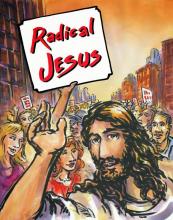
THE GRAPHIC NOVEL Radical Jesus, edited by Paul Buhle, has three distinct sections offering different expressions of Jesus’ life and social message. The brevity of the graphic novel medium allows the writers to construct a clear and distinct message in a moving art form.
Part one, “Radical Gospel,” illustrated by Sabrina Jones, uses biblical quotes to construct a visual story that connects the words of Jesus to modern situations. The black and white ink styling is simple yet profound.
While Jesus and his disciples are portrayed as first century Jews, the people Jesus interacts with and tells parables about are all in modern dress. This puts Jesus in an accessible conversation not only with his disciples, but also with the reader. In a collection of Jesus’ sayings from the Sermon on the Mount, the art drives home the emotional impact of his words.
Jones does not shy away from the radical implications of Jesus’ message. My favorite of her modern interpretations is an image of the destruction wreaked by the 9/11 attacks, contrasted with Jesus’ reference to the temple in Jerusalem, where he exclaims, “The day will come when there isn’t one stone left on top of another that is not thrown down.”

Understanding the process of turning an implement of death and violence into a tool for creativity and imagination is one part of the strategy. In doing so, there is hope that participants in such an event will begin to reimagine their own world and how they engage it. After all, true change first begins with imagining the possibility of such transformation.
Further, Reyes hopes to challenge U.S. citizens to consider their relationships with guns, and moreover, the impact that value has on people in other countries. Again, in the NPR story, Reyes explains, “We have to be allowed to ask questions. If you are not allowed to ask questions, you are not free."

An Iraqi woman dons a black hijab but bares her thighs. A Lebanese woman wearing a sheer blouse curls up on a bed, both innocent and seductive. An attractive young Iranian couple shares breakfast at a small table, seemingly oblivious to the tank looming just a few yards away.
There are no harems, belly dancers, or male oppressors in this photography show, nor any of the other Middle Eastern stereotypes that Westerners generally associate with that far away, often misunderstood, region.
“She Who Tells a Story,” a photo exhibit now showing at Boston’s Museum of Fine Arts and headed to other U.S. museums, features the work of 12 women from the Middle East who shatter stereotypes with works that are provocative, beautiful, mysterious, and surprising, all at the same time.
I’VE RECENTLY spent time researching the vision of the U.S. through the lens of one film for every state, following the intuition that, as most movies are set in Southern California or New York (and there’s a lot more America where those didn’t come from), we need to examine Fight Club and On the Waterfront, Brokeback Mountain and Nashville no less than The Wizard of Oz and Gone with the Wind to begin to capture the American dream life. It seems obvious, but it’s often dismissed: Contrasts between the states are mighty and rich. A Wyoming plain and a Sonoma vineyard, Hoboken and Harlem and Hot Springs, the Florida Keys and the Swannanoa Valley are all magnificent intersections of dreams and mistakes, which in honest art allows them to be places where the past can be faced.
And on that note, here’s my list of the 10 best U.S. films released in 2013:
The new Criterion Blu-ray John Cassavetes box set includes The Killing of a Chinese Bookie, the best entry to his work: A grimy thriller about one man trying to make art against the odds.
Jeff Bridges and Rosie Perez show us something more of how to be human in Fearless (newly available on Blu-ray), about a man who needs to die before he can live (and love).

Way back in the day (circa 2004), Switchfoot's lead singer, Jon Foreman, was asked if the band is a “Christian” band. Even though it's been a while, his response is worth looking at again.
Still Shining
David Hilfiker is a retired inner-city physician and writer on poverty and politics who has Alzheimer’s. He writes about his experience, with the hope of helping “dispel some of the fear and embarrassment” that surrounds this disease, on his blog “Watching the Lights Go Out.” www.davidhilfiker.blogspot.com
Transported
Laura Mvula is a British, classically trained musician, songwriter, and former choir director whose debut album,Sing to the Moon,is a lush fusion of soul, jazz, gospel, and pop. While not overtly “about” faith, her arrangements are imbued with spiritual longing and visions of beauty. Columbia

It didn’t take long to erase the gun.
Greg Bokor’s ArtPrize drawing of an assault rifle at Grand Rapids’ Fountain Street Church was rubbed out Sept. 21 after the public was invited to wield erasers imprinted with sorrow.
Normally festive art lovers obliterated the killing machine with erasers bearing the names of 83 massacred children and adults. They included Jesse Lewis, age 6, one of 20 children killed at Sandy Hook Elementary School last December; Veronica Moser-Sullivan, also 6, youngest of 12 people killed in the 2012 Aurora, Colo. movie-theater slaughter; and the 45 victims of the Columbine High School and Virginia Tech shootings.
Within hours, the public had rendered the AR-15 just a faintly visible image. It was a powerful symbol of what many of us would like to see happen to these weapons of death so easily available to mentally deranged people seeking sick revenge.
Tragically, in real life, it is the children and other victims who have been so easily erased from our consciousness.

Meet “Our Lady of Perpetual Exhaustion,” a saint everyone probably can relate to.
The chaos of everyday life and the methods we use to overcome it are on display at the “Our Lady of Perpetual Exhaustion” exhibit in two D.C. galleries.
“We all have coping mechanisms,” said Cynthia Farrell Johnson, creator of the exhibit’s theme. “And for most of us, part of our coping mechanism is our spiritual life.”

Biblical writers suggest that God loves a holy mess. They compare God’s creative spirit to a strong wind, and we all know what happens when a powerful wind blows through our windows or through our lives — everything gets upended! One image in Genesis has God scooping up a bit of earth to create us. Yes, God had to get some dirt under the fingernails in order to bring us about.
Jesus was creative in how he touched and healed people, often making himself ritually unclean in the process. He embraced his uncleanliness.
Sadly, many religious institutions discourage us from doing the same.

For centuries, popes sponsored the work of artists such as Michelangelo, Raffaello, or Bernini, who went on to create some of their masterpieces within the very walls of the Vatican.
Yet over time, the marriage between art and faith grew stale — the Vatican’s culture minister even called it a “divorce” — with the Roman Catholic Church finding itself estranged from the art world it did so much to create.
Now, in a bid to revive its ancient tradition of arts patronage, the Holy See will participate with its own pavilion at the 2013 Venice Biennale, a leading international arts festival.
IF THEY HAD met, Aaron Swartz and Vernon Bowman probably wouldn't have hit it off. The 26-year-old Brooklyn, N.Y. computer whiz and the 75-year-old Indiana grain farmer might have been from different planets. But they were brothers-in-arms in a historic struggle over the shape of the 21st century economy and culture. Each, in his own way, has challenged the iron, unyielding hegemony of copyright law that increasingly protects permanent, private, for-profit ownership of artistic creations, scholarly research, and the very processes of life itself.
Aaron Swartz won't be around to see the outcome of this struggle.
Swartz was a successful internet innovator who used his wealth and position to promote "free information." In 2008, he wrote a program that was used to liberate thousands of public-domain federal court records from a site that was charging 10 cents per page for their use. More recently he used his access to the M.I.T. computer network to execute a massive robo-download of millions of scholarly articles from the subscription database JSTOR. The idea was to make the scholarship available free.
After he was caught, JSTOR reached a civil settlement with Swartz that included his surrender of the hard drives containing the articles and then treated the case as closed. But federal prosecutors decided to throw the book at Swartz. He was under a felony indictment for computer fraud and facing a possible 35-year prison sentence. Finally, in January, Swartz, who had a history of depression, killed himself. His parents blamed overzealous prosecutors for his death.
Almost two years ago, I took a titanic risk. If you look at things from an earthbound perspective, what I did is: I took my livelihood, and my children's provision, in my hands alone. I quit my job at The News & Observer, a major, Pulitzer-prize-winning newspaper where I earned a decent salary and reached 150,000 to 200,000 readers on any given day.
The decision was a long time coming — my whole adult life, really. Before I ever started my first newspaper job in 2000, I’d wanted to help people explore deeper things than just tax policy, or crime, or environmental regulation. These just skim the surface of who we are as humans: why we share or hoard, why we hurt or protect one another, what we owe to Mother Earth.
What I found as a newspaper reporter was that I had no choice but to skim the surface of things. There’s not enough space to go deeper, but, more importantly, deeper takes you into hypothesis, not fact — and hypothesis is a leap of faith. What you find when you go deeper depends a lot on the gear you’re wearing when you dive. I’m cloaked in Bible stories and Christian tradition, and therefore I live in hope that there’s a Creator and that this God is working quietly to heal the world.
I read recently in Psalm 27:
“The Lord is my light and my salvation —
whom shall I fear?
The Lord is the stronghold of my life —
of whom shall I be afraid?”
How is it possible that the creative life can feel simultaneously self-giving and narcissistic? On the one hand, the artist, or musician, or writer has a gift that not everyone has. And because paintings and songs and books give other people great joy – and might even change their lives — those gifts must be shared. But that means the artist herself must be shared, and that’s the problem.
For the artist, self-expression is unavoidable – it is part of the job description. As a songwriter, my raw material is the world as I observe it. That’s all I’ve got. The most realistic painter or sculptor still has to rely on his own vision. Even as a journalist, I have to draw upon my five senses, my own mind and my own experiences. Even as I tell someone else’s story, it is in part my story. I can’t tell your story without filtering it through my story; it’s how we make sense of new information. I’m only human, after all.