washington dc
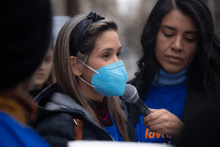
Local faith leaders and asylum seekers gathered on Feb. 22 to demand that Washington, D.C., government allow asylum seekers to access resources available to the rest of the district’s unhoused population.

WHEN URBAN CHURCHES disband, congregations face decisions about what to do with their property. In cities with hot real estate markets, church buildings are often sold off and redeveloped as condominiums or for other profitable uses. But the logic of the market need not guide all such decisions.
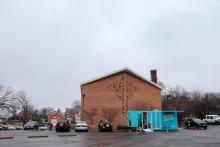
In 2016, the Community of Christ, a small church in central Washington, D.C., gave away the building it had owned for more than 40 years, a property worth more than $1 million. During the process of disbanding, the church members had decided that they wanted to pass their building on to an organization doing socially meaningful work in the neighborhood. Their story demonstrates ways of thinking about property as a spiritual and collective resource—and how to put those ideals into action.
The Community of Christ was formed in 1965 in Washington’s Dupont Circle neighborhood. Although founded by Lutherans, it was from the beginning an ecumenical church. And like several other congregations forming in D.C. around the same time, the community was an experiment in church: dedicated to social justice and to doing God’s work in the neighborhood, including building relationships with their neighbors. In 1973, the group purchased an 11-room storefront building in the nearby Mt. Pleasant neighborhood, a diverse and relatively affordable area where a number of church members had already moved, and began worshipping in that space. Shortly thereafter, the Community of Christ became a lay-led, shared-leadership congregation, with no single minister and no paid staff. All activities of the church—both spiritual and logistical—were from then on carried out on a volunteer basis by members, and all major decisions were made by consensus.
Senior citizens braved the winter weather on Thursday morning for their COVID-19 vaccine appointments at Pennsylvania Baptist Church in Southeast Washington, D.C. By the end of the day, 100 Washingtonians would be vaccinated at the church.

In the months prior to the November 2020 election, progressive activists Jethro Heiko and Nick Jehlen partnered with Choose Democracy to create the Coup-o-meter in order to provide clear communication about how close the U.S. was to an anti-democratic usurping of power. By Wednesday afternoon, they had shifted the meter.
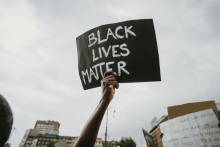
To be a Black woman in America and be relatively conscious, to paraphrase James Baldwin, is to be in a state of constant rage. Sweet holy songs don’t readily come to me. Christmas songs do not come to me. As a Black woman who happens to serve at a church that experienced white rage this past weekend when a group of demonstrators ripped down our Black Lives Matter banner and set it on fire, I am angry. And I’m tired.
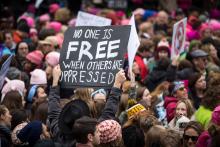
On Jan. 21, more than 1 million women and men around the world rose up and became part of a resistance.
Here are just a few of those faces — six people who showed up to make their voices heard at the Women's March on Washington. They each marched for individual reasons, but found common ground among the crowd.

AS SOME of you have no doubt already heard, the Post American [the original name for Sojourners] and our entire community will be moving, in early September, from Chicago to Washington, D.C. ... The Post American, first published in late 1971, began as a quarterly tabloid and has developed into a monthly magazine with a broadly ecumenical, national, and international readership. ... The final decision came less through an analytical process of weighing the pros and cons and more as a result of a growing sense among us all that Washington, D.C., was the right place for us to be.
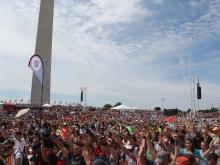
Evangelical Christians converged on the nation’s capital for a prayer rally on one of the hottest days of the summer.
With the nation reeling from recent shootings and shocked by news of a terrorist attack in France and an attempted coup in Turkey, speakers at “Together 2016” cited the global events from the stage and spoke of the challenges facing Americans.
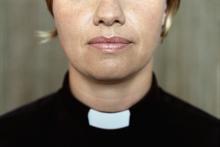
In an interview that aired last week, Stephen Colbert — possibly the only Catholic whose popularity rivals Pope Francis himself — admitted that one of the times the Eucharist felt “most real” to him was when he attended an Anglican service and heard a woman consecrate the bread.
“The freshness of hearing a woman say that gave the message a universality that it always should have,” said Colbert.
Today, if you walk through the red doors of an Episcopal church on Sunday morning, the person presiding over the Eucharist might be female, gay, lesbian, bisexual, or transgender. But on Sept. 12, some of the first women ordained as Episcopal priests reminded the church: it hasn’t always been that way.
Forty years ago last week — before women were allowed to be priests — four women were "irregularly" ordained as Episcopal priests before the altar of St. Stephen and the Incarnation in Washington, D.C. Closely linked with the "irregular" ordination of eleven women in Philadelphia (the “Philadelphia Eleven”) the previous year, the ordination of the Washington Four — Lee McGee Street, Alison Palmer, Betty Powell, and Diane Tickell — is seen by many as a key step in securing women’s ordination in the Episcopal Church.
My friends and colleagues are generally aware that before I began working at Sojourners, I was a patent examiner at the U.S. Patent and Trademark Office (USPTO) for six and a half years. What most of them do not know, however, is that I interviewed for that job — a five-minute drive from the Pentagon — on September 11, 2001.
Early that morning, I decided to take the Metro rather than drive to the USPTO’s offices in Crystal City, Va. I reasoned that if I got the job, I would want to get some idea about my future daily commute. This would prove to be a fortunate decision later on.
Even before the end of my trip to Crystal City, I had already heard news of the first World Trade Center tower being hit. When I arrived at the office, I hoped the interviewer would remember me after our conversation. He did — but considering the significance of all that happened that day, my concerns about employment now seem minuscule in hindsight.

I was raised in Atlanta during the heyday of the civil rights era. I went to high school with some of Martin Luther King, Jr.’s children. And I didn’t know there was a racial problem in my city. Because for me and my people there wasn’t. It was somebody else’s problem. Across town. Somewhere else.
The black maids and gardeners rode a tidal wave into my white neighborhood each morning, tended babies, fried chicken, and manicured lawns. And then the tide washed them back out again. We didn’t often ask where they landed for the night and whether it was as sumptuous as our digs, or whether their neighborhoods were even safe. We just dropped our bath towels on the floor and figured that somebody would pick them up again in the morning. Life was good.
From the remove of 40 years and 600 miles, I see it differently. But it took more than time and distance to reckon with my own cluelessness about race. It took what it always takes for barriers to fall between “us” and “them” — getting to know some of “them.” I’ve gotten as far as being able to name that I am on one side of many different divides, including the dinner counter at the Mission, and I’m usually on the less-shitty side. And it’s through no merit of my own. In fact it’s where people like me, white and privileged, have long been and have little questioned.

The white ministers didn’t fly down to Alabama in January, when Sheriff Jim Clark clubbed Annie Lee Cooper outside of the county courthouse, nor in February when a state trooper fatally shot twenty-six-year-old Jimmie Lee Jackson in the stomach for trying to protect his mother after a civil rights demonstration.
But on Bloody Sunday everything changed. At 9:30 p.m. on March 7, 1965, ABC news interrupted a broadcast to show hundreds of black men, women, and children peacefully crossing the Edmund Pettus Bridge toward Montgomery and a sea of blue uniforms blocking their way. The marchers were given two minutes to disperse, and then the screen filled with the smoke of tear gas, police on horseback charging the screaming crowd, burly troopers wielding billy clubs and bullwhips, a woman’s hem rising up over her legs as a fellow marcher attempted to drag her away to safety.
Overnight the nation’s eye turned toward Selma. Rev. Martin Luther King sent a telegram to hundreds of clergy that Monday, urging them to leave their pulpits and join him in Alabama to march for justice. Some supporters, like the reporter George Leonard, packed their things immediately after watching the newscast from Selma.
“I was not aware that at the same momemt ... hundreds of these people would drop whatever they were doing,” Leonard wrote later.
“... That some of them would leave home without changing clothes, borrow money, overdraw their checking accounts, board planes, buses, trains, cars, travel thousands of miles with no luggage, get speeding tickets, hitchhike, hire horse-drawn wagons, that these people, mostly unknown to one another, would move for a single purpose to place themselves alongside the Negroes they had watched on television.”
Selma changed the course of history by paving the way for the passage of the Voting Rights Act, but its impact didn’t end there. The spirit of Selma rippled outward, forever changing those who made the long journey to Alabama — including a white minister from Washington, D.C., named Rev. Gordon Cosby.
Lonely Planet just ranked Washington, D.C., as the #1 Best Place to Travel in the world(!). Coming on the heels of Forbes crowning D.C. the coolest city in America in August, the admittedly unexpected parade of accolades appears to just be starting for the place Sojourners has called home for the past few decades.
Of course, “coolness” is elusive by nature — if it was measurable, it wouldn’t be cool — and the metrics used by both outlets are questionably desirable, if technically true for a portion of the city. Lonely Planet points to a city “whose official religion is national politics,” while Forbes lists “higher influxes of new people” and “most college degrees per capita.”
This shows a problematic tendency to weight Washington the industry over D.C. the city (this post from DCis toutlines that nicely). It also largely misses what’s actually great about this place. I’ve found D.C. to be far beyond the House of Cards-meets-Cherry Blossom Festival sketch beloved by press and many residents alike. In my daily experience, D.C. is collaborative, generous, and deserving of accolades in ways that continually surprise.
Based on my very unscientific metrics of personal observation and emotional investment, here are a few things that are uniquely great about D.C.

The last time I listened to Nickel Creek was to analyze their adaptation of Robert Burns’ poem, “Sweet Afton,” in my English literature class in college three years ago. Indeed, the waters of Nickel Creek flow gently, a trait reflected in “Sweet Afton” and many other Nickel Creek staples. And that general lack of bite, paired with an almost robotic mastery of each band members’ respective instrument, pushed me away from the band.
So it was strange that, with no expectations and an arbitrarily negative perception of the classic folk band, I really enjoyed seeing Nickel Creek reunite in Washington, D.C. after a six-year hiatus. The show, in sum, was really, really good.
I live in Washington D.C., a city in which mistakes are messaged and shortcomings are spun. True confession and true repentance do not occur — unless it is politically advantageous. Naturally, cynicism runs rampant.
In this environment, though we all know our own weaknesses, grace is rarely offered for failures.
Which is why Lent is such an important season on the Christian calendar. It is an opportunity to pause and reflect, to examine our hearts, and to acknowledge the ways in which we have fallen short. But we don’t confess our failures to a public waiting to crucify us. Instead, we confess our sins to one who loves us and was willing to be crucified in order to reconcile us once and for all.
Lent is rarely talked about as a celebration, but it is an opportunity to revel in the joy of forgiveness.
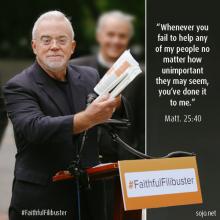
Editor's Note: Not in D.C., but want to join in the #FaithfulFilibuster? Click HERE to make your voice heard, and spread the word on Facebook by sharing HERE.
On our way over to the Capitol, I re-read the story of the Tower of Babel in Genesis 11. I was struck by the phrase of those building the tall tower "we'll become famous." That sounded a lot like lawmakers and politicians in Washington — it seems that they all want to become famous. In the story, the people were confounded by speaking different languages and their words went past each other. The words of the politicians and pundits are going past each other and their words are not really meant to be understood. They're not meant to find solutions or common ground. These are words that are meant to fight. To win. To defeat. Even, it seems, to foster hate.
The words we're hearing are of politics and punditry, meant to divide and not to unite. The words coming from the top have consequences for those at the bottom. And like Babel, these words are just babble.
We're hearing lots of babble at the Capitol, but across the street, we're trying to hear the word of God — what God says about the people, families, and children who will suffer the most because of Washington's babble. These words aren't just directed to churches and charities about what we should do with the poor. They're about the obligations of kings, rulers, and government to protect the poor.

My heart is in creation care. And frankly, it’s stressful. Every day, I learn about new things that are harming the environment. Another species is extinct. Another oil spill has spoiled a neighborhood. Plastic micro-beads in soap are clogging up the Great Lakes. The list is never-ending, and defeating.
But the other day, a Bible verse came to mind. It’s the one where we learn that not one sparrow falls to earth without God noticing. And while the next verse tells us that this is how we know God is especially watching over us, I want to pause for a moment and consider the sparrow part of the equation.

The metro is crowded today, and the 20-something, well-dressed white man has to stand, one hand holding the bar and the other his smartphone. It’s the end of the day. All the commuters — but one — are turned toward home. The young man’s face, like most of the others, is dulled with exhaustion. No one makes eye contact.
In a seat near the door, one woman sits facing everyone, looking backward. She studies the young man’s face intently, uncomfortably. He shifts. She rearranges the bags at her feet. Her reflection in the window shows an ashy neck above her oversized T-shirt collar. The train hums and clicks through a tunnel. As if in preparation, she takes another sip from the beat-up plastic cup she’s holding.
At last, she raises her voice and asks: “Why are white people so mean?” Boom! The electricity of America’s third rail crackles through the train. Faces fold in like origami or turn blank like a screensaver.
Gordon Cosby was my spiritual father, not simply a brother in Christ. This relationship continued for some 45 years until his dying days. In a time when egalitarianism defines nearly all relationships as the desired norm, it’s well to remember the role of mentors who maintain, purely through their own internal integrity and faithfulness, a spiritual authority in the lives of others. Gordon Cosby was such a person to me, and to countless others.
I first encountered Gordon when I was a young legislative aide on the rise in Washington, D.C., working for Senator Mark O. Hatfield and his legislative efforts to end the Vietnam War. Disgusted with the moral vacuity of the evangelicalism that had been my heritage, but searching for faith that was more than just following a progressive social agenda, I discovered the Church of the Saviour. Gordon’s insistence that following Jesus required a disciplined inner spiritual journey always expressed in joining God’s outward mission in the world captivated me then, and ever since.
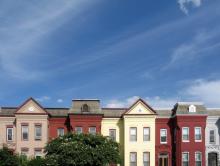
Annie Lowrey's recent New York Times magazine article "Washington's Economic Boom, Financed by You" provides a stimulating look into Washington, D.C.'s "economic boom" of the last few years. As D.C. residents, many of us encounter the ongoing transformation of our city every day. We know the area's economy has grown about three times as much since 2007 as the country — largely a result of expanded government spending (primarily in the form of two foreign wars). We also know that the greater metropolitan region is one of the richest in the country. As Lowrey noted, the Washington metro area has seven out of the top 10 highest-income counties in the U.S., including the three highest.
However, Lowrey only tells one side of the story — the rich side. The "economic boom" has largely passed by D.C.'s poor and working people. By not mentioning D.C.'s grossly high poverty rates, the article is misleading.
Amid Washington's economic boom, there is also massive economic displacement, increased economic inequality, and higher rates of poverty.