interview

How are a poisoned water supply in Flint and water shut-offs in Detroit connected? Tommy Airey, co-editor of RadicalDiscipleship.net, talked with Detroit activists Monica Lewis-Patrick and Cecily McClellan to get the story behind the story.
LONG BEFORE water shut-offs and poisoning in Flint, democracy in much of Michigan had been hijacked. By the time a governor-appointed “emergency manager” was foisted on Detroit in spring 2013, every large black-majority city in Michigan—from Flint to Benton Harbor to Highland Park to Saginaw—had been appointed an EM, stripping all powers from elected leadership while possessing the authority to renegotiate or cancel union contracts, hire and fire government employees, and sell, lease, or privatize local assets.
Two years ago, about the same time that Flint’s EM transferred the city’s water source from Detroit’s water system to the highly toxic Flint River, Detroit’s EM ordered the city water and sewerage department to begin shutting off the water of all Detroiters who were two months or more behind on their water bills.
Today, in a city with 40 percent of its population surviving below the poverty line, Detroit water rates are twice the national average, and an estimated 100,000 residents, including many elderly folks and children, have had their water shut off by the city. The measures are forcing many longtime, low-income residents, the majority of them black, to leave the city.
Since 2008, the grassroots organization We the People of Detroit (WPD), led by five African-American women, has been creatively resisting emergency management—first of the school system and then the entire city—with a steady campaign of awareness-raising, canvassing, water delivery and advocacy for shut-off victims, and a comprehensive mapping project soon to be released.
Monica Lewis-Patrick is the charismatic, energetic point guard of the group, fueled by the Holy Ghost and her morning standard: a cup of coffee sweetened with four sugar packets. Lewis-Patrick, who’s a grandmother and the mother of two teenage daughters, lost her bid for city council two years ago by a few hundred votes. A few weeks later, she lost her only son to gun violence.
Cecily McClellan, the quiet, confident, all-business power forward of Team WPD, is a retired city employee and former vice-president of the Association of Professional and Technical Employees.
I spoke with them at WPD headquarters on the third floor of St. Peter’s Episcopal Church—a stone’s throw from a downtown getting a corporate facelift financed by public bonds, subsidies, and tax abatements to draw companies in from the suburbs, while many residents struggle just to survive and keep their homes. —Tommy Airey
Tommy Airey: Let’s get this straight: Are you advocating for free water for low-income Detroiters?
Monica Lewis-Patrick: Free water has never been the ask. Personally, I’m not opposed to free water. I believe that water is a human right, and that everyone should have access to it. But the ask here in Detroit has always been for affordable water.
What are the mayor’s objections to an affordability plan in Detroit?
Lewis-Patrick: Over the last 11 months, water shut-offs have led to more foreclosures and pushing people out of the city. We believe [city officials] do not want to participate in a water-affordability plan because it would allow more people to stay in the city, especially in communities they want cleared out for future development.
Is this a conspiracy?
Lewis-Patrick: Conspiracy, in my mind, isn’t the appropriate term, because a lot of times people marginalize conspiracy as just somebody’s idea or accusation. What I would say is that it has been a collaborative, well-orchestrated system of evil. We know for a fact, through all the political analysis and economic research that has been done, that the city bankruptcy didn’t have to go down. People saw it as an opportunity to be able to divest from the water department, to weaken the water department intentionally.
Flint was actually advised by the governor and his emergency managers to come off of the Detroit Water and Sewerage Department system and then to become a part of another water system called KWA [Karegnondi Water Authority]. Flint was the largest external customer of the Detroit water system. How is it that you are advising us to become financially solvent, while at the same time all your deeds are making us insolvent?

A few days ago I had the wonderful opportunity to spend a day with Richard Rohr. Our conversation from the moment he picked me up from the airport, was energizing and thought provoking. Rohr's demeanor is very calming and without the fear of shaming or blaming, it's pretty easy to talk to about anything. We discussed the institutional church, poverty, self-care, the contemplative life, and many other issues. But one topic came up that I didn't anticipate, the issue of white privilege.

Michelle Higgins has been making waves lately. A leader in the #BlackLivesMatter movement, she recently addressed a gathering of 16,000 evangelical students at an InterVarsity conference in St. Louis, during which she urged them to back the movement.

Sojourners founder and president Jim Wallis appeared Nov. 7 on the Drew Marshall Show, a spiritual talk show that broadcasts on radio stations all over Canada. In the interview, Rev. Wallis discussed a range of topics from baseball and his love of coaching his sons, to Sojourners’ push for immigration reform, Pope Francis’ recent visit, and his upcoming book America’s Original Sin: Racism, White Privilege, and the Bridge to a New America.
Rev. Wallis also talked about his faith journey, from his experience at a revival as a child, to his leaving his home church to join the student movements in the 1960s and 1970s. He discussed the encounter with an elder in his church where an elder said that they had “nothing to do with racism. That’s political. Our faith is private.”
This exchange, Wallis noted, is what led him to eventually leave his church, only to come back to his faith after reading in Matthew 25 about how followers of Christ should treat the “least of these,” and what leads him to say that “Faith is always personal, but never private.”
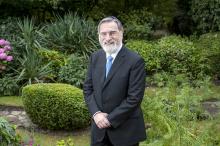
Religious zealots fill newspapers and screens with bloody images of bombings and beheadings. They kidnap children and make them into soldiers. They pray before they rape women.
But “not in God’s name,” says Rabbi Lord Jonathan Sacks, the former chief rabbi of Great Britain, who just published a book by that title.
“The greatest threat to freedom in the post-modern world is radical, politicized religion,” Sacks writes. Religion News Service asked Sacks how people can kill in the name of God, and how religion can counter religious extremists.

“When Trayvon Martin was shot and killed, I felt - you might call it the lament of a white father. I knew and the whole country knew that my son Luke — six-foot-tall baseball athlete, going to college next year — had been walking and doing the same thing, same time that Trayvon was doing in Sanford, Fla., everyone knows he would've come back. But Trayvon didn't come back, and so it was a parable. Jesus talked about parables. They teach us things. Michael Brown — Ferguson — was a parable. Charleston was a parable. The parable about where we are as a nation — we have to see our original sin and how it still lingers in our criminal justice system.”
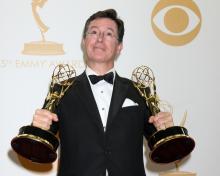
“I’m no particular exemplar of my faith,” says Stephen Colbert.
“I just happen to have affection for my church.”
Colbert’s latest interview with Toronto-based Catholic outlet Salt and Light is bursting at the seams with wisdom — and, of course, more than a few good laughs.
The new host of the Late Show sat down with Father Thomas Corsica for a 45-minute conversation, one which centered on the Catholic comedian’s reflections on faith and theology.
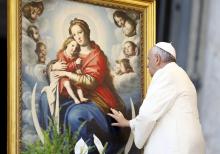
In two wide-ranging new interviews, the pontiff discusses matters both weighty and personal, such as: the perils of his popularity, his plans to welcome divorced and remarried Catholics, and his fear that the church has locked Jesus up like a prisoner.
Speaking Sept. 13 to the Argentine radio station, FM Milenium, Francis lamented those who posed as his friends to exploit him, and decried religious fundamentalism.
And speaking to Portugal’s Radio Renascença in an interview that ran on Sept. 14, Francis said that a priest comes to hear his confession every 15 to 20 days: “And I never had to call an ambulance to take him back in shock over my sins!”

My friends and colleagues are generally aware that before I began working at Sojourners, I was a patent examiner at the U.S. Patent and Trademark Office (USPTO) for six and a half years. What most of them do not know, however, is that I interviewed for that job — a five-minute drive from the Pentagon — on September 11, 2001.
Early that morning, I decided to take the Metro rather than drive to the USPTO’s offices in Crystal City, Va. I reasoned that if I got the job, I would want to get some idea about my future daily commute. This would prove to be a fortunate decision later on.
Even before the end of my trip to Crystal City, I had already heard news of the first World Trade Center tower being hit. When I arrived at the office, I hoped the interviewer would remember me after our conversation. He did — but considering the significance of all that happened that day, my concerns about employment now seem minuscule in hindsight.

The “Pope of the Interview” strikes again: Pope Francis has given a lengthy — and fascinating — interview to a Mexican television station, which broadcast it on March 13 to mark the second anniversary of his election.
Speaking to the program “Noticieros Televisa,” Francis displays his usual candor, dishing details about the secret conclave that elected him, talking about how he senses his papacy will be short, how the church must get tough on sexual abuse, and how all he really wants “is to go out one day, without being recognized, and go to a pizzeria for a pizza.”
Here are some of the highlights based on Vatican Radio’s English translation and the original Spanish:
On whether he likes being pope:
“I do not mind!”
Florida is a target state for traffickers, with the Tampa Bay area as a top destination for this monstrous activity. Tampa Bay has a lethal combination of tourism, world famous beaches, hospitality and agricultural industries, sports arenas, a military base, international seaports and airports, as well as a destination spot for one of thelargest adult entertainment industries in the nation. This combination attracts all forms of human trafficking which has become a larger money maker than selling drugs, as the human "product" can be used and re-used over and over again.
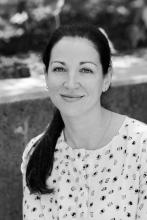
Beth Latz is founder and executive director of Project Interfaith, projectinterfaith.org
1. Why did you decide to launch Project Interfaith?
There are a couple experiences in my life that led me to found PI. One would be that my grandparents immigrated to this country after experiencing harsh persecution as a result of their Jewish identity. Another would be growing up as a religious and ethnic minority and encountering a lot of people making assumptions about what that means. I didn’t always feel welcome or free to be who I am. But growing up and hearing about my grandparents’ experiences in other countries, I realized how lucky we are to have certain rights in this country. So I wanted to make sure people understand these rights and freedoms.
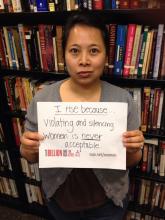
I firmly believe that people of faith can transform the world. Despite the many flaws and failures of the church and her people, Christians have a tremendous amount of power and influence to do good. This campaign is all about harnessing the leadership of churches and clergy, and encouraging people of faith to raise their voices on behalf of women and girls. Through education and empowerment, we can confront gender-based oppressions and change harmful practices, policies, and structures within the church and the broader culture. It’s a tall order, but one that demands nothing less from us if we truly believe in the sacred worth of women and girls.

“Behind every number, there’s a story.”
That’s what inspires Maria Hinojosa, host and executive producer of NPR’s Latino USA, to investigate the dramatic demographic changes taking place in the United States in her new PBS show, America by the Numbers. In a nation that will be majority non-white by 2043, Hinojosa’s storytelling focuses largely on the oft neglected experiences of immigrants and people of color.
Unafraid of what mainstream media too often neglects, Hinojosa’s America by the Numbers brings to life the tensions at the heart of a rapidly diversifying America. She examines not only the unjust treatment of underrepresented communities by the American government but also the cultural conflicts inherent within these communities. For Hinojosa, the conflicts between tradition and progress, community and individuality, white and non-white are not to be avoided, but rather spotlighted.
Last week, Sojourners chatted with Hinojosa about America by the Numbers and the role the media can play in welcoming these demographic changes. This conversation has been lightly edited for length and clarity.
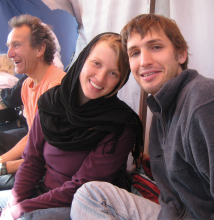
Bio: Kelly and Peter Shenk Koontz spent the last three years serving in Kabul, Afghanistan, through a Mennonite Central Committee partner.
Website: MCC.org
1. What work were you doing in Afghanistan?
We worked with a Mennonite Central Committee (MCC) partner in Kabul as Peacebuilding Project Managers. Our job was to integrate peacebuilding within different sectors of the partner organization, including adult education, community development, and many others. Day-to-day, this primarily meant developing curriculum and planning and conducting trainings for a variety of contexts—including rural community development teams and university students in Kabul.
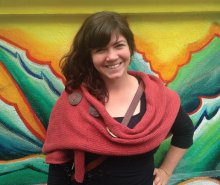
Bio:
Katerina Friesen is studying theology and peace studies at Anabaptist Mennonite Biblical Seminary in Elkhart, Ind.
1. How would you describe your current vocational role?
I see my role as both revaluing what has been cast down and degraded and building resilient communities. So far this has taken shape through land-based ministries of farming and community gardening, inviting people to work together and celebrate the sacramental in soil, food, and one another.
2. You spent several years with the Abundant Table Farm Project in Santa Paula, Calif. Can you describe the project and your role there?
The Abundant Table Farm Project is a working farm and young adult internship program that has evolved into a Christian community. I joined the project in 2009 and lived in community with four other women. My daily work of farming gave me a bodily understanding of farm workers’ labor and the need for justice and wholeness in our incredibly disconnected food system.

“I AM A storyteller,” says Daniel Beaty, “and my purpose in the world is to inspire people to transform pain to power.”
He was first inspired to share his stories when his third-grade teacher showed a videotape of Martin Luther King Jr.’s “I Have a Dream” speech. Now as a writer, actor, singer, teacher, and motivational speaker, his storytelling is expressed in a dizzying array of different forms and outlets. The week in April that Sojourners’ editorial assistant Rebecca Kraybill interviewed him, Beaty was doing daily performances in Los Angeles of a one-person play he wrote on the life of performer and activist Paul Robeson, “The Tallest Tree in the Forest” (in which he plays 40 characters and sings 14 songs) and, during the day, taping for a Ford Foundation-funded documentary on work he does with children of incarcerated parents.
This was just a fortnight after Beaty finished a six-week speaking tour in support of his memoir, Transforming Pain to Power: Unlock Your Unlimited Potential (Penguin-Random House). He’s also the author of a children’s book released in December 2013 by Little, Brown and Company, Knock Knock: My Dad’s Dream for Me, with graphics by award-winning illustrator Bryan Collier, which is an adaptation of a poem Beaty wrote about his experience growing up with an incarcerated father. “Knock knock down the doors that I could not” is one especially poignant line the father in the book writes to the son; it carries a call to healing and liberation that is found in all of Beaty’s work.
Kraybill talked with Beaty about the effects of mass incarceration on families, the power of a “theater sanctuary,” and how the arts call us toward “the capacity to do better.”
Matthew Vines sits down with Sojourners to discuss his first book, "God and the Gay Christian: The Biblical Case in Support of Same-Sex Relationships."
“THE CHURCH radicalized me,” celebrated author and ordained Episcopal deacon Denise Giardina once said, describing how she sees herself as both social activist and servant minister. “The phrase in the prayer book is ‘Interpret the world to the church and the church to the world.’ It’s a totally different way to advocate, with a spiritual point of view.”
This philosophy has shown up in her bestselling novels, published over her long career, such as Storming Heaven (1987) and The Unquiet Earth (1992), which chronicle the history and social impacts of coal mining in Giardina’s native Appalachia; Saints and Villains (1999), which tells the story of Dietrich Bonhoeffer’s resistance against Hitler and the Nazis; and, most recently, Emily’s Ghost (2010), a reimagining of Emily Brontë’s story and how her life was changed by her encounter with an ardent member of the clergy.
Shortly before her recent retirement from teaching creative writing at a West Virginia college, Giardina talked with Jason Howard, author of A Few Honest Words and coauthor of Something’s Rising, about her literary career, social justice activism, and her time in the late 1970s in Washington, D.C., as a member of Sojourners community (the intentional Christian community that founded Sojourners magazine and other ministries).
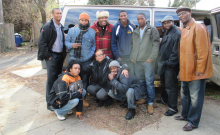
Bio: Tyrone Parker is the executive director of Alliance of Concerned Men (ACM), a nonprofit that works with youth living in high-crime areas in Washington, D.C.
1. What event or episode in your life has most informed your passion for working with urban youth and families?
One was the loss of my son, Rodney [who was killed in 1989]. The other was the record number of homicides within the District of Columbia. The District was once considered the “murder capital” of the United States.
When we first got started with the intervention program, it was due to a 12-year-old kid who was shot in the nation’s capital on the day of the Clinton inauguration. If you would’ve gone 10 minutes on East Capitol Street, you would’ve seen the inauguration with a major celebration. And 10 minutes down the same street, you had a whole community under house arrest. After that, we came together as a group to form the Alliance of Concerned Men.
2. What sorts of services and programs does ACM provide?
We teach a number of skills to at-risk youth, including gang intervention/prevention and mediation, workforce development, life skills training, leadership development, coaching for re-entry, and youth gang conflict resolution.