Immigration
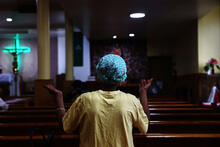
Hundreds of thousands of Haitians in the U.S. are living in uncertain times. On June 25, 2026, the U.S. Supreme Court ruled that the Trump administration could proceed with a plan to end Temporary Protected Status—a federal program that allows people to stay in the United States when the government considers their own country unsafe—for around 350,000 Haitians and 6,000 Syrians. Their work permits are scheduled to end July 24, leaving TPS holders at risk of deportation.
This uncertainty is not new. In 2010, President Barack Obama granted TPS to Haitians living in the U.S. after an earthquake killed approximately 200,000 people in Haiti. The original period was 18 months, but TPS has been renewed multiple times because of humanitarian concerns, gang violence, and political unrest.
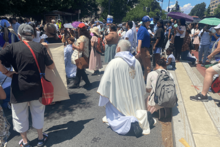
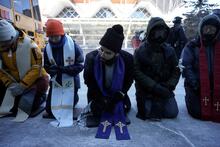
As Catholics from all over the world observed Corpus Christi by processing through the streets to celebrate the Eucharist, about 300 parishioners in Washington, D.C., did the same—with a specific focus on honoring the dignity of immigrants.
Going back to the 13th century, Corpus Christi is the Catholic Church’s celebration of Jesus Christ’s real presence in the Eucharist. For Bishop Evelio Menjivar-Ayala, who led the immigrant-focused procession in Washington and serves as bishop of the Diocese of Wheeling-Charleston in West Virginia, the day is a reminder to stand in solidarity with those who are suffering, especially immigrants who live in fear of deportation.
“The mystery we celebrate today is a mystery of unity,” he told Sojourners on Sunday. “We share one bread, one cup, and then we become the body of Christ … But the Eucharist has to go beyond just receiving Jesus at Mass or adoring Jesus in the blessed sacrament.”
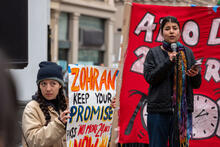
In New York City, many home care workers work 24-hour shifts for up to five days straight, and are only paid for 13 hours of each shift. If they do not agree to this, they risk losing their job.
Home care workers provide 24-hour, live-in care for elderly and disabled patients, as defined by Medicaid. Home care workers feed, bathe, and administer medicine to patients. These workers attend to their vulnerable patients’ unpredictable needs around the clock. But because insurance companies like UnitedHealthcare and New York Healthfirst receive fixed public Medicaid payments to manage care, they make a profit by hiring only one worker for an entire shift.
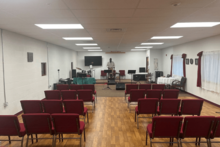
Maranatha Church, Jasmine Ministries, and Creole Resources have served the Haitian population in Spokane, Wa., for years—most recently by creating job and housing opportunities made scarce to them due to social and legal barriers created by the Trump administration.
Only a month ago, many Haitians in Spokane nearly saw the end of their Temporary Protected Status, leaving them with the choice to return to Haiti or find a new way to achieve legal status in the U.S.
Even though a federal judge barred the expiration from taking effect, public uncertainty about the longevity of their TPS has made it hard for Haitians in the U.S. to do things like rent an apartment or apply for jobs.
It might seem like the mission to abolish Immigration and Customs Enforcement is unique, but there are important parallels between this movement and the 19th-century fight to abolish slavery. As we seek to follow the gospel and make a new world, it is worth turning to abolitionists from the 19th century as we look for examples of how to win the fight against tyranny and wickedness, even if it takes longer than our lifetime.
The Fugitive Slave Act of 1850 required U.S. marshals in free states to capture people who were attempting to liberate themselves from slavery. While the act was meant to assuage the Southern malcontent at the admission of California as a free state in the same year, it prompted widespread protests in Northern cities from abolitionists who sought to prevent the enforcement of what they saw as a fundamentally evil law.
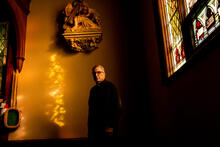
When Father Dale Korogi takes the podium to give the homily to the parishioners of the late morning Mass at Ascension Catholic Church in north Minneapolis, he is used to seeing hundreds of faces watching him—mostly the faces of immigrants from Latin America.
Now, he sees only a few dozen in the pews, as most of the immigrants in his congregation are staying home until the Trump administration withdraws the thousands of immigration agents who have been deployed in Minnesota as part of Operation Metro Surge.
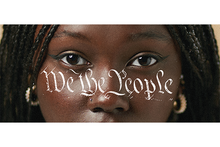
AS THE UNITED STATES celebrates its 250th birthday this year, I am thinking about who is included in the “We the people” of the Constitution’s preamble. This is particularly urgent in light of the MAGA movement, the largest effort in over a generation to redefine who and what is truly American.
Since its inception our nation has been in a tug of war between those seeking to narrow “We the people” to primarily white men and those seeking to expand it to include every person. Sadly, white evangelical Christians remain more fearful and resistant to the nation’s changing demographics compared to all other religious groups, as recent surveys from both Pew and PRRI have shown. Rather than a source of hope and a glimpse of the kingdom to come, our increasing diversity has been used to build political power by stoking anxiety and prejudice.

SHAFTS OF SUNLIGHT streamed through the clouds on an early November morning when I set out with three older women for a two-hour drive from Los Angeles to the ICE detention center in Adelanto, Calif. I was traveling with Rev. Betty Stapleford, a retired Unitarian Universalist minister, and her affable, wise-cracking friends, Maureen Kimberling and Ellen Deeb. While this was Kimberling and Deeb’s second visit, this was my first time visiting a detention center.
Rev. Betty—as she is affectionately called—began making these monthly trips in 2014, taking seriously Jesus’ command to visit the sick and imprisoned. Her outreach is supported by Clergy and Laity United for Economic Justice, a nonprofit coalition of inter-faith congregations that advocate for the rights of low-wage workers and immigrants.
She was dressed in vibrant purple, a color she wears every day, partly inspired by Jenny Joseph’s poem “Warning,” with its famous opening lines: “When I am an old woman, I shall wear purple.” Recalling her final day as a minister in a church, she said she delivered a sermon about “finding what you love that brings you joy”—even something as simple as your favorite color. Joy would be challenging to find at the place we were headed.

Chaos fills the streets as families are separated by force, and mothers cry out as their children are taken from them. To exert control and maintain power, a ruler orders agents to detain people off the street. Those the ruler labels as “subversive” are treated as a threat to his reign. The violence is indiscriminate and unrelenting. It does not matter who gets hurt, as long as the ruler stays on the throne.
If your mind went directly to President Donald Trump or the news of Immigration and Customs Enforcement agents shooting and killing two Minnesota residents—mom and poet Renee Nicole Macklin Good, and intensive care nurse Alex Pretti—you are not alone. But in this case, I am talking about Herod and his order to kill the children in Bethlehem and its surrounding region (Matthew 2:16). While the parallels are not identical, the shared logic of unrestrained state power is unmistakable.

Attorney General Pam Bondi announced on Thursday morning that the FBI had arrested at least two leaders of a demonstration inside Cities Church in St. Paul, Minn., protesting one of the church’s pastors works for Immigration and Customs Enforcement.
The FBI arrested Nekima Levy Armstrong, a civil rights lawyer and activist in the Twin Cities, and Chauntyll Louisa Allen, a community organizer and schoolboard member, according to Bondi’s posts on X. Bondi called Levy Armstrong a key organizer of the “coordinated attack on Cities Church in St. Paul, Minnesota.”
“WE WILL PROTECT OUR HOUSES OF WORSHIP,” Bondi wrote, adding a prayer hands emoji.
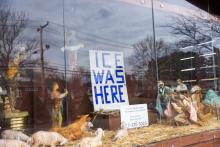
On Thursday, Dec. 11, a man dismantled a nativity scene depicting Immigration and Customs Enforcement arresting the Holy Family at a Charlotte church. The now-viral video depicts the man knocking over the mannequins in ICE uniforms who appear to be detaining a kneeling Mary and Joseph.

AS ORGANIZERS IN her city began preparing for the No Kings protest in October 2025, Erin Groble thought seriously about whether she should attend. On the one hand, she felt the need to do something. She was raised Lutheran and attended the Jesuit Loyola University in Chicago, and the increased presence of federal agents in Chicago challenged her to figure out what it meant to love her neighbor. On the other, she was genuinely scared at the possibility of being physically harmed or getting into conflict with authorities.
“I realized it just wasn’t really authentic to who I was. It just didn’t feel like the right thing for me to do,” Groble told Sojourners. “But then I started thinking, ‘OK, well, what is the right thing for me to do?’”
Groble was already part of a group chat organized by Brendan Curran, a Catholic priest and community organizer with The Resurrection Project. Curran had brought her block about 50 yard signs advertising “Know Your Rights” information via QR codes. Groble and her neighbors had planted a few of the signs, but there were plenty sitting in her neighbor’s home. “Yard signs are kind of hard to put up—especially in the city!” Groble said. “You have to find a place to put them; there’s a lot of concrete here and a lot of the soil is compacted. So, you need a lot of determination. I just went on my normal walking route, and in front of schools, by parks, by bus stops, I put them all up.”
In late November, a child care worker at The PLACE, a refugee center in Amarillo, Texas, reported to work with a worried look on her face. She asked Brady Clark, whose community development nonprofit helps run The PLACE, if the latest announcement from the Trump administration would affect her family. She was referring to a memo from U.S. Citizenship and Immigration Service announcing it would re-interview all refugees admitted under President Joe Biden and beyond—an estimated 233,000 people.
The USCIS memo, dated Nov. 21, said the agency will terminate the refugee status of people already in the U.S. if they are found not to meet refugee criteria. The memo claims the Biden administration potentially prioritized expediency, quantity, and admissions over quality interviews and detailed screening and vetting.

The early seasons of Stranger Things hit different in 2025. I realized this as I rewatched the series ahead of the final season’s premiere. Watching federal agents sow mistrust and harm children no longer seems like a sci-fi nostalgia trip, and the creeping evil influence of the Upside Down feels more like commentary on current events than a Stephen King pastiche. In fact, in fighting for the world they want and practicing radical solidarity, the kids in Hawkins, Ind., teach us exactly the lesson we need for right now. Stranger Things might even be a modern-day parable.
When the show debuted in 2016, it was a smash hit and proved that Netflix could compete in the original-content arena. Following a group of teenagers and the adults they trust in a fight against the forces of evil, the show owes much of its success to ’80s nostalgia. The group has fought various monsters over its seasons, many of which took cues from Dungeons & Dragons, but Season 4 took a more psychological turn, focusing on a being that feeds on the ongoing trauma people in Hawkins have experienced in their personal lives.
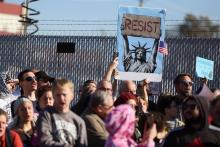
In early November, Democrats won several key elections up and down the ballot in states like Virginia, Georgia, Pennsylvania, and, perhaps most notably, in New York, where Zohran Mamdani became the first Muslim, South Asian, Democratic Socialist mayor-elect in New York City’s history. For voters concerned about the Republican Party’s authoritarian lurch, it was a reminder that political wins on the left are still possible.
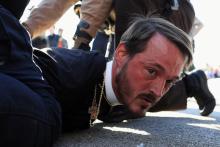
On Nov. 14, more than 100 clergy gathered to raise their voices to demand the closure of the Immigration and Customs Enforcement processing facility in Broadview, Ill., the release of all detainees, and that the Department of Homeland Security honor federal law by allowing detainees spiritual care.
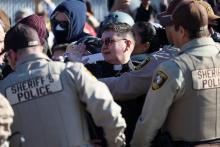
Chicago is in a state of holy rage. Last Friday morning, I stood with many of my colleagues in ministry at a multifaith service outside the Immigration and Customs Enforcement processing facility in Broadview, Ill. It would be better to call this facility an abduction center, as those who are detained there have little to no contact with the outside world.
Working at a peacebuilding organization during times of war, genocide, and political upheaval is a strange kind of calling. At Telos, where I serve as director of marketing and communications, our mission is to equip communities to be peacemakers—working across lines of difference to help all people live in safety, freedom, and dignity.
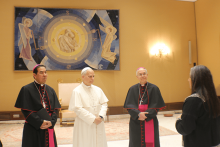
As President Donald Trump ordered federal troops into Chicago to assist with deportation efforts, immigrants and their advocates found an ally in Pope Leo XIV. A native of the city, the new pope urged U.S. bishops to confront the government’s escalating targeting of migrants.
After a private audience with Catholic leaders from El Paso, Texas, at the Vatican, on Oct. 8, Leo said he would like the U.S. Conference of Catholic Bishops to issue a formal statement. His appeal followed recent comments questioning the consistency of some American Catholics’ moral stances: “Someone who says that ‘I’m against abortion, but I’m in agreement with the inhuman treatment of immigrants in the United States,’ I don’t know if that’s pro-life.”
Alongside Bishop of El Paso Mark J. Seitz, Hope Border Institute, a grassroots organization rooted in Catholic social teaching, presented the pope with a stack of letters from immigrant community members. The letters expressed both the worries and hopes of migrants in today’s political climate and were received with emotion, said Astrid Liden, Hope’s communications officer.

I WRITE THIS month’s reflections with a heavy heart as the federal government’s violent attacks on immigrants continue. As a Korean-descent immigrant, I understand how scapegoating, hatred, and being blamed for things beyond our control can be exhausting for body and soul. Our communities are on the brink of despair; our hopes for a better future are shattering.
And yet, we hold on to our faith. We know we are not alone. God is our refuge. We have friends, colleagues, and neighbors who are in solidarity with us and who pray for us. As we face lawlessness geared with imperial might, we believe that our God, the only true “king,” will “judge between the nations” and “settle disputes.” Then we will beat “swords into plowshares” and “spears into pruning hooks.” God is the ultimate judge of all (Isaiah 2:4).
The transformative path of Zacchaeus inspires me. His story is a model of faithfulness. Whether or not you claim Jesus as your savior, I believe that you can change by caring for the poor and oppressed, participating in reparations, and sharing your abundant gifts. After all, the gospel says so.