In late November, a child care worker at The PLACE, a refugee center in Amarillo, Texas, reported to work with a worried look on her face. She asked Brady Clark, whose community development nonprofit helps run The PLACE, if the latest announcement from the Trump administration would affect her family. She was referring to a memo from U.S. Citizenship and Immigration Service announcing it would re-interview all refugees admitted under President Joe Biden and beyond—an estimated 233,000 people.
The USCIS memo, dated Nov. 21, said the agency will terminate the refugee status of people already in the U.S. if they are found not to meet refugee criteria. The memo claims the Biden administration potentially prioritized expediency, quantity, and admissions over quality interviews and detailed screening and vetting.
“Given these concerns, USCIS has determined that a comprehensive review and a re-interview of all refugees admitted from January 20, 2021, to February 20, 2025, is warranted,” the memo stated. “When appropriate, USCIS will also review and re-interview refugees admitted outside this time frame.”
It’s not unusual for refugees to feel anxious about upheaval in the immigration system, Clark said. Usually, he’s able to quickly reassure people like the child care worker that she and her family, who were evacuated from Afghanistan in 2021 on special visas under Operation Allies Welcome, had nothing to worry about. They were the kind of immigrants who had enjoyed favored status even among conservative Americans—the ones who “did it right,” undergoing an extensive vetting process that can take years before being relocated to cities like Amarillo in the U.S.
That vetting process is neither sloppy nor political, said Matthew Soerens, vice president of policy for World Relief, a Christian humanitarian organization. Many of the USCIS officers who conducted refugee interviews during the Biden administration were hired and trained under the first Trump administration. “These are career professionals,” Soerens said. They are trained not only to ensure that the refugees meet a threshold for admittance, but that they do not pose a threat to their potential communities in the U.S.
Soerens said that individually revisiting cases that seem to have been mishandled would be understandable, but calling for the re-vetting of hundreds of thousands of people is inefficient and wasteful of government payroll dollars. On top of that, he said, “It is profoundly cruel.”
To be granted refugee status, applicants must be able to demonstrate “that they were persecuted or fear persecution due to race, religion, nationality, political opinion, or membership in a particular social group.” For many, Soerens said, the interview recounting their experiences as members of a persecuted group is traumatic in itself. Many have told him “the refugee interview was one of the hardest days of their lives.”
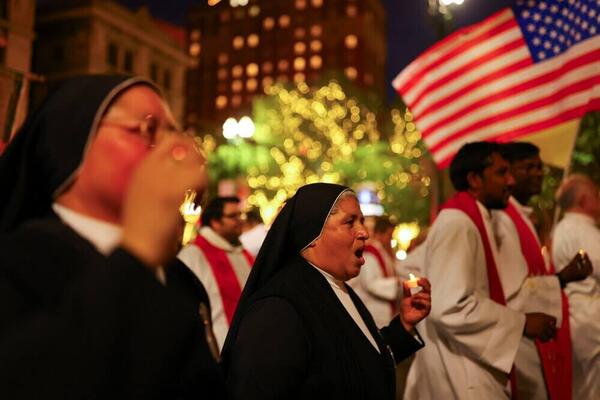
Often, the horror they are being asked to relive, Soerens said, is religious violence. For decades, most of the refugees the U.S. has accepted are Christians who face threats of death or extreme persecution in their home countries.
Myanmar, where Christians and Muslims are persecuted, is one of the countries where a large percentage of U.S. refugees have come from. In 1980, the U.S. accepted over 200,000 refugees, the highest the “refugee cap” has been in history. For most of the last three decades, presidents have set the cap between 70,000 and 125,000 per year, with a focus on war torn countries and groups facing physical danger. That norm is changing under President Donald Trump, who set a historically low cap for refugee admittance at 7,500 for the coming year. His administration will focus on accepting white South Africans of Afrikaner ethnicity.
Now, many who thought their days of limbo and danger were over are now finding themselves set back, with security slipping away, Clark said.
Like the other refugees The PLACE serves, the young Afghan woman’s hardworking family had been inching their way through the legal labyrinth to citizenship. All but one member of the family, her little brother, had managed to get a green card before the memo, which also halted all green card proceedings for refugees.
Then, after an Afghan immigrant shot two National Guard members on Nov. 26, the administration further curtailed asylum and green card applications for immigrants from “Third World countries,” an outdated economic term Trump used on social media in concert with calls for “reverse migration” and vows to “denaturalize” immigrants who “undermine domestic tranquility.”
The administration later indicated that the countries Trump referred to were the 19 countries placed under a travel ban in June—including places with large, displaced populations like Afghanistan, Haiti, Sudan, and the Republic of Congo. Eleven of the countries from the list are also identified by the Christian nonprofit Open Doors as places where Christians face “extreme” or “very high” persecution.
Ending migration from poor countries has been a theme of both Trump administrations, using travel bans, refugee ceilings, and halts on asylum. Danilo Zak, director of policy for Church World Service said that in the first Trump term, the goal seemed to be limiting newcomers. As CWS braced for the legal and advocacy challenges of the second administration, he said, “we were prepared for restrictions.” But Zak said they’ve been more concerned by the broad efforts at “de-documentation”—removing legal status from those already here legally.
“There’s a clear effort to target those who have already found safety here,” Zak said.
READ MORE: The Christian Case for Open Borders
That shift in focus is creating uncertainty for refugee families and those who work with them. For most of 2025, Clark said, he’s tried to keep up his prior confidence that once someone had legal status in the U.S.—especially refugee status—they were secure. Despite anti-immigrant bluster and sentiment, he didn’t think the government would remove legal status for those already here. But as he’s watched the systematic dismantling of all legal pathways into the U.S., including those who are already here and wish to remain, he can’t give them reassurance.
Looking at his frightened child care worker and neighbor, he made the only promise he could: “We don’t know, but we’re going to fight for you.”
Reuters reporting contributed to this article.
“There’s a clear effort to target those who have already found safety here.”—Danilo Zak, director of policy for Church World Service

Did this article have an impact on you? Tell us how! Whether you’re moved to take action, have a question, or want to share a comment (good or bad), we value your feedback!