On Thursday, Dec. 11, a man dismantled a nativity scene depicting Immigration and Customs Enforcement arresting the Holy Family at a Charlotte church. The now-viral video depicts the man knocking over the mannequins in ICE uniforms who appear to be detaining a kneeling Mary and Joseph.
The nativity scene was created by a church called Missiongathering Charlotte in partnership with a local art collective and was meant to elicit reactions to how modern campaigns of immigration enforcement invoke the same authoritarian violence that the Holy Family faced. The display has since been restored, and the church will not press charges.
Similarly, another anti-ICE nativity display at Lake Street Church in Evanston, Ill., was attacked recently. Chicago has been the epicenter of anti-ICE protests, and Rev. Michael Woolf hosted a scene featuring baby Jesus wearing zip ties, Mary and Jesus wearing gas masks, and all three flanked by Roman centurions dressed as ICE agents wearing masks and sunglasses.
It’s a provocative scene. So much so that vandals decapitated and smashed the statue of Mary. In response, the Evanston church replaced the destroyed Mary with a sign saying that Mary had been beaten and dragged away in front of her son and is being held in immigration detention.
As these moments illustrate, anti-ICE nativity scenes are deeply controversial but incredibly important. They highlight how the story of the nativity is especially relevant today as immigrants—both those with documents and those without—are being attacked and disappeared from the street, sometimes alongside legal citizens.
All this invokes the biblical story of the Nativity. These provocative nativities remind us that Jesus was born in an authoritarian regime that sought his death. It’s ultimately the reason his family flees from Bethlehem.
The Nativity scene is a parable of radical hospitality and empathy. In a country where white Christianity has become a weapon of authoritarian violence, anti-ICE nativities re-center the reason for the season: Christ’s humble beginnings amid political violence.
Jesus lived his life unsettling people in comfortable positions of religious and social power, and he refused to abide by guidance from religious elders that hurt others. This point resonates strongly in one story of a nativity on display at St. Susanna Parish in Dedham, Mass. Almost one week before the unidentified man attacked the Charlotte nativity, the Archdiocese of Boston condemned the anti-ICE nativity scene at St. Susanna Parish.
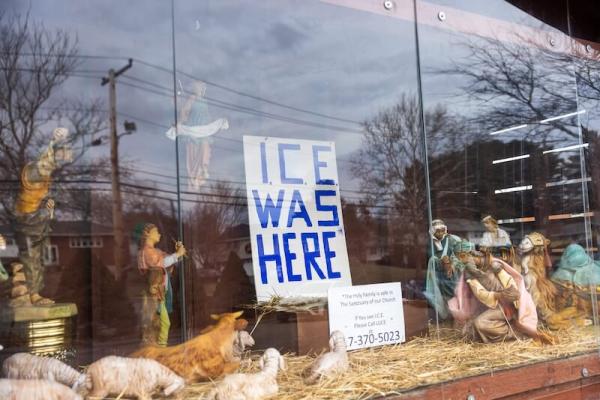
The scene at St. Susanna Parish was of two signs reading, “I.C.E. WAS HERE. The Holy Family is safe in The Sanctuary of our Church. If you see I.C.E. Please Call LUCE at 617-370-5023.” Run by the Immigrant Justice Network of Massachusetts, the LUCE Defense Hotline operates a local watch and hotline to monitor ICE and other federal agents.
The lack of the Holy Family and the presence of a “political” opinion rankled the diocese. A spokesperson for the diocese explained their condemnation in a statement, saying “the people of God have the right to expect that, when they come to church, they will encounter genuine opportunities for prayer and Catholic worship—not divisive political messaging.”
Another spokesperson for the Archdiocese of Boston told the National Catholic Register that “regarding the recent incident, St. Susanna Parish neither requested nor received permission from the Archdiocese to depart from this canonical norm or to place a politically divisive display outside the church. The display should be removed, and the manger restored to its proper sacred purpose.”
The diocese isn’t alone. ICE's acting director, Todd Lyons, also said that “the actions of the activist reverend, Stephen Josoma, are absolutely abhorrent and add to a dangerous narrative responsible for a more than 1,150 percent increase in assaults on ICE officers.”
Department of Homeland Security spokesperson Tricia McLaughlin similarly said that not only is the scene offensive to Christians, “but it is also depicting something that —despite what Rev. Josoma says—NEVER happens. ICE does not separate families.” Earlier this month, PBS News found that the Trump administration has separated thousands of migrant families in the United States.
The archdiocese spokesperson also called on St. Susanna Parish to take down the signage in the nativity scene. So far, the church has refused to comply.
In a video statement, Father Stephen Josoma said, “We are waiting for an opportunity of dialogue and clarity with Bishop Henning before reaching any final decisions.” Richard G. Henning has been the archbishop of Boston since 2024. In a press conference on Monday, Dec. 8, Father Josoma said that the fact “that some do not agree with our message does not render our display sacrilegious nor [make it] the cause of any scandal to the faithful.”
In defense of the church’s nativity display, Father Josoma cited Pope Leo XIV’s call to stand for migrants. Last month, the pope called out the “extremely disrespectful” treatment of immigrants in the United States. Furthermore, the United States Conference of Catholic Bishops also issued a statement when they gathered in Baltimore this past November that rebuked the treatment of immigrants in the United States.
Referring to multiple incidents in Chicago where ICE agents blocked faith leaders from delivering Communion to immigrants, the bishops’ statement read: “We are disturbed when we see among our people a climate of fear and anxiety around questions of profiling and immigration enforcement. We are saddened by the state of contemporary debate and the vilification of immigrants. We are concerned about the conditions in detection centers and lack of access to pastoral care.”
Because of this statement, Father Josoma said that he was surprised at the archdiocese’s pushback. “The bishops’ message[s] on their own are totally in line with what we have done over the past week, this past Advent season,” he said. “We’re a bit surprised at that.”
It’s a powerful statement on the growing schism between some increasingly radical high-profile actors in the American Catholic Church and the Church in Rome. It’s also a timely reminder that Catholic communities have been hit hard by anti-immigrant violence, with Latino communities facing harassment and bigotry.
READ MORE: Of Course the Virgin Mary Would Trample ICE
This is why Father Josoma is right to stand firm. To give in to diocesan and government orders that seek to censor religious expression and political dissent would be to deny the very roots of what our country was founded on, and also our Christian faith.
The best example is perhaps another work of art by Andy Rios Toro, an artist born in Los Angeles. This past Friday, Rios posted an image of La Virgen de Guadalupe turned away from the viewer, her arms behind her in handcuffs. The illustration, titled “Madre de los Detenidos,” urged viewers to think about how this is not only a discussion about countering anti-fascist violence but also about asserting religious freedom as a tool of liberation instead of bigotry.
Father Josoma’s commitment to defending and maintaining the anti-ICE nativity is itself a reflection of standing on the principles instilled by the story of the Nativity—radical welcome, protection of the vulnerable, and commitment to empathy, even when it puts our names, jobs, and safety at risk. For this reason, St. Susanna Parish is not alone.
As just one example of creative solidarity, some feminist, anti-ICE organizers have been flooding ICE with false leads, calling to report pregnant foreigners seeking shelter in a local manger. These are far more than childish prank calls. They waste ICE agents’ time and money, and more importantly, urge them to question the morality of their actions and the reason for the season.
As anti-fascist art spreads, churches are uniquely positioned as spaces to hold and host this resistance. With the rise of white Christian nationalism, churches that remain true to gospel teachings about kindness, empathy, and hospitality challenge the view that Christianity is hegemonically (and artistically) a weapon of empire.
It also challenges the idea that Christmas, which Woolf describes as a parable of anti-authoritarian resistance, can be co-opted by far-right forces. The Department of Homeland Security’s post on X depicting ICE agents decked in string lights and wearing Santa hats alongside the words “YOU’RE GOING HO HO HOME” shows exactly how ICE leaders and agents seek to use Christmas to sanctify violence.
The churches putting up these nativities are declaring that they refuse to be complicit in the very same violence that threatened Jesus at his birth. They refuse to be bystanders to the violence of ICE—whether in other communities or their own. They use their buildings and their bodies as a sanctuary for the threatened and attacked, as the sign at Dedham’s nativity says.
So, the anti-ICE nativity—a popular addition for the 2025 Advent season—is perhaps the best example of the reason for the season. In its truest sense, the churches and artists creating these scenes are keeping Christ in Christmas as if they were fighting for the Holy Family in biblical times.
In a country where white Christianity has become a weapon of authoritarian violence, anti-ICE nativities re-center the reason for the season: Christ’s humble beginnings amid political violence.

Emma Cieslik (she/her) is a queer, disabled religious scholar and museum worker based in Washington, D.C.
Did this article have an impact on you? Tell us how! Whether you’re moved to take action, have a question, or want to share a comment (good or bad), we value your feedback!