violence against women
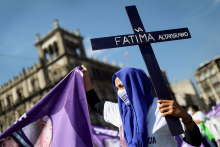
Holding aloft crosses bearing the names of murdered women, hundreds of people marched in Mexico’s capital on Wednesday to protest violence against women amidst a steady nationwide increase in femicides.
Chanting “we are your voice,” organizers used megaphones to read out the names of murdered women in downtown Mexico City.
The “Day of Dead Women” march took place a day after Mexico’s national holiday Day of the Dead. About 500 people took part in the protest, according to a Reuters witness.

“He’s placed on an emphasis on women’s role in the church that is fast being questioned, even in the confines of the present-day convention, as that letter signed by women asking for something to be done attests,” Leonard said. “These were not moderate, liberal women. These were women who came of age in the SBC and who challenged his particular theology of marriage and spouse abuse.”

The letter was published May 6 in the wake of a video of Patterson making objectifying comments about a teenage girl in a 2014 sermon and the surfacing of an audio recording of Patterson advising victims of domestic violence not to divorce their spouses.

THE TONYA HARDING saga was a Great American Novel of the 1990s waiting to be written—equal parts Theodore Dreiser and Three Stooges. Harding was the impoverished striver who muscled her way to the top of the hoity-toity world of women’s figure skating, only to be disgraced when her ex-husband’s buffoonish associates carried out a bizarre assault on a rival skater, Nancy Kerrigan.
The film I, Tonya delivers this story well, both as tragedy and as farce. It shows us the particular violence of frustrated hopes, malnourished emotions, and internalized self-hatred that passes from generation to generation like a plague in the lives of poor white people in America.
In 1972, when Tonya Harding was 2 years old, sociologist Richard Sennett and Jonathan Cobb published a book called The Hidden Injuries of Class. That phrase kept running through my mind as I watched I, Tonya. Sennett and Cobb profiled white working-class Americans who felt the pain of being disrespected and looked down upon, yet couldn’t help blaming themselves for that fact. One of their interviewees remarked, “I really didn’t have it upstairs to do satisfying work.”
Less than two years after Sennett’s book arrived, LaVona Golden, a foul-mouthed, chain-smoking wraith of a waitress (played by Allison Janney), intimidated a WASPy skating teacher into taking her daughter Tonya as a student. From that point on, in the movie, the girl’s life is blur of skating and abuse. Her mother torments her into giving her best on the ice, but comes up empty on empathy or affection. And the abuse gets physical. As a teenager (played by Margot Robbie), Tonya moves out to live with her boyfriend and ex-husband-to-be, Jeff Gillooly, and he hits her too.

And I am quite sure, based on what I’ve seen in my church, that Mormon women who are abused are not always likely to be believed, and that bishops are untrained in how to deal with abuse – both of which make women less likely to come forward at all.

The report estimates that an average of 23-27 honor killings occur every year in the United States, and suggests that 513,000 women and girls are at risk of FGM. These are horrific acts of violence against women. But simply preventing immigrants from entering the U.S. won’t stop these acts. If the Trump administration is serious about combating these abuses against women and girls, it would be funding education initiatives, preventative programs, and resources designed to help survivors. But that isn’t where the administration is putting money, suggesting their goal isn’t to stop these acts from happening — it’s simply to make sure these violent acts against women happen somewhere else.

It’s important for the church to get involved, it says, because Christians believe all people are created in the image of God, meaning violence against women is violence against God.

"It became apparent that in some areas, the accusations of sexual aggression were being taken seriously and people were being held accountable ― except for our president,” Leeds said. “We’re at the position now where in some areas of our society, people are being held accountable for unwanted behavior, but we are not holding our president accountable for what he is and who he is."

“He is nothing but a godly man trying to make this country come to its senses because of liberals and the other side of the fence trying to protect their evil ways,” an evangelical supporter of Moore recently told a reporter at Jackson, Ala.’s Walker Springs Road Baptist Church.

If our supposedly secular culture leaps at revelations of hypocrisy, that’s because the concept is deeply embedded in the Abrahamic tradition. The early Hebrew prophets like Amos and Isaiah were all about denouncing demonstrations of piety and religious observance as worth nothing in the absence of righteous behavior.

"I will probably be back next week and the week after that forever and ever,” Strong concludes, “because this isn't just a scandal. It didn't just start this week. It's just actual reality for half of the population.”
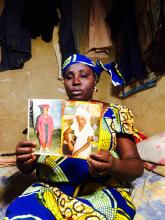
Too often in the biblical witness, violence against women and girls focuses disproportionate energy on the feelings and actions of men. King David is furious. Absalom feels hatred. And the desolate Tamar is instructed to be quiet. Her rapist was, after all, her kinfolk, her half-brother, a member of her tribe.

Rape. Domestic Violence. Acid Burnings. Female Infanticide. Human Trafficking. Emotional Abuse. Sexual Harassment. Genital Mutilation. These are just a few forms of sexual and gender-based violence (SGBV) that women and girls endure on a daily basis. But these assaults on the human spirit and sacred worth of women and girls will not have the last word.

When Baltimore Ravens running back Ray Rice was suspended for only two games for beating his fiancée (now wife), it became a dramatic public example of the lack of accountability for professional athletes. Only when a video came out showing Rice punching his fiancée so hard it knocked her unconscious, and then dragging her limp body from the casino elevator, did the NFL take further action. As new incidents of domestic violence and child abuse come out, many are calling for Commissioner Roger Goodell to resign or lose his job.
But this epidemic is about so much more than Goodell, whose lack of leadership is typical in professional sports. It’s about more than one team, one league, or sports in general.

It was 2006’s “The God Delusion” that many credit with sparking a growing interest in atheism in the U.S. Along with best-selling books by the other members of the “Four Horsemen” of atheism—the late Christopher Hitchens, Sam Harris, and Daniel Dennett—Dawkins’ rising star mirrored the growth of atheism in the last decade.
In 2012, the Pew Research Center found 5.7 percent of Americans identified as either atheists or agnostics, up from 3.7 percent in 2007.
“Richard Dawkins has done a lot to bring atheism to a whole new generation,” said Phil Zuckerman, a sociology professor who studies atheism and who also credits Dawkins with speaking out against the pedophilia scandal within the Catholic Church. “On the other hand, Dawkins seems to embody everything that people dislike about atheists: He is smug, condescending and emits an unpleasant disdainfulness. He doesn’t ever seem to acknowledge the good aspects of religion, only the bad. In that sense, I think he doesn’t help atheism in the PR department.”
One of Dawkins’ biggest missteps came in 2011, when he blasted Rebecca Watson, a young atheist activist who wrote about feeling sexually harassed at a freethought conference. In a now infamous series of comments posted to the blog Pharyngula, Dawkins wrote in a message titled “Dear Muslima,” “Stop whining, will you? ... For goodness sake grow up, or at least grow a thicker skin.”

The women were there at the foot of Jesus’ cross.
The women were there when they laid him in the tomb.
The women walked through the desolate graveyard in the darkest hours of the night — the hours just before dawn, carrying sweet spices prepared to anoint Jesus’ dead body for proper burial. But they never got the chance.
They witnessed the earthquake, talked to the angel, and ran to the other followers announcing the resurrection of their beloved.
And Jesus’ mother, Mary, huddled in the upper room praying with the other women and the rest of the disciples in the days following the resurrection. Until that day, 50 days later, when tongues of fire fell on them all and Peter reminded the crowd of Joel’s ancient prophecy: “Your sons and daughters will prophesy.”
From the cross to the upper room, the women are lifted up! As the church stands in the light of Easter Sunday and now sets its face toward Pentecost, let us remember the women. And, as we do, let’s also remember the women in our pews and surrounding communities — the challenges, fears, and the very real dangers women face every day.


Christian men - males who are caught up in the ancient, raw, and radical Jesus movement, this is to you:
It's high time we say something, do something - good Christian men, stand up. Women are being raped and sexually abused across the world, and we continue to theologically shrug our shoulders. It's just the way it is, we say.
Whether we want to admit it or not, we turn a blind eye to the ways in which our holy scriptures have sanctioned this throughout history.

Tomorrow is Valentine’s Day, our annual reminder to celebrate the love we share in our lives. While many may be struggling through aisles of candy hearts and bunches of roses, I invite you to flip this day of mandatory public expressions of love on its head.
What if, along with romantic dinners and expensive chocolates, we celebrated those we love by committing ourselves against sexual and domestic violence? This Valentine’s Day, or V-Day, Sojourners is joining with One Billion Rising to speak out on violence against women — the most hidden injustice in our world. We speak out because one in three women will be raped or beaten in their lifetime. That’s one in three women in my family, in my circle of friends, in my workplace — and in my church.
We speak out because we want a different reality for our daughters.
We speak out because our Christian faith tells us to lift up the voices others would silence.
And we speak out because we must rally our church leaders to commit themselves to do the same.

Caleb is a father in Africa. He works hard as a night watchman, and he and his wife save from their small income with the dream of sending their daughter to college. But the family’s dreams are destroyed when the police arrest Caleb on a random sweep for a robbery he had nothing to do with. This is not to say that the evidence against him was flimsy; there is no evidence against him whatsoever. The police needed to show an arrest had been made, and Caleb was an easy target … because he was poor.
Once in police custody, Caleb is viciously beaten. He is shaken down for bribes. And then, he is thrown in jail and charged with a capital offense. He is given no indication of when he might have a chance to prove his innocence – and even if he were, Caleb can’t afford a lawyer to help him. His family struggles to hang on without him.
What is perhaps most stunning about Caleb’s story is not the brutality (though it certainly is brutal), the singular unfairness of it all (though it is dramatically and utterly unjust), the hopelessness (though the story is obviously devastating). No, what is most stunning is just how ordinary Caleb’s story is.