Immigration
Despite the recent Supreme Court ruling on Arizona's immigration laws, the battle between legislators at the local and federal level is still raging, writes Adam Sorensen for Time:
"Last Tuesday, Chicago Mayor Rahm Emanuel held a press conference to announce that he didn’t want his city’s law-enforcement authorities to follow federal requests to hold some undocumented immigrants, picked up on other charges, for deportation. The national media’s ears perked up. Emanuel, a former Chief of Staff to President Obama, was at loggerheads with his old boss — good copy in the making. But on the same day, back in Washington, D.C., much bigger news was developing on the future of federal and local cooperation on immigration policy. John Morton, the director of Immigration and Customs Enforcement (ICE), told a House subcommittee that his efforts to persuade officials to honor any of ICE’s detention requests in the jurisdiction of Cook County, which includes Chicago, had hit a wall. 'I won’t sugarcoat it,' he said. 'I don’t think that approach is going to work in full.'”
Read more here
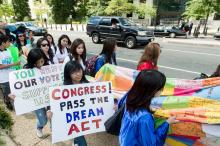
Spending time with family last week caused me to reflect on what it means to be an American and what it means to be family. I spent the evening of July 4th back home with family, half of whom are not U.S. citizens. We watched fireworks blast off above the Allegheny River in the hills of northwestern Pennsylvania—the place I grew up, and the place I will always call home.
But my life story actually begins in a country outside of the United States.
When I was a very young child, my parents decided a better future would likely be afforded for me in the U.S. Before an age when I could comprehend the situation and without my given consent, I was brought across the border into the United States.
I am a foreign-born, U.S. citizen who was adopted as an infant.
After announcing the Evangelical Statement of Principles for Immigration Reform, Sojourners asked Christians across the country to add their endorsement. More than 10,000 people have now signed their name!

Today, in a long and complicated ruling, the U.S. Supreme Court upheld the Affordable Care Act. This is an important victory for millions of uninsured people in our country and ultimately a triumph of the common good. Children, young adults, and families will have access to basic health care, adding security and stability to their lives.
While I believe the decision is reason to celebrate, it doesn’t mean that this legislation is somehow the flawless will of God; it is an important step in expanding health care coverage and reducing long term costs, but it still is not perfect and more work is yet to be done.
Many Christian organizations and people of faith were involved in advocating for expanded insurance coverage, specifically for low-income and vulnerable people. And that’s what we can never forget: our involvement in the world of politics is always based in and motivated by the way that it affects the lives of real people, and especially poor people.
This last week, I’ve watched the endless political pre-coverage of the Supreme Court decision, and I was struck first by the poor quality of the questions being asked. Now that the decision has been made, the pontification is just as bad. We need to be focused on those who are left out and left behind, not who is up or down in politics and the polls.

Even at 10 p.m., the dry heat caused the collapse of multiple people of faith gathered in a candlelight vigil outside Sheriff Joe Arpaio’s infamous tent city jail on Saturday evening. Earlier in the day, nearly 120 miles due south of Phoenix, the bodies of three immigrants who died of heat stroke were found. In one of those cases of tragic death, the man who collapsed was Guatemalan and his pregnant wife sat by his side.
Arizona continues to lead the way in the border humanitarian crisis and with immigrant rights violations. As a humanitarian, ally, and advocate, I came to the migrant justice movement with the belief that the U.S. immigration system and border policies were merely broken, but I am convinced now that these violations of human dignity are the symptoms of systemic racism targeted at immigrants.
The system is not broken, it is meant to break people.
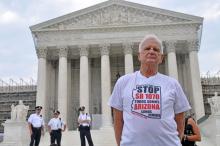
Both sides have been spinning and claiming victory in Monday’s Supreme Court ruling on Arizona’s now infamous immigration legislation SB 1070. Not surprisingly the Court ruled on the side of federal supremacy, striking down three out of four measures in the Arizona legislation, but upholding the right of local law enforcement to demand “papers” if they believe someone is undocumented.
Since the 2008 failure to move comprehensive immigration reform and last year’s disappointment on the Dream Act, the immigration reform movement has had trouble getting any “air-time” in a country that is rightfully concerned about financial recession. However, the 2012 election and a strategically placed Hispanic electorate in key swing states has candidates talking about immigration anew since the GOP primaries.
There has for some time been a larger strategy at play here that I will bluntly call “evil.”
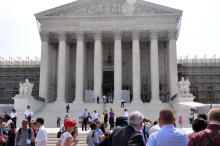
The recent ruling by the U.S. Supreme Court should put to rest any notion of North Carolina trying to enact an Arizona- or Alabama-style immigration bill. While we remain concerned that the ruling could leave the door open for legalized racial profiling, the Court has made clear that immigration policy and enforcement should be left up to the federal government.
States and localities are rightly turning away from these laws as divisive, costly, and ineffective. Instead, they’re looking for common-sense approaches that uphold our nation’s values and move us forward together. That means national immigration policy reform that creates accountability and a pathway to citizenship. It means laws that promote public safety and uphold due process and equal justice. And it means integrating new Americans into our economic engine and social fabric, including through English-language learning. Increasing numbers of states are rejecting divisive laws, and voters are rejecting politicians that promote them.
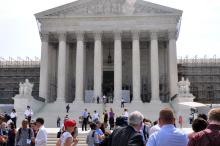
Brewer’s law had four legs. Now it has one—a lame one. The Supreme Court’s ruling was not a vindication of Brewer, rather it issued a death sentence for an unjust law. The law is not dead yet, but it may as well be a dead man walking.
Now, all eyes turn toward Congress.
Our U.S. Immigration system is still broken and something must be done. The Supreme Court has made it clear, that action must come from Congress. Now is the time for comprehensive immigration reform. Now is the time to declare, in concert with the Evangelical Immigration Table and the thousands of people who have signed the Statement of Principles for Immigration Reform, released two weeks ago today: “We call for a bipartisan solution on immigration that:
- • Respects the God-given dignity of every person
- • Protects the unity of the immediate family
- • Respects the rule of law
- • Guarantees secure national borders
- • Ensures fairness to taxpayers
- • Establishes a path toward legal status and/or citizenship for those who qualify and who wish to become permanent residents”
For CNN, Allison Brennan writes:
"After two years of protests, boycotts and lawsuits over Arizona's immigration law, Monday's Supreme Court decision leaves the state of immigration reform almost unchanged with states frustrated and Congress avoiding the debate. "I would guess [Congress] won't touch this with a 10-foot pole until after they come back after the election," Charles H. Kuck, managing partner at Kuck Immigration Partners in Atlanta, told CNN."
Read her full analysis here
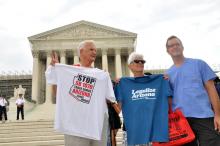
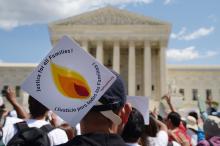
Today, as I stood on the steps of the U.S. Supreme Court eagerly following Arizona’s SB 1070 ruling, I had the opportunity to interview some advocates of the immigration reform movement.
The message that seemed to resonate among those present was that athough three of the four provisions were struck down, the fourth —the so called “show me your papers” clause — is very harmful to communities. It allows racial profiling on the basis of appearance. Even though there might be limits on how this last provision is implemented, those who feel they have the legal authority to enforce laws might feel compelled to use this piece as an excuse to discriminate.
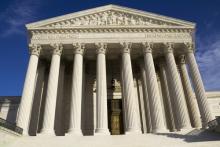
Today the Supreme Court struck down three central provisions of Arizona’s controversial anti-immigrant law, SB 1070. Attempts by Arizona to force immigrants to carry identification, create legal penalties for undocumented workers seeking employment, or detain individuals solely based on suspicions about their immigration status were ruled to interfere with the federal government’s right and responsibility to set immigration policy.
The Court let one section, known as 2(B), to stand, which allows law enforcement to check the immigration status of individuals apprehended for non-immigration offenses, if law enforcement has a “reasonable suspicion” that the person violated U.S. immigration laws in entering the country. (Read more on concerns about the racial profiling measure HERE.)
The Supreme Court on Monday struck down large portions of the controversial Arizona anti-immigrant law SB 1070.
In the decision—with Justice Sonia Sotomayor in favor—the Supreme Court struck down three major pieces of the legislation including provisions that made it illegal for immigrants to fail to carry immigration papers and a crime for undocumented immigrants to seek employment. The court also struck down the ability of police officers to arrest someone based solely on suspicion of legal status.
The most divisive provision of the law—requiring state and local police to inquire about a person's legal status when stopped in process of another offense—was upheld.
This is breaking news. Please check back for updates and analysis.
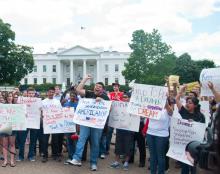
Dreams came alive today as President Obama granted relief to thousands of undocumented students. While the decision does not create a pathway to citizenship, it eliminates the threat of deportation for many unauthorized students and makes them eligible for work permits.
Sponsored by Casa de Maryland, a number of organizations—Amnesty International, Jews United for Justice, 32BJ SEIU, National Council of La Raza, and the National Gay & Lesbian Taskforce—participated in a rally in front of the White House to celebrate the president’s announcement.
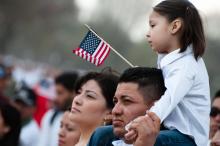
Within the next couple of weeks the Supreme Court will rule on the constitutionality of Arizona’s anti-immigrant law, SB1070, which mandates racial profiling by police officers and deputizes them to act as an extension of ICE (U.S. Immigration and Customs Enforcement).
Since the passage of SB1070, states across the country have introduced copycat measures into their state legislatures. Chief among them was Alabama’s HB658—the most draconian measure of them all. The crafters of HB658 intentionally pushed immigrants to the point where life was so miserable in their state that they chose to “self-deport.”
This week our nation is witnessing a new level of low. Even as we await the Supreme Court’s ruling on states’ rights to pass their own immigration laws, some Senate Republicans are arguing for two sets of federal legislation even worse than the state bills. These new federal bills aim to take money and food from children—American children.
Earlier today, the White House announced a change to deportation enforcement that would grant work permits to certain young undocumented immigrants. President Barack Obama spoke in the Rose Garden this afternoon, explaining his position, and pointing to a lack of Congressional action on the DREAM Act.
See the President's comments below:
According to the Associated Press:
"The Obama administration will stop deporting and begin granting work permits to younger illegal immigrants who came to the U.S. as children and have since led law-abiding lives. … The policy change, described to The Associated Press by two senior administration officials, will affect as many as 800,000 immigrants who have lived in fear of deportation. It also bypasses Congress and partially achieves the goals of the so-called DREAM Act, a long-sought but never enacted plan to establish a path toward citizenship for young people who came to the United States illegally but who have attended college or served in the military."
Jim Wallis, president and CEO of Sojourners, has been at the forefront, pushing for changes to immigration policies that rip apart families. Wallis released the following statement on Friday:
“The announcement from the White House today is very good news for 1 million young people who have a dream of staying in the country where they have lived most of their lives. Instead of being placed in the deportation pipeline, they will receive work permits enabling them to contribute to the nation and help build America’s future. This is an important step but only a beginning toward comprehensive reform of an utterly broken immigration system. This week a very broad and deep table of Evangelical leaders called on the political leaders of both parties to fix that broken system and protect ‘the stranger’ whom Christ calls us to defend. As Evangelicals we love the ‘good news’ of the gospel, and today we affirm this good news that gives hope and a future for young immigrants who are an important part of both the church and this country.”
A year after publically admitting his status as an undocumented immigrant, journalist Jose Antonio Vargas writes for Time Magazine:
"There are an estimated 11.5 million people like me in this country, human beings with stories as varied as America itself, yet lacking a legal claim to exist here. It’s an issue that touches people of all ethnicities and backgrounds: Latinos and Asians, blacks and whites. (And, yes, undocumented immigrants come from all sorts of countries like Israel, Nigeria and Germany.) It’s an issue that goes beyond election-year politics and transcends the limitations of our broken immigration system and the policies being written to address them."
Read more and follow Time's coverage here

Tuesday was a big day.
Nearly 150 evangelical leaders signed onto an “Evangelical Statement of Immigration Reform.” Signers came from across the spectrum of evangelicalism including leading Hispanic evangelical organizations, to pastors such as Max Lucado, Bill Hybels, Joel Hunter, and Jim Daly, president of Focus on the Family.
No, that isn’t a typo. Sojourners stood side by side with Focus on the Family to draw attention to the plight of millions who have been caught up in our broken immigration system. It was exciting to see such unity across the traditional political spectrum that rarely happens in Washington.
Make no mistake, there are still big gaps in theology and politics among those in this group. But Tuesday wasn’t about politics. Rather we focused on the things we agreed were fundamental moral issues and biblical imperatives. This coming together to help fix a broken immigration system on behalf of those who most suffer from it is just what politics needs and could begin to affect other issues, too.
Instead of ideology, we came together because of morality and common sense. And that’s what leaders are supposed to do.
From The Atlantic, a plea for an immigration policy that encourages the movement of high-skilled foreign nationals to the United States:
In this age of extreme polarization, it seems unlikely that there would be an issue where the benefits were so large and the correct course of action so clear that it would unite liberals and conservatives, allowing Democratic and Republican congressmen to pause in their struggle and rocket it through Congress. But it is not wishful thinking. There exists such a policy. The United States must admit many more high-skilled immigrants.
Read the full article here

My second grader helped me understand that the story of Harriet Tubman is still being lived out today in the lives of Latino families in my school and across the country.
Mary Bauer and Sarah Reynolds authored the report “Under Siege: Life for Low-Income Latinos in the South for the Southern Poverty Law Center.”
They explain, "Latinos in the South—many of whom came here to escape crushing poverty in their home countries—are encountering wide-spread hostility, discrimination and exploitation."
This report helps us understand the struggle for life that many of our Latino students take on, a clandestine struggle like the one Harriet Tubman made all those years ago.