Genocide

At the beginning of 2026, President Donald Trump said that his New Year’s resolution was to accomplish “peace on earth.” As he asserted last year with his aggressive campaigning for the Nobel Peace Prize, and the White House dubbing him “THE PEACE PRESIDENT” on X, Trump was convinced that he would be the one to fulfill it with “no new wars.” But just two days after issuing this resolution, Trump had Venezuelan President Nicolás Maduro kidnapped.
It is a pattern that has continued deep into 2026—promises of “peace” followed by bloodshed and violence. In January, Trump announced the Board of Peace, an international effort to “stop generations of hatred and bloodshed.” A month later, a joint U.S.-Israeli airstrike hit an Iranian all-girls elementary school as a result of outdated intel, killing at least 168 people, most of whom were children.
On April 7, Trump threatened the people of Iran if the government refused to reopen the contested Strait of Hormuz, a trade route through which about 20% of the world’s oil passes. “A whole civilization will die tonight, never to be brought back again,” Trump threatened on his social media platform.
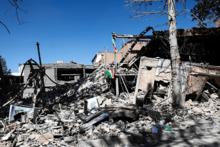
Iran showed no sign of accepting Donald Trump’s ultimatum to open the Strait of Hormuz by the end of Tuesday, while the U.S. president threatened that “a whole civilization will die tonight” unless Tehran reached a last-minute deal.
Trump has given Iran until 8 p.m. in Washington—3:30 a.m. in Tehran—to end its blockade of Gulf oil, or he will destroy every bridge and power plant in Iran. Iran says it would retaliate against U.S. allies in the Gulf, whose desert cities would be uninhabitable without power or water.
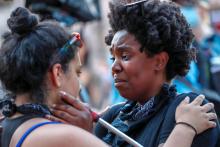
Our shared planet is crumbling under the weight of human greed and exploitation; our neighbors are being snatched up and disappeared from our communities; and money for jobs and education is being used to fund wars and genocide. And I’m expected to believe that God is good?
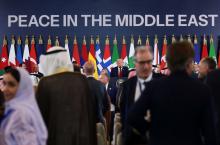
In Palestine, we welcomed the news of a ceasefire with hope—a fragile, trembling hope. After months of unbearable horror, we allowed ourselves to exhale. For the people of Gaza, it meant a pause in the killing, a night of uneasy quiet, and the possibility of sleep without bombs.

Last weekend, I visited my home state of Illinois to attend the Church at the Crossroads conference, which was held at Parkview Community Church in Glen Ellyn. Conference organizers estimated that 580 attended in person and 300 more joined virtually. The conference was convened to encourage American evangelicals to listen to Palestinian Christians and to confront and correct those who use scripture to “justify war, occupation, or silence” in the face of the escalating violence in Israel and Palestine.
Practically speaking, though, what was the point of this shindig?

The Fantastic Four: First Steps starts out with a trade proposal of the highest stakes. Galactus, the world-eating villain of Marvel’s latest reboot, will spare the Earth from his insatiable hunger in exchange for one child.
The child on the cosmic bargaining table is Franklin, son of Reed Richards, aka “Mister Fantastic” (a subdued Pedro Pascal) and Sue Storm, aka “The Invisible Woman” (Vanessa Kirby, who really gets to shine as the Fantastic Four’s leader).

Indie Imago Dei
In the title track of his new album, People Watching, indie rocker Sam Fender sees the face of God in the strangers he passes: “Envious of the glimmer of hope / Gives me a break from feeling alone / Gives me a moment out of the ego.” Polydor Records
Prophetic Dispatches
One Day, Everyone Will Have Always Been Against This is a lament and rallying cry from Egyptian-Canadian journalist Omar El Akkad. With honest prose, he debunks American “fiction[s] of moral convenience,” including ideologies that fuel U.S. support of a genocide in Palestine. Knopf
Saints and Sinners
Characters in Jared Lemus’ debut collection, Guatemalan Rhapsody, are as broken and beautiful as their country. Among them are a band of thieving siblings, who justify their crimes by invoking Saint Dismas: “He stole because he had to ... and God forgave him.” Ecco
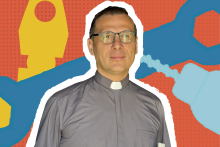
When I visited Rev. Munther Isaac in Bethlehem, the West Bank, in October, he mentioned that he was previously opposed to liberation theologian James H. Cone. Isaac was trained in theologically conservative teachings, growing up in a conservative church and then leaving Palestine to attend a conservative seminary in the U.S.
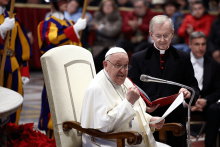
An Israeli government minister criticized Pope Francis on Friday for suggesting the international community should study whether Israel’s military offensive in Gaza constitutes a genocide of the Palestinian people.
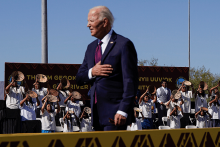
“This to me is one of the most consequential things I’ve ever had an opportunity to do in my whole career,” Biden said in his apology at an outdoor football and track field in Laveen Village, Arizona, near Phoenix. “It’s a sin on our soul. ... I formally apologize.”

Ruth Padilla DeBorst told her audience: “There is no room for indifference toward all who are suffering the scourge of war and violence the world round, the uprooted and beleaguered people of Gaza, the hostages held by both Israel and Hamas and their families, the threatened Palestinians in their own territories, all who are mourning the loss of loved ones.”
Less than 48 hours later, the director of the Fourth Lausanne Congress emailed all attendees, issuing a lengthy apology for Padilla DeBorst’s speech.
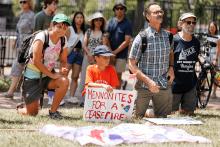
Starting on Thursday, July 18, between 35 and 125 Mennonites and interfaith allies from the U.S. and Canada made steady progress on their 11-day, 141-mile “All God’s Children March for a Ceasefire” trek from Harrisonburg, Va., to Washington, D.C. Upon arrival in Washington on Sunday, July 28, the marchers urged Congress and President Joe Biden’s administration to support an immediate, permanent ceasefire, the release of all hostages and political prisoners, an end to military aid to Israel, and a political solution that ends the occupation of Palestine, ensuring peace for Palestinians and Israelis. And on Tuesday, July 30, 46 of the people were arrested by Capitol Police during a protest.

“I have friends and family who lost people in the attack by Hamas on Oct. 7. I have colleagues and friends in Gaza who were bombed by the Israeli attack. I go to demonstrations against the genocide in Gaza because I want to be with others that shout and call for the immediate stop of this unforgivable crime. And I cannot chant all the chants in those demonstrations. I chant some of them.”
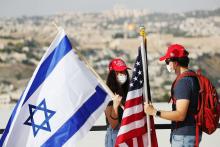
Like many across the world, the events in Israel and Palestine have had me glued to a wide variety of sources in search of live updates. My first reaction was to message my dear friends living in Israel-Palestine to check on them and their families’ safety: Sami, Mohammad, Jehad, Feras, Jack, Miriam, and Naama. My heart is tremendously heavy with the immense loss of precious life that has already unfolded and the dread for the violence still to come. I say this sorrowfully and without an ounce of callousness: This attack by Hamas, though sudden and horrific, did not come as a surprise to me.

“We had a prayer meeting [Monday] morning with dozens and dozens of people from all different traditions, from bishops to people sitting in the pews,” Cannon told Sojourners. “We’ll have another prayer gathering on Wednesday morning. We’re grieving, we’re lamenting, and we’re also working really hard.”

MY JOURNEY WITH the Uyghur people began in 1985 when I accepted a teaching position at Xinjiang University in Urumqi, a regional capital on China’s far western border. My wife and I made many friends during our seven years there. The Uyghur, an ethnic Turkic people of 12 million, are predominantly Muslim and live in the only Muslim-majority area in China, called the Xinjiang Uyghur Au-tonomous Region (by China) or East Turkestan (by the Uyghur and Kazakh peoples).
In 2017, we were greatly distressed to hear credible reports that the Chinese government was interning citizens in (what the government calls) “reeducation” camps. As many as a million people have been detained in 300 to 400 facilities in Xinjiang prov-ince, according to the Australian Strategic Policy Institute, including “political education” camps (part of a 70-year program of forced cultural assimilation), pretrial detention centers, and prisons. Detainees are subjected to torture, cultural and political in-doctrination, and forced labor. The U.S. Holocaust Museum says this state-sponsored violence meets the threshold for genocide and crimes against humanity. Friends and colleagues have disappeared.
In May, I met Uyghur poet, linguist, and human rights activist Abduweli Ayup on a Zoom call. Ayup spent 15 months in Chinese prisons for his defense of Uyghur linguistic culture. On our call, he told the terrible story of his failure to save from the camps his 30-year-old niece, Mihriay, who taught Uyghur children in the Chinese education system.
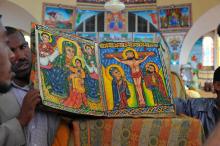
As a Tigrayan and a Christian, I want to know why my fellow Christians who claim to worship the Prince of Peace have engaged in legitimizing violence and death. How do you start with the theology of the gospels — which teaches us to love our enemies, to be peacemakers and to suffer with those who suffer — and end up with a theology that endorses war, rejoices in massacres and destruction, and brands critics as sub-human? Tigrayans are created in the image of God.

Like other teams that have mascots that they claim “honor” Indigenous peoples, many Chiefs fans proudly sport their headdresses and tomahawk chops, perpetuating the stereotypes that we are primitive people who either no longer exist or only exist as savage warriors.

Interestingly, the ambit of 'flashbulb memory' provides insight into cases where courts have failed to prosecute crimes of sexual violence — those hearings took place years after the actual event. In those years, memories we thought to be foolproof had deteriorated as survivors battled trauma, tragedy, and time. As testimonies were vetted for reliability, misconceptions around memory articulated through each step of the legal processn and increased the probability of a miscarriage of justice.

The Sudanese revolution is half-complete. On April 12, merely 24-hours after they had gotten rid of Omar al-Bashir, their dictator of 30 years, the Sudanese people were still out on the streets. They are out today too.