Jon Gromek currently serves as Central Regional Organizers for Bread for the World, a Christian voice urging our nation’s decision makers to end hunger at home and abroad. He has organized and worked throughout faith communities both in Washington DC, Ohio, and Florida for over 10 years. He holds a degree in Theology and Political Science from Xavier University in Cincinnati and is currently pursuing a graduate degree at Wright State University. He has worked at the Catholic Campaign for Human Development, Sojourners, Network, a National Catholic Social Justice Lobby, and as a community organizer for congregation based community organizations in Ohio and Florida in the DART Network. He is active in the life of his local church community serving as an officer on the Parish Council of Annunciation Greek Orthodox Church in Dayton, OH. He and his wife Colleen live in Dayton, OH.
Christianity
3-19-2014
The first time I heard the phrase “Nones” was from my friend Jim Wallis, who wrote about the release of a Pew Forum study documenting the growing number of people who responded “none of the above” when asked about their religious affiliation. As I wrote in a response back then, “Calling people ‘Nones’ is a mistake.”
I’m even more convinced of this now — and I think it’s especially a mistake for Christians to adopt this moniker. Here’s why:
3-18-2014
Renowned theologian Walter Brueggemann observed in a Sojourners article, "Lent is 'Come to Jesus' Time": "Lent is a time for fresh decision-making about reliance upon the God of the gospel. Such decision-making in Lent is commonly called "repentance." It's a time to reflect on the way in which God gives new life that is welcome when we recognize how our old way of life mostly leaves us weary and unsatisfied. Lent is a time to face the reality that there is no easy or "convenient" passage from our previous life to a new, joyous life in the gospel. The move is by the pattern and sequence of Jesus' own life, an embrace of suffering that comes with obedience, a suffering which comes inevitably when our lives are at odds with dominant social values."
3-03-2014
“Sojourners” has an important interview this month with Cynthia Bourgeualt.
Here are two excerpts. But the whole thing is worth reading at: http://sojo.net/magazine/2014/02/pursuit-wholeness
Bob Sabath: What need is your vocation responding to in the world today?
3-03-2014
"Offering your child to God is a way of offering yourself to God again, and it felt that way to me. For the religious and not, there is a powerful spirituality in the birth of a child. Already, we're learning a little about the unconditional love of God for us in the way we feel about our own child. Through one of the most universal human experiences, parent after parent is taught the lessons of love and life. And all is grace." - Jim Wallis, following the birth of his son, Luke
3-03-2014
Jim Wallis, president and founder of Sojourners, and best-selling author of books such as “God’s Politics.”
Stephan Bauman, president and CEO of World Relief, an international organization with 4,000 staffers and 40,000 volunteers.
2-28-2014
Lisa Sharon Harper, Sojourners’ director of mobilizing, was the founding executive director of New York Faith & Justice—an organization at the hub of a new ecumenical movement to end poverty in New York City. In that capacity, she helped establish Faith Leaders for Environmental Justice, a citywide collaborative effort of faith leaders committed to leveraging the power of their constituencies and their moral authority in partnership with communities bearing the weight of environmental injustice. She also organized faith leaders to speak out for immigration reform and organized the South Bronx Conversations for Change, a dialogue-to-change project between police and the community.
2-28-2014
This very helpful book grew out of a nine-month conversation among six politically diverse Christians at Respectful Conversation.net. The convener, Heie, summarizes it here, taking up in turn a series of contentious issues ranging from immigration, gun control, and abortion to a variety of foreign policy questions, noting where there is common ground and where there are sharp differences. The six participants—Amy E. Black, Paul Brink, David P. Gushee, Lisa Sharon Harper, Stephen V. Monsma, and Eric Teetsel—model the overarching commitment to "respectful conversation" even as they disagree.
2-28-2014
“Not all liberal churches are MTD,” says a reader, who sent me this article from the leftie Christian site Sojourners, in which writer Stephen Mattson lists “7 Things Churches No Longer Do, But Should.” Excerpt:
2-28-2014
My friend Jonathan Merritt and Kirsten Powers co-penned a piece on the Daily Beast titled, “Conservative Christians Selectively Apply Biblical Teachings in the Same-Sex Marriage Debate.” Their essay, written in opposition to the Arizona legislation allowing companies to refuse service to same-sex couples on religious grounds, is fair and even-handed. In fact, if anything, it’s too safe.
2-20-2014
In a piece over at Sojourners, Jamie Calloway-Hanauer notes that
Steinem frequently speaks of the effects of religion on the feminist cause.
Evan Dolive 2-19-2014

'Love' written on window in the rain, Wolf__ / Shutterstock.com
Let’s face it: we are an opinionated society.
We have entire television channels and radio stations dedicated to the propagation of one particular way of thinking. Some people like this channel because they are “more liberal” while others like this channel because they are “more conservative” and the rest of the world falls into the trap that we can be objective (read: ‘fair and balanced’).
We seek out opinions from everything from a new toaster to the new medical center in the area. We want to know people’s experiences about something before we waste our time, money and energy on a futile venture. If a product on Amazon has too many “one-star” reviews I am not going to purchase it. If my friends or family members have a bad experience at a restaurant or store then I will think twice about going there myself.
Sharing our opinions or perceptions is never easy. They can be met with great disdain or hostility. ESPN prides itself on these conflicts. Its marketing plan is to put four talking, opinionated heads in a room and ask a question that none of them can agree on like “Who is the greatest basketball player of all time?” or “Is Tom Brady overrated?”
Some of the greatest conflicts in the world’s history have been over difference of opinion. Governments have been shut down over difference of opinion. Trying to “change” someone’s opinion is hard if not impossible; for some people the “damage” is done and there is no turning back.
The church is not immune to this to this.
2-07-2014
How can we do this? This article from Sojourners, written by a fitness coach, is a little bit strident, maybe, but it speaks of the need for churches to consider our task of making disciples more seriously, and then “get to work” doing it, instead of just talking about it.
2-04-2014
It’s a tired trope that evangelicals only recently began caring about “social justice,” a buzzword that carries connotations of political activism and “the social gospel.” In fact, orthodox Christians have long recognized in Scripture a call to defend and uphold the dignity and well being of all persons, especially the poor and powerless. Take, for example, John Wesley, who led prison reform and abolitionists movements in 18th-century England. More recently, evangelical leaders like Ron Sider and Jim Wallis have promoted Christian engagement in anti-war, environmental, and immigration causes, while facing suspicion of falling prey to partisan politics. At the local church level, sex trafficking, fair trade, and clean water campaigns are trendy ways today for lay Christians to fight social ills, even if that means simply clicking a “Like” button.
Julie Polter 2-04-2014
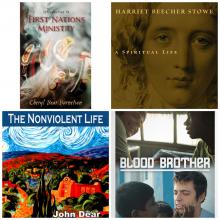
Faith and Reform
Writer and social reform Harriet Beecher Stowe’s controversial 1852 novel Uncle Tom’s Cabin brought many people to the anti-slavery movement. In Harriet Beecher Stowe: A Spiritual Life, biographer Nancy Koester illuminates the shifting role and expression of faith in Stowe’s personal and public life and work. Wm. B. Eerdmans
Falling into Love
A few years ago a young man named Rocky Braat left Pittsburgh to wander India; he’s ended up working for years in an orphanage for HIV-positive children there. His friend, filmmaker Steve Hoover, went to explore why. The result is a Sundance-award-winning documentary, Blood Brother. www.bloodbrotherfilm.com
Evan Dolive 1-27-2014

Child in the park, Dragon Images / Shutterstock.com
We don’t give children enough credit. They are infinitely smarter than we think. Children figure out things that most adults have trouble comprehending. I truly believe that my daughter came out of the womb knowing how to operate an iPad. She gets that finger swiping and she can navigate the world of apps and photos with more precision and understanding that people 20 times her age.
In the Gospel of Mark, we find these words of Jesus: “ I assure you that whoever doesn’t welcome God’s kingdom like a child will never enter it.” (Mark 10:15--Common English Bible). This verse is referenced when someone speaks that followers of Christ should have “faith like a child.” Generally, this is defined as “simple faith” or “faith without question.” This, however, is a misguided understanding.
Joe Kay 1-27-2014

Chick breaking out of a shell, S-F / Shutterstock.com
Have you ever watched a chick break out of its shell?
My first experience with hatching was at the poultry barn at the Indiana State Fair. The building is the temporary home for hundreds of chickens, ducks, geese, and pigeons each summer. And they make quite a ruckus. There’s a constant din of crowing and honking and cooing and whatever other adjectives you care to apply. Colorful feathers drift through the air.
As you walk through the front door, there’s a protected case for baby birds that have just hatched. And there’s an incubator full of eggs that are slowly being pecked and pushed apart by the little ones inside.
If you have some time, you can stand and watch a miracle unfold, peck by peck.
It takes hours for the chick to work its way out of the shell, sometimes an entire day. A 4-H volunteer sits by the incubator and records each chick’s progress during the exhausting escape from the shell into the greater world.
The chick has spent its entire life in its protective shell. But now, the nourishment of the yolk is all used up. The chick no longer fits comfortably inside the oval confine. It has no clue what lies outside the shell, but it knows instinctively that it has to break out or it will die.
Is that a good analogy for what we experience in our lives? Do we often find ourselves breaking out of shells?
Jon Huckins 1-22-2014

Theory v. action concept, art4all / Shutterstock.com
I was down in Mexico a few years ago for a gathering of peers who are leading faith communities around the world. It was a rich time of conversation, encouragement, and visioning.
Walking through a local Mexican neighborhood between sessions, something struck me. While those of us in the Minority World (often called the 1st or Western World) are thinking and talking about our theology, most of the folks in the Majority World (often called the 3rd World) have no choice but to simply live into their theology. Talking about our theology, faith, and practice in lecture halls, church buildings, and conference rooms is a luxury that the vast majority of Jesus followers in the world have no opportunity to participate in.
It’s not necessarily a bad thing, but it is reality. And those of us with this luxury better own up to it, because it is easy for us in the West to think we have a corner on the market of theology, which we then project (whether consciously or subconsciously) onto the rest of the world. But who's to say theology built in academia is any more valid than theology build in the realities of everyday life?
Stephen Mattson 1-22-2014
Holding hands, Mats Bergström / Shutterstock.com
Beyond the realm of churches, religious blogs, and bible colleges, nobody really cares about theology. What does matter is the way you treat other people.
Within Christendom, we’re often taught the exact opposite: that doctrines, traditions, theologies, and distinct beliefs are the only things that do matter. It’s what separates churches, denominations, theologians, and those who are “saved” and “unsaved.”
Historically, Christians have been tempted to categorize the Bible into numerous sets of beliefs that are either inspired or heretical, good or bad, right or wrong — with no room for doubt or questioning or uncertainty.
It’s easy to get caught up in theorizing about God, but within our everyday lives reality is what matters most to the people around us. Theorizing only becomes important once it becomes relevant and practical and applicable to our lives.
When I'm sick, and you bring me a meal, I don't care whether you're a Calvinist or Arminian
Mark Sandlin 1-21-2014

Man shouting, pio3 / Shutterstock.com
If any list has been overdone in the Christian blogging world, it's this list.
Just about every Christian blogger has done one, and if they haven't, they've thought about it and then thought better of it – because just about every Christian blogger has done one. (See what I did there?)
And yet, here we are.
You. Me. And my list of things Christians shouldn't say. Hmmmm – must be God's will. (And I just realized this list should have had 11 things on it. Oh, well. I have no doubt that it's on one of the lists out there!)