Christianity

On the road, listening to NPR's Terry Gross interview Lawrence Wright, author of Going Clear: Scientology, Hollywood and the Prison of Belief, and having recently spent two hours at the United States Holocaust Memorial Museum seeing the Nazis photographed, not in the usual black and white, but in the full colors of the natural world, it occurred that the human impulse to be part of an exclusive group has deep, powerful roots in religion.
People join "true churches" for this same impulse, a motivation that could not be further from the intention of the Gospel, which, at the heart of its mission, contains the abolition of exclusivity of any kind.
Christ following is not about joining the best club, but about following where Christ leads, straight into the company of every person, no matter their situation or circumstances, in order to be a servant to them, one who lays down his or her life, like Jesus, for the life of the world.
We were made for Communion with God and our neighbor, who Jesus tells us is every person.
Scientology, National Socialism, and other cults, past or present, religious or tribal, are modern forms of Gnosticism. They say, in varying ways, "We have something (usually 'knowledge') not publicly available to everyone and you must join us, submit to us, to participate in our secret." It's important to recognize that this is also an offer of power.
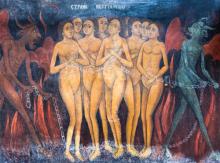
Yesterday, I discussed some of the historical bases for our contemporary understanding of Satan. Today, I’ll consider how hell evolved as part of the Christian faith.
In Old Testament scripture, the resting place for the dead is called Sheol. While some believe this is the same as hell, there are indications to the contrary. In the ancient Jewish tradition, Sheol is a place of rest for both righteous and wicked, with no distinction.
Not everyone is happy about it either.
In the third chapter of Malachi, the prophet recognizes the consternation of faithful Jews who are frustrated that the wicked share the same fate. In Ecclesiastes, the priest Koheleth claims that serving God is vanity. For him, the fact that the righteous are treated the same as the wicked and vice-versa should be a call to eat, drink and be merry.
With respect to any relationship between Satan in the Old Testament and Sheol, there is none.

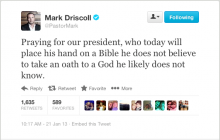
Rev. Mark Driscoll, founder of Mars Hill church, has a true gift. Just when I think I’m making at least a modicum of progress toward tolerance – if not actual Christlike love – toward the guy, inevitably he does something to make me despise him all over again.
On the Monday, before President Obama’s inauguration ceremony, Driscoll sent out the following message to his more than 300,000 Twitter followers:
Praying for our president, who today will place his hand on a Bible he does not believe to take an oath to a God he likely does not know.
As of Thursday morning, the tweet has received more than 3,400 retweets and nearly 1,350 favorites. Driscoll’s next tweet was about an iPad Mini giveaway.

It is an odd juxtaposition, December 21, 2012 and January 21, 2013. The former date representing the “so-called” Mayan apocalypse where the usual suspects prepared for the end of the world – many of whom were Christians awaiting the second coming of Christ – and the latter date, which is the day President Barack Obama will be inaugurated for his second term.
In my estimation, this odd 21st-century connection reflects the event known as the baptism of Jesus as described in Luke 3:15-17 and 21-22. Initially we see that there is an expectation elicited by the preaching prowess of John the Baptist. The unnamed “men” wonder in their hearts if “whether perhaps he was the Christ” (Luke 3:15 RSV). John, then goes on to describe what he understands to be Christ-like qualities when he proclaims, “[One] who is mightier than I is coming, the thong of whose sandals I am unworthy to untie” (Luke 3:16).

The only reason that I am Christian is because I am spiritual-but-not-religious.
Right. That's it.
Let me first say that in my own thinking, I don't separate these two things, religion and spirituality. I get that many do and I can see the rhetorical advantages to doing so. I just don't do so for any other reason than popular conversation has done so.
Here's why, and please forgive the autobiographical nature of this post. It's a testimony of sorts and dreadfully difficult to summarize. I'm pretty well convinced that I'm not all that unique in what I'm about to share. Also, if you have been paying attention (assuming you've known me for some time or been reading my blog) none of this should come as a surprise.
The only reason that I am Christian is because I am spiritual-but-not-religious.

“You’re a Christian? But you’re so nice!”
I’ll never forget these words, spoken to me by a friend of mine from my college’s theatre program. He was one of my more eccentric friends, more blunt than most, and he was also very openly gay. His exclamation of surprise may be the instance that I remember the most, but he certainly wasn’t the only person during my college years to express their surprise at the thought of Christians living by principles of love rather than intolerance, or at the very least, indifference.

I know this sounds totally bizarre, but I had a moment of clarity about the value of human life in, of all places, a kid-themed pizza joint yesterday. No, they don’t exploit their workers (that I know of, short of submitting them to overstimulated kids all day). It took a few steps for me to get there, so bear with me.
Yesterday, my daughter, Zoe, turned four years old. It’s a crappy time of year to have a birthday party, since lots of people are out of town, and those who are around are more or less partied out from the holidays. On top of that, we just moved here a few months ago and hardly know anyone. So to try and make up for all of that, we let her pick anywhere she wanted to go for dinner.
Not surprisingly, she picked John’s Incredible Pizza Company, which is like Chuck E. Cheese on steroids. Not high on my list of choices, but hey, it wasn’t my birthday. Zoe’s grandparents are in town and they invited a couple other family members who live nearby to join us. One of Amy’s distant cousins brought along her husband or boyfriend (still not sure which), and I remarked after the dinner to amy that he bore a striking resemblance to the alt-rock front man Perry Ferrell, of Jane’s Addiction fame.
“What ever happened to Perry?” Amy asked. Short of founding the Lollapalooza Festival and hitting every Coachella festival ever held, I had nothing. So I Googled him.

I sat behind a couple of folks on a plane to Seattle this morning who were discussing their distress about a so-called war on Christmas.
“Memorial Day is a holiday,” said the man in a santa hat with disgust. “July 4th and Thanksgiving are holidays. Christmas is, well, Christmas!”
“Absolutely,” nodded the woman next to him. “It’s just more evidence of this war against Christmas.”
On the way off the plane, a flight attendant made the grave mistake of wishing the man happy holidays. He stopped the line of outgoing traffic behind him (including me) to correct her. She demurred, looked toward her feet and smiled sheepishly.
We Christians have a long and storied history of playing the martyr, whether there’s actually anyone persecuting us or not.

I cannot
think that you don't
sound
or breathe
weep
or grieve
I will not
think that you don't
want
or ply
the cosmos
with love
or grace
seeking
us
lost again
I can believe
I can lose you
I can thwart you
I can set you up
I can watch you fall
to die
again
you breathe
weep
cry
sing
and I
am here seeking
better signs

Oh, ladies. Just when you thought we were emerging again from the sudden backtrack into 20th-century gender politics, this happened. (Before continuing, I warn: this is the most offensive bit of so-called Christian, “red pill” patriarchy that I have ever read.)
A blog post written on the website of the Christian Men's Defense League — yes, an organization dedicated to protecting the rights of white American Christian men is apparently a thing — blames Mitt Romney's loss Tuesday night on what the author brilliantly coins "the slut vote."
Hat tip to Gawker for finding the cached version of this post, as it was quickly locked down post-publishing. You can view snippets of all of author “BSkillet’s” witticisms HERE.
Most disturbing in this man's tirade against so-called "sluts" — and trust me, there's a lot in there to creep us out — is that he is doing so from a Christian perspective. The banner of the blog cites Psalm 144:1, "Blessed be the LORD, my rock, Who trains my hands for war and my fingers for battle."
The verse of choice is interesting, to say the least. I usually cringe when I hear terms like "war on religion," "war on women," etc., but if anyone is waging it, it's this guy.
There is so much here that completely defies logic, but I thought I'd pull out a couple of gems for our review.
EARLIER THIS year, the Interfaith Partnership of metropolitan St. Louis held a public panel presentation addressing three Abrahamic religions—Judaism, Christianity, and Islam—on war and peace. Members of Interfaith Partnership and interested people from the community filled the chapel at Eden Theological Seminary to hear a Jewish scholar, a Muslim academic, and a Christian theologian (me) offer brief presentations on how our respective faith traditions value peace, as well as why, when, and how each religion views the use of violent force as sometimes morally justified.
During the question-and-answer period, I highlighted how in recent years both nonviolent and just war Christians have worked together on an approach, known as just peacemaking, for dealing with the underlying causes of war and thereby preventing its outbreak. As is often the case when I talk on this topic, most persons in the audience seemed unfamiliar with just peacemaking. After I attempted to clarify it further, someone asked the panel if other religious traditions had anything comparable to just peacemaking. The answer is yes, at least for Judaism and Islam, as shown in Interfaith Just Peacemaking, edited by Susan Brooks Thistlethwaite, a theologian and ordained minister in the United Church of Christ.
The 10 proactive practices that have been empirically proven as realistic and effective ways for preventing many wars form the framework for Interfaith Just Peacemaking. They were first identified in Just Peacemaking: The New Paradigm for the Ethics of Peace and War, edited by theological ethicist Glen H. Stassen. That book’s 23 contributors (scholars and practitioners from multiple disciplines—theology, political science, psychology, and history—and from pacifist and just-war perspectives) shared concerns about how just war has devoted insufficient attention to dealing with catalysts that lead to conflict (and not making war truly a last resort) and about how pacifism has failed to offer clear guidance about practical alternatives to war.

SINGER-SONGWRITER Caroline Herring was completely naked when she truly found God.
Straight out of college, she spent three months as a missionary in China. “I was so ill-equipped,” she says now, over tea just before a show in Knoxville, Tenn. “The program was respectable—we weren’t Bible smugglers, but obviously we had an agenda.”
One of her students—a woman who had journeyed seven hours to attend English classes Herring was teaching with her fellow missionaries—took a liking to her and asked if she would leave the comfort of her air-conditioned room (with a private toilet) to join her students at the dirty, crowded bath-house, outfitted with several spigots in the ceiling. Herring believes it was a way to welcome her into their fold.
“And I felt like I was a part of humanity for the first time in my life,” Herring says, her face suddenly luminous. “My preconceived notions about the Trinity just slipped away. It was too much to comprehend, but I knew that the Holy Spirit was moving amongst us because we were people together, being kind to one another.”
Herring, now 42, says the experience changed her life. She left China a different, humbled person, with whole new ideas about what God, religion, and service were.
“I knew for sure that I had a lot more to figure out about my own place in the world before I had the audacity to spread the word of Christ across the globe,” she says.

Editor's Note: Anne Marie Roderick tells her story of why she's NOT part of the 20 percent of Americans who identify with "no religion in particular." Find more stories (or share your own) HERE. Read about the study HERE.
It’s not surprising that a third of my peers say they are religiously unaffiliated. Our religious lives are too complex these days to fit in neat boxes with one-word labels. I may be a “Christian,” but does that mean that I am like other Christians? Not necessarily.
There is sometimes more truth in being a “none” — in stating what we are not — rather than trying to pin down exactly what we are. But, I choose to affiliate anyway. Here’s why I am not a “none:"

 Editor's Note: Kevin Gonzaga tells his story of why he's part of the 20 percent of Americans who identify with "no religion in particular." Find more stories (or share your own) HERE. Read about the study HERE.
Three years ago when I arrived at seminary to pursue my calling to fulltime pastoral ministry, one would probably have struggled to find someone in my generation more committed to the ministry and vitality of the local church.
While imperfect, I believed the church was the best hope of the world, and it was better to stay and work toward change than abandon the church and look for greener pastures. A year and a half later, I wrote a blog post explaining that I was no longer a Christian. I fear that this would only deepen the stereotype that seminary is a place where people lose their faith, so I should explain.
The truth is I am one of growing number of people who choose not to affiliate with any organized religion. I am a “none,” and my journey to “none” started a long before I left for seminary. My disillusionment with, and eventual abandonment of, Christianity did not center around one traumatic event that shattered my faith, but rather it was something that coalesced from numerous experiences over a long time.
It really started when I began studying the scriptures for myself in college. I was shocked to find many things I had been taught by the Church were wrong, were not in the Bible, or were even contrary to what the scriptures actually taught.

Editor's Note: This is part one of a three-part series from Dr. Miroslav Volf an a voice instructing us how to involve our values into our present politcal debates.
In this year of presidential elections, I have decided to summarize key values that guide me as I decide for whom to cast my vote. There are three basic elements of choosing a candidate for public office responsibly:
- Values we hope the candidate will stand for and the order of priority among them (which requires of us knowledge of faith as a whole, rather than just a few favorite topics, and knowledge of how faith applies to contemporary life)
- Ways in which and means by which these values are best implemented in any given situation (which requires of us a great deal of knowledge about how the world actually functions and what policies lead to what outcomes — for instance, whether it would be an economically wise decision to try to reintroduce the gold standard)
- Capacity — ability and determination — to contribute to the implementation of these values (which requires of us knowledge of the track record of the candidate)
Most important are the values. As I identify each value, I will (1) name the basic content of the value, (2) give a basic rationale for holding it, (3) suggest some parameters of legitimate debate about it, and (4) identify a key question for the candidate.
I write as a Christian theologian, from the perspective of my own understanding of the Christian faith. Whole books have been written on each of these values, explicating and adjudicating complex debates. In providing a rationale for a given value, I only take one or two verses from the Bible to back up my position, more to flag the direction in which a rationale would need to go than, in fact, to strictly offer such a rationale.
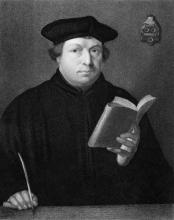
DURHAM, N.C. — Protestants have traditionally celebrated Oct. 31 as the anniversary of the start of the Protestant Reformation, a movement that divided Western Christendom and gave birth to such diverse religious groups as Lutherans, Presbyterians, Anglicans, and Mennonites.
On Oct. 31, 1517, an Augustinian friar named Martin Luther nailed 95 theses for debate on the door of the Castle Church in Wittenberg, Germany, and so sparked a religious reform even he could not control.
But Luther's public life actually began five years earlier, 500 years ago this week, on Oct. 19, 1512, when he finished his formal theological education and was installed as a professor of Bible at a relatively new and still nonprestigious Catholic university in Saxony.
No one, least of all his patrons, expected this soft-spoken young man with a tenor voice and a bubbling sense of humor to turn into a religious bomb thrower, whose theological convictions would alter the religious and political structures of Europe for five centuries. Indeed, no one could have been more astonished by this unexpected development than Luther himself.

[The "nones"] recite history and Christian leadership's collusion with the agents of empire-building and warfare. Then they say something like, “I'd rather live like Jesus than be a Christian.”
They see the Church as the rich young man and they wonder if anyone actually follows Jesus anymore.
Of course, this is not the only demographic shift at work in the religious life of the world.
There are more Anglicans in Nigeria than there are in England.
More Presbyterians in Ghana than in Scotland. ..
More Baptists in Southeast Asia than in the Southeastern United States.
More Christians go to church in China than in Europe.
In 1900, 71 percent of the world's Christians were in Western Europe. By 2000 that percentage dropped below twenty percent in some European nations.
Here's the real kicker: these are not problems to fix. They are simply realities to be faced.

It’s always annoyed me when people assume that, because I’m a Christian, I must also be socially conservative on all requisite issues. And while I understand those who lean further right because of their Christian beliefs, I take issue with those who suggest that being both a follower of Christ and a social progressive are mutually exclusive.
In fact, most of my positions on social issues can be traced back to my faith, which goes to show that the spectrum of beliefs taken from any given faith, as well as the many ways in which those beliefs are applied, is wide and arguably still growing as we continue to become increasingly pluralistic and intertwined.
Depending on your perspective, it could be argued that the landscape of presidential candidates either reflects such religious diversity, or that it’s still more of the same old majority rule at play, with a few minor cosmetic adjustments. For some, the fact that a Mormon is the Republican nominee is nothing short of astonishing, and what’s more, that the evangelical right is generally finding their way toward alignment with Mitt Romney’s presidential ticket.
It’s also worth noting that last week's vice presidential debate was the first time in history that we’ve had two Catholic VP nominees running against each other. The only fairly typical one in the group (unless you ask the Muslim conspiracy theorists, that is) is Barack Obama who is a member of the mainline protestant Christian denomination, the United Church of Christ.