ICE
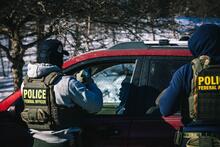
On Jan. 24, 2025, U.S. Border Patrol stopped Samuel Tunick at the Hartsfield-Jackson Airport in Atlanta and demanded to search his phone. Tunick was part of the “Defend the Atlanta Forest” movement in Atlanta, opposed to the development of a police training center dubbed “Cop City.” He has been charged with a felony for giving a customs officer a duress passcode that deleted the contents of his phone when the officer entered it. Not only is the case chilling because of the aggressive nature of the prosecution, but also because the federal government wants to assume characteristics that are typically reserved for God.
The point of government surveillance is not merely to know everything, but to fundamentally change what we do.
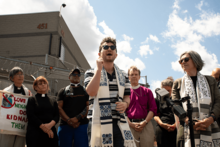
Walking into the Immigration and Customs Enforcement Delaney Hall detention facility in New Jersey, Rev. Robin Tanner quickly noticed that the windows were blocked off. Tanner, a Unitarian Universalist minister in Summit, N.J., pointed out one issue for people inside: “For many people in their faith tradition, [prayer] is a daily act,” she said. Muslims are instructed to face the city of Mecca during their five daily prayers, and a Muslim detainee wouldn’t have any way to know which direction to pray.
But for months, Amadou, a father and truck driver from Burkina Faso, whose full name Sojourners is withholding for his safety, struggled to convince guards to let him pray with other detainees at all. In Islam, Friday prayers, or salat al-Jumu’ah, are not only obligatory for every nondisabled man but are required to be performed in congregation. Amadou was detained 16 months ago and transferred to New Jersey last year. In Delaney Hall, it took four months for Amadou and other Muslim detainees to gain access to occasional gatherings for Friday prayer, finally prevailing in time for Ramadan.
ICE has a stated duty to provide spiritual care for those in its custody. According to ICE manuals, detainees must be provided with “regular opportunities to participate in practices of their religious faiths, limited only by a documented threat to the safety of persons involved in such activity itself or disruption of order in the facility.” As ICE continues to fail even its own guidance, a host of faith leaders have emerged to chip away at the agency’s spiritual blockade of those in its custody.
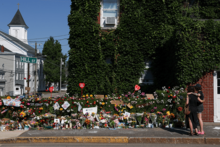
Bee Moorhead was surprised by the turnout at a July 7 press conference in San Antonio, calling for free and fair elections. The event was simple: a group of clergy, standing in front of San Fernando Cathedral on the city’s Main Plaza, announcing their intention to ask individual lawmakers to sign commitments to defend constitutional voting rights. Important work, she knew, but not usually the stuff of headlines. Moorhead has been organizing clergy around the state as executive director of Texas Impact for more than 20 years, and she said she’s accustomed to being all but ignored by the media and everyone else.
“Faith leaders all over the country, and certainly in Texas, keep speaking up and what comes back is, ‘Why aren’t you saying anything?’” she said. But suddenly, there were microphones and cameras. People were listening to what the group of interfaith pastors, imams, rabbis, and priests were saying about the need to protect voting rights. Something was changing.
Moorhead had launched the policy initiative and called the press conference in coordination with national interfaith organizing group Faith In Us, which formed after clergy from multiple faiths in Minneapolis and St. Paul took a visible role in the resistance movement during Operation Metro Surge. In January, when Immigration and Customs Enforcement was overwhelming the Twin Cities, clergy there began to call for sustained national mobilization of their peers. Faith leaders invited colleagues from around the country to come and train with community organizers and unions in Minneapolis.
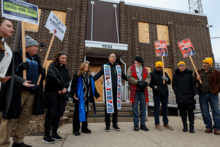
A federal district judge ruled that government authorities must allow clergy to minister to Broadview Processing Center detainees on Ash Wednesday this Feb. 18. The order, if followed, fulfills a year of organizing by Chicago area clergy to minister to detainees of Immigration and Customs Enforcement within the oft-protested facility.
The government and its officials substantially burdened the exercise of religion by the clergy group who brought the lawsuit and made no argument that the burden was “in furtherance of a compelling governmental interest, and that it is the least restrictive means of furthering that compelling governmental interest,” according to the injunction, written by Judge Robert W. Gettleman.
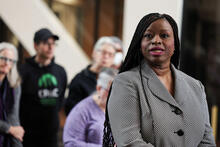
On Jan. 22, federal authorities arrested at least two organizers linked to a nonviolent protest inside Cities Church in St. Paul, Minn., that interrupted services at a congregation where one of the pastors doubles as the acting director of the Immigration and Customs Enforcement St. Paul field office.
Celebrating the arrests, Attorney General Pam Bondi vowed through a post on X: “WE WILL PROTECT OUR HOUSES OF WORSHIP 🙏🏻”.
Rev. Nekima Levy Armstrong, a Minneapolis activist and ordained minister, was one of the organizers arrested. Referring to ICE, she told the Canadian Broadcasting Corporation on Feb. 4 that “They have been physically brutalizing people, dragging people from their homes, kicking down people’s doors, coming into people’s homes with big guns, arresting people unjustly, even U.S. citizens, and people who are here legally.” She added, “To have someone serving as a pastor who is also overseeing these agents is unconscionable, unacceptable, and antithetical to the Christian faith.”
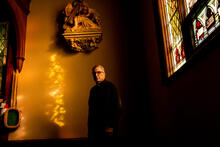
When Father Dale Korogi takes the podium to give the homily to the parishioners of the late morning Mass at Ascension Catholic Church in north Minneapolis, he is used to seeing hundreds of faces watching him—mostly the faces of immigrants from Latin America.
Now, he sees only a few dozen in the pews, as most of the immigrants in his congregation are staying home until the Trump administration withdraws the thousands of immigration agents who have been deployed in Minnesota as part of Operation Metro Surge.
The only time I heard my father speak Spanish was in prayer. Before dinner, he thanked God for the food we received and for our presence to each other in the language of his home country. He still does.
We lived in Minnesota from 1993 to 1999, and on wintry nights, when the wind chill might dip so low that Fahrenheit equaled Celsius, our meal was blessed with words that seemed out of place and yet essential to who we were—as prayer should.
At the time, the infrastructure of immigrant communities in Minnesota was only beginning to develop. The number of families from Southeast Asia and Somalia was just starting to increase; it was still far from the critical mass that would make possible civic and cultural organizations, restaurants, and stores, let alone political power. In my school, I recall no other families from Latin America. The local Mexican restaurant was Taco John’s.

t’s more than likely that you have asked yourself in the early parts of this new year, “What am I supposed to do?” As we watch the country slip further into the abyss of “papers please,” and witness Immigration and Customs Enforcement agents operating as though they are a death squad, it’s fair to feel overwhelmed; it’s fair to wonder if anything can be done at all.
Sometimes, the best thing to do during times of authoritarian rule is to pause and reflect. When we do this, we realize two things: First, there are many ways, both materially and emotionally, to support those who are being targeted by a regime. Second, although we, like the Apostle Paul in 1 Corinthians 15, may wonder if we are “one untimely born,” our existence is perfectly timed for this moment.
A resource to help those of us looking to pause and reflect so that we can take action is Hanna Reichel’s new book, For Such a Time as This: An Emergency Devotional.
Chaos fills the streets as families are separated by force, and mothers cry out as their children are taken from them. To exert control and maintain power, a ruler orders agents to detain people off the street. Those the ruler labels as “subversive” are treated as a threat to his reign. The violence is indiscriminate and unrelenting. It does not matter who gets hurt, as long as the ruler stays on the throne.
If your mind went directly to President Donald Trump or the news of Immigration and Customs Enforcement agents shooting and killing two Minnesota residents—mom and poet Renee Nicole Macklin Good, and intensive care nurse Alex Pretti—you are not alone. But in this case, I am talking about Herod and his order to kill the children in Bethlehem and its surrounding region (Matthew 2:16). While the parallels are not identical, the shared logic of unrestrained state power is unmistakable.

As a lifelong resident of Minnesota’s Twin Cities and a minister trained in deescalation, Matt Moberg has spent many of his past mornings at the Whipple Building in Minneapolis alongside those protesting Immigration and Customs Enforcement descending on their cities. He’s spent his nights at the 19,000-seat arena in the Target Center, as a chaplain to the NBA’s Minnesota Timberwolves.
“Sports can be done and sports can be held—and I think the Timberwolves in particular do it well—not as a distraction from real-life unfoldings,” Moberg told Sojourners. “It's a way to go, we’re still going to come together, not in spite of that, but because of that, and figure out how we can move forward together.”
Now, Moberg’s found himself in a small spotlight after his words reflecting on faith and social justice went viral on social media, where he chastised churches for “posting prayers for peace and unity today while my city bleeds in the street.”
“Don’t dress avoidance up as holiness. Don’t call silence ‘peacemaking,’” he wrote. “Don’t light a candle and think it substitutes for showing up.”
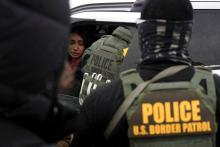
2025 was hard. For more reasons than we can count, the collective, personal, social, and systemic weight of tragedy, death, frustration, and hopelessness has left many weary in the dawning light of this new year—at least, I feel weary. Already in 2026, we have witnessed a masked Immigration and Customs Enforcement agent needlessly kill Renee Nicole Macklin Good. In Venezuela, the U.S. engages in an imperial war and openly admits its intentions to occupy the country. I cannot bear another year of genocide, ICE raids, complacent and inactive leaders, artificial intelligence deepfakes, social media toxicity, and trying to convince people that fascism is wrong.
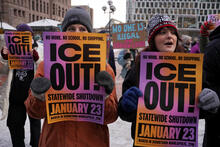
Clergy and labor leaders in Minnesota are calling for a “Day of Truth and Freedom” on Jan. 23, during which Minnesotans do not shop, work, or go to school. The “pause,” leaders say, is intended to highlight the ongoing violence of Immigration and Customs Enforcement agents in the state. “What is happening here in Minnesota is a horror that we’re living through, but we’ve been organizing in preparation,” said Minister JaNaé Bates, co-executive director of ISAIAH, a faith-based collective organizing the day’s events. “It’s not completely a shock.”
An ICE agent’s Jan. 7 shooting of unarmed mother Renee Nicole Macklin Good has become a flashpoint that sparked protests around the country. Bates said the federal agency has been escalating aggression in the Twin Cities for months. On Jan. 18, CBS News reported that there were 3,000 ICE and Border Patrol agents deployed in Minneapolis—five times the size of the city’s police force—making it the nation’s largest ever deployment of immigration officials. Bates said that as the community has resisted ICE’s presence through patrols, social media awareness campaigns, mutual aid networks, and accompaniment of immigrants to work and school, the Trump administration has escalated retaliatory pressure, threatening to send active-duty Army troops. On Jan. 9, U.S. Department of Agriculture Secretary Brooke Rollins notified Gov. Tim Walz and Minneapolis Mayor Jacob Frey that her department would suspend $120 million in food assistance funds to the state, giving it less than a week to produce proof that it had not committed widespread fraud.
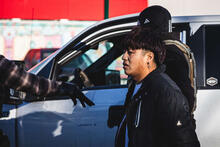
Faith-based refugee resettlement organizations are raising alarms that Immigrations and Customs Enforcement is detaining lawfully resettled refugees in Minnesota, in an operation one resettlement official called “shameful and unpatriotic.”
“This is a five-alarm fire,” Myal Greene, president and CEO of World Relief, said in a press release. “These are not the ‘worst of the worst;’ these are innocent children and families who fled the worst wars and persecution imaginable, who were invited by the American people to become Americans under the terms of American law.
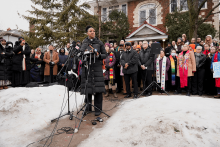
After an Immigration and Customs Enforcement agent shot and killed Renee Nicole Macklin Good, faith leaders in Minneapolis joined demands that ICE leave their city and repent.
“We have our demands. Hundreds of clergy across this state who have gathered together across faith traditions are standing with the rest of Minnesotans to say not again,” Minister JaNaé Bates Imari, co-executive director of ISAIAH, a multiracial interfaith nonprofit, told a crowd of Minnesotans at a press conference.
The press conference, organized by ISAIAH, drew more than a hundred leaders from numerous faith traditions, representing the breadth of the city’s religious communities. ISAIAH presented its demands: That ICE agent Jonathan Ross be arrested, charged, and prosecuted for killing Good; that ICE immediately cease its surge in operations in the state; and that Congress investigate the Department of Homeland Security.
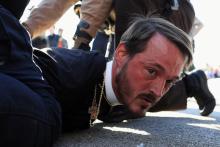
On Nov. 14, more than 100 clergy gathered to raise their voices to demand the closure of the Immigration and Customs Enforcement processing facility in Broadview, Ill., the release of all detainees, and that the Department of Homeland Security honor federal law by allowing detainees spiritual care.

Every age of Christian art has wrestled with power. From the earliest icons to contemporary murals and prints, artists have used sacred imagery to question authority, confront injustice, and call the church to stay accountable to its own ideals. As chaplain Federico Cinocca writes, protest art can serve as “a precious ally to help theology in its [critical] role and uncover narratives that reinforce marginalization.”

On Oct. 28, U.S. Border Patrol Chief Gregory Bovino sat before U.S. District Judge Sara Ellis, who had ordered him to appear in court after attorneys accused him of throwing tear gas into a crowd in the Little Village neighborhood. Bovino was selected by the Trump administration to lead its immigration raids in Chicago—dubbed “Operation Midway Blitz.”
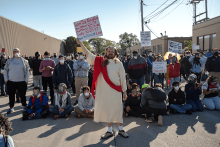
In response to ongoing federal threats from President Donald Trump, Chicago faith leaders organized a surge of solidarity to protect the most vulnerable. Alongside a deep pride for their city, some of the organized actions share a critical motif: joy.
Community leaders in Chicago were already alert to the threat that Trump posed to immigrant communities in Chicago when the president began hinting at sending the National Guard into the city to support Immigration and Customs Enforcement agents and cut the crime rate of what he falsely claimed to be the most dangerous city in the world. For some of the faith leaders, it was important that they protest not just the dangerous influx of troops, but also the false narrative surrounding their city.
“We’re called to be constantly rejoicing,” Rev. Juan Pablo Herrera told Sojourners. “It’s a spiritual strength that we can have in times of negativity coming against us, that we can choose to live with joy as a way of defying the forces of principality.”
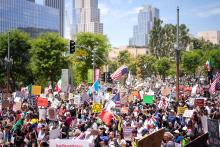
During the first week of June, aggressive Immigration and Customs Enforcement raids in and around Los Angeles sparked protests. To quell these protests, President Donald Trump deployed the National Guard and the Marines to the city. The federal escalation seems intentionally frightening; editor at large and founder of The 19th Errin Haines described the situation as a “public and excessive show of force …[as] a means of reinforcing control.” As the situation continues, we can anticipate further conflicts over control of the military and other shocking acts like the aggressive removal and detainment of Sen. Alex Padilla (D-Calif.), who was removed from Homeland Security Secretary Kristi Noem’s press conference on June 12 while peacefully attempting to ask questions.
I live in LA, and I think what is happening in our city is also happening across the country.
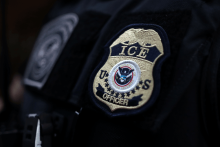
Sara arrived in the United States as a 7-year-old refugee when her family fled religious persecution in Bangladesh. Eleven years later, Sara now calls Montgomery County, Md., home. But if the Trump administration has its way, she would be immediately deported because of her undocumented status.