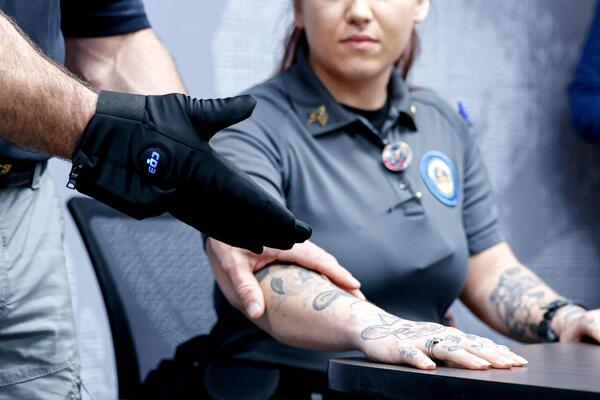
In August, U.S. Immigration and Customs Enforcement awarded a $16.7 million no-bid contract for 6,000 pairs of electric-shock gloves. The Generated Low Output Voltage Emitter, abbreviated as G.L.O.V.E., can be activated by an officer against bare skin, delivering pulses of up to 380 volts—more than three times the voltage of a standard U.S. wall outlet. ICE says the gloves give officers another way to control people in close settings while supposedly avoiding more serious or lethal force. They’re manufactured by a company called Compliant Technologies, because subtlety is dead in our current political environment.
The gloves arrive at a strange moment in the Trump administration’s ongoing immigration crackdown. ICE arrests surged to nearly 51,000 in August. From June to August, ICE set arrest records. But deportations haven’t followed that trend. They’ve plateaued around 1,200 per day, roughly the same pace as May 2026, when ICE made about 32,000 arrests. There are many reasons for this gap: asylum claims, court proceedings, diplomatic issues with receiving countries. But the gap also makes the continued buildup of ICE’s arrest-and-detention machinery more revealing. If they are not getting better at the deportation part of their mass deportation campaign, what exactly is all this additional force accomplishing?
In September, an ICE officer in Austin shot Wilber Rafael Garcés Pérez, a 28-year-old Venezuelan delivery driver. The officer who fired was not wearing a body camera. Garcés Pérez appeared in court in a wheelchair, with the bullet still lodged in his back. The story, however, has lodged itself in the minds of countless immigrant families. NPR reported that immigrant parents are delaying or avoiding medical care for their children because they fear immigration enforcement. This may not be one of the stated goals of the Department of Homeland Security, but it’s an obvious consequence of increasingly relying on a blunt instrument like violent force.
When the Trump administration’s blustery promise to deport millions collides with courts, foreign governments, and human beings who don’t want to be separated from their families, it quickly runs into the limits of its power. But rather than reconsider its campaign, the administration has escalated the part it can control: how much force its officers can bring against the person standing in front of them. Deportations have plateaued, but fear doesn’t need a successful deportation campaign to spread. It only requires enough people to see what ICE can do to a body. Enter the electric glove.
I came across the G.L.O.V.E. story while reading Augustine’s Confessions for a theology class this fall. In his spiritual memoir, Augustine remembers being beaten by his teachers as a child for disobeying them and failing to study, as he admits to preferring games over lessons. He remembers his fear and the adults who laughed at it. More importantly, he notices that the adults administering his punishment were hardly free from their own anger, jealousy, pride, and petty competition. Augustine noted, “The schoolmaster who caned me was behaving no better than I when, after being refuted by a fellow-teacher in some pedantic question, he was more tormented by jealousy and envy than I when my opponent overcame me in a ball-game.” Those failures could even be masked as something noble: Anger could pass for discipline, pride for responsibility, and the desire to be obeyed for moral authority. Their authority gave them the power to punish Augustine, but it didn’t make them morally innocent.
READ MORE: Ms. Rachel Is Simply Prophetic
That’s what makes the electric glove such a fitting artifact for this moment. The federal government can try to create the appearance of strength by becoming more violent, but it doesn’t make it wiser, more competent, or more just. The glove may make it easier for an agent to throw a person into an unmarked van, but it can’t fix a broken immigration system or make the agent’s action moral. This is not just a political problem but a moral one, too. And the administration seems to know this.
The federal government can try to create the appearance of strength by becoming more violent, but it doesn’t make it wiser, more competent, or more just.
Last month, DHS hired Catholic theologian Chad (of course) Pecknold as its principal director for cultural outreach. Pecknold has publicly defended the administration’s immigration policies against criticism from Catholic bishops and Pope Leo XIV. The same department purchasing electric-shock gloves has decided it also needs a theologian as a publicist. But Christianity offers a very different response to how we should approach the limits of our power. We are called to love our neighbor and welcome the stranger even when standing beside them doesn’t guarantee that they will be safe. Our limits don’t release us from one another; they call us to draw closer.
That call matters as we approach the midterms this year. The votes that built this current immigration enforcement regime have already been cast. The money has been appropriated. Immigrant families will live with the consequences for years. No election this November will make that disappear. But our inability to undo all of it doesn’t absolve us of the responsibility to undo some of it and imagine what might come after. The midterms can still place new limits on this administration’s power. On the ground, churches can stand beside families who are afraid. We can refuse to disappear from one another’s lives. Communities can organize and pressure elected officials. We may not be able to guarantee that every family will be safe or every cruelty prevented, but we are still obligated to stand beside one another.
This is not the first time Christians have had to learn how to be faithful without being in control. Our tradition was born among people who lived under an authority that used brutal force as a public spectacle. Their answer was not to return the brutality or find someone more vulnerable to make afraid. It was to become more deeply bound to one another.
That is a different kind of strength than the one we will be sold this election season. One reaches for greater control whenever it encounters its limits. The other accepts those limits and asks what their responsibility is to each other anyway. And when facing the increasing hostility toward our communities, we must remember that an electric glove can make a weak hand dangerous, but it doesn’t make it strong.

Colin Martinez Longmore is an opinion writer for the 2026 Sojourners Journalism Cohort.
Did this article have an impact on you? Tell us how! Whether you’re moved to take action, have a question, or want to share a comment (good or bad), we value your feedback!