Donald Trump
Earlier this month, at a private Easter luncheon at the White House, President Donald Trump delivered some of the most revealing comments of his second presidency.
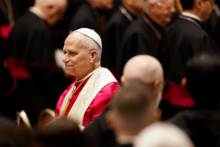
President Donald Trump issued an attack on Pope Leo late on Sunday, calling him “WEAK on Crime” and “terrible” for foreign policy after the religious leader criticized Trump’s foreign and immigration policies.
“Pope Leo is WEAK on Crime and terrible for Foreign Policy,” Trump wrote in a lengthy post on Truth Social.
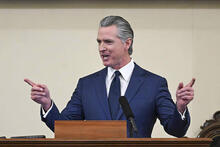
I want to talk about a Christian response to Gov. Gavin Newsom’s campaign, and to do that, we need to start with Batman.
WHEN DONALD TRUMP sat down in the Oval Office with four reporters from The New York Times for two hours in January, he was asked if there were any restraints on his global actions. “Yeah, there is one thing,” the president replied. “My own morality. My own mind. It’s the only thing that can stop me.” That unvarnished truth came as many were wondering what was signaled by Trump’s military operation in Venezuela to extract President Nicolás Maduro and his wife, Cilia Flores, and what to expect next. The answer? It was a prototype, and we should expect more.
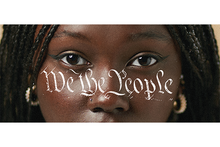
AS THE UNITED STATES celebrates its 250th birthday this year, I am thinking about who is included in the “We the people” of the Constitution’s preamble. This is particularly urgent in light of the MAGA movement, the largest effort in over a generation to redefine who and what is truly American.
Since its inception our nation has been in a tug of war between those seeking to narrow “We the people” to primarily white men and those seeking to expand it to include every person. Sadly, white evangelical Christians remain more fearful and resistant to the nation’s changing demographics compared to all other religious groups, as recent surveys from both Pew and PRRI have shown. Rather than a source of hope and a glimpse of the kingdom to come, our increasing diversity has been used to build political power by stoking anxiety and prejudice.

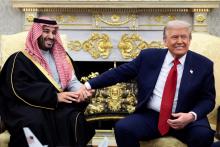
When President Donald Trump and New York Mayor-elect Zohran Mamdani first met back in November, I had to laugh. Partially because there is something deeply absurd about these two men—Mamdani, a self-proclaimed Democratic Socialist, and Trump, who once proclaimed he wished to be a dictator for “one day”—smiling and posing for photos in the Oval Office. But I mainly found myself laughing because, despite the drastic differences between these two politicians, both have been critical to my own faith and political journey.
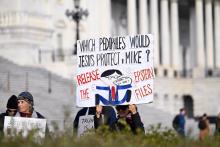
As the Apostle Paul warns us in 1 Timothy 6:9: “But those who want to be rich fall into temptation and are trapped by many senseless and harmful desires that plunge people into ruin and destruction.” And if you want proof of Paul’s words, look no further than the release of Jeffrey Epstein’s emails.
Let’s take a quick trip back to the fall of 2016. Justin Bieber, Drake, and Twenty-One Pilots are topping the charts. All the cool kids are bottle-flipping. And almost every adult I know is falling in line to vote for Donald Trump. I’m from the western side of Michigan, and my home county went to Trump by almost 30 percentage points.
I was just starting to develop political opinions at that time, but it shocked me how so many people—who I knew cared deeply about their own moral lives—could countenance voting for a candidate who made a mockery of Christian values like forgiveness and marital fidelity.
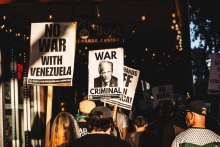
The Trump administration is blowing boats to pieces off the coast of Venezuela.
At different points this year, I’ve been left with the unsettling feeling that I don’t have the emotional bandwidth to fully process—let alone respond to—all of what’s happening. Early in the year, we all acknowledged that this overwhelmed feeling was by design, part of the Trump administration’s “flood-the-zone” strategy, intended to weaken and divide its opposition.
I’ve been wrestling with this in light of the attacks the Trump administration is orchestrating in Venezuela. On one hand, I’m perplexed at why such a costly, unlawful, and frankly evil operation isn’t garnering louder public outcry; on the other hand, I know there is so much else on people’s minds. It’s not that we don’t care about it all—from Chicago to Palestine to Sudan to so many other places where we know there’s urgent suffering—but there’s only so much outrage we can process before weariness takes over.
And yet I can’t ignore what’s happening in Venezuela
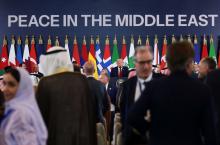
In Palestine, we welcomed the news of a ceasefire with hope—a fragile, trembling hope. After months of unbearable horror, we allowed ourselves to exhale. For the people of Gaza, it meant a pause in the killing, a night of uneasy quiet, and the possibility of sleep without bombs.
In the past week, the Trump administration brokered a deal that secured the release of Israeli hostages and Palestinian prisoners. While the terms of the long overdue ceasefire are being contested, this is a groundbreaking accomplishment for which I’m deeply thankful. But this short-term peacemaking victory abroad was quickly undermined by the administration’s bellicose rhetoric and actions at home.
President Donald Trump has repeatedly abused his ability to declare emergencies and seize power under the pretense of maintaining law and order. For example, he declared immigration emergencies to further militarize the U.S.-Mexico border and label drug cartels terrorists; he declared a “trade emergency” to justify and impose costly tariffs; and he declared an energy emergency to greenlight new drilling projects and ignore regulations. Most alarmingly, he has falsely declared a “crime” emergency to federalize and deploy National Guard troops to additional cities.

You may have heard that, at Charlie Kirk’s memorial service, Erika Kirk said that she forgave her husband’s assassin.
You may have also heard that only a few minutes later, President Donald Trump said that while Charlie Kirk “did not hate his opponents—he wanted the best for them,” he was different: “I hate my opponent, and I don’t want the best for them!” This moment got a lot of attention, understandably so, but another moment stuck out to me even more. And even though we’re almost a week and a half removed from the memorial service, I think it’s still worth exploring today.

“On Sunday, Erika Kirk forgave the man who shot her husband,” Jimmy Kimmel told his live studio audience on Tuesday night, his first show back after a six-day suspension following his musings on Charlie Kirk’s assassination. “She forgave him.”
“That is an example we should follow,” Kimmel continued, his voice cracking with emotion. “If you believe in the teachings of Jesus, as I do, there it was. That’s it. A selfless act of grace, forgiveness from a grieving widow that touched me deeply. And if there’s anything we can take from this tragedy, I hope it’s that.”

When the House passed President Donald Trump’s Big Beautiful Bill Act, House Speaker Mike Johnson gave glory to God.
Johnson, the Louisiana Republican and Christian, believes that his work and the work of the United States are divinely orchestrated. But if the so-called “Big Beautiful Bill” is truly from God, then what are we to make of cuts that negatively impact the most marginalized in our society?
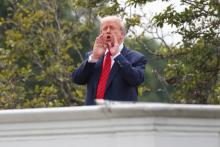
On Tuesday, President Donald Trump climbed onto the roof of the White House briefing room, saying he was there “taking a little walk,” and surveying the “ballroom on the other side.”
Last week, the White House announced plans for a $200 million ballroom, with hopes for the golden, gilded East Wing to be completed by 2029.
Surprisingly, the Bible has a lot to say about rooftops. In the Hebrew Bible and New Testament, rooftops are a key part of stories where powerful rulers stand and hatch plans to exploit the vulnerable, where God intervenes to encourage inclusive polity, and even in the tempting of Jesus. At other times, the Bible instructs people on how to build their rooftop decks, and roofs are used to ask Jesus to care for others. Rooftop stories show God cares about good infrastructure, accessibility, and safe communities.

In 2022, Dua Lipa appeared as a guest on The Late Show with Stephen Colbert, and asked him about the role his faith plays in his work.
“Does your faith and your comedy ever overlap?” she asked. “And does one ever win out?”
Colbert first offers a little quip (“I think, ultimately, us all being mortal, the faith will win out in the end”) and then launches into a lengthy and eloquent treatise on how Catholic teaching has trained him to wield humor as a defense against despair.

If it’s not obvious: I genuinely enjoy celebrating July Fourth. Yet I know that many Americans — including Christians who share my commitment to social justice — have a far more complicated relationship with the holiday. And I get that reluctance. So often, celebrating Independence Day is wrapped in a weaponized, politicized form of patriotism which allows no room for critiquing the real harms and contradictions of our nation. But I think it’s a mistake for us to cede patriotism to those who turn it into a poisonous blend of nationalism and ethnocentrism, fixated on blood and soil and fueled by fear of “the other.”
We also need to be clear: Iran did not possess a nuclear weapon. Iran was enriching uranium needed for such a weapon and had recently increased its production, but intelligence assessments concluded they had not made a final decision to produce a bomb. In fact, the assessment said Iran would be more likely to produce a weapon if the U.S. attacked its uranium supply.
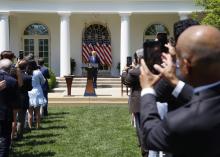
During the first White House National Day of Prayer of his second term, President Donald J. Trump said he is making America “rich, healthy, and religious again.”
Trump’s approval ratings have dropped sharply since he returned to the White House and stand at 42% after his first 100 days in office, according to a poll by NPR. Still, Trump claimed that the spirit of the country shifted positively since Nov. 5, the day he was elected. Trump said his administration was “bringing religion back” to the United States of America.
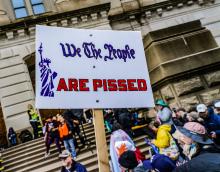
There’s been plenty of coverage of what Trump and his administration have done in their first 100 days. In the conservative media ecosystem, this coverage appears as disinformation-riddled praise for how Trump has restored America’s greatness and created renewed prosperity. In mainstream media outlets, this coverage is often focused on cataloguing the harms of policies that often felt chaotic or cruel. And while I’m grateful for those who ensure the public has an accurate understanding of the impact of Trump’s decisions, there’s another set of stories beneath those headlines that rarely get as much attention: how people have consistently been taking courageous action to counter these harms.