Christmas

Misinformation is widespread, and it can be dangerous. And while correcting misinformation can feel urgent, a team of experts told Sojourners that challenging our loved ones’ beliefs is a difficult and time-intensive undertaking. This is because misinformation about politics, religion, and health often ties into our deepest beliefs about ourselves: Challenging them isn’t just correcting facts, it’s resetting an entire worldview.
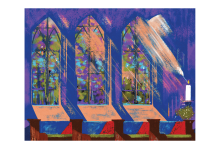
WE HAVE COME through a turbulent year in which health concerns, weather concerns, social unrest concerns, and more have been at the center of our thoughts. From the first time we heard “COVID-19” to the last storm of hurricane season to the deaths of many significant cultural icons in the U.S., we have found ourselves reeling—or at least I have, and so have many people I know.
Advent and the beginning of the Christmas season give us an opportunity to recalibrate and take a breath. We are into the new Christian calendar, and for Christians that reality should mean something. Expectation, hope, joy, and peace are just some of the Christian ways of leaning into life. Advent allows us to flex those faith muscles. And we need them, because, as the texts for the first days of Christmastide notes, the struggle under which we live does not dissipate. We live our Christian faith most often amid social crises. “Calm” and “peace” are aspirational at best. The reflections for this month try to make sense of how we flex those muscles I mentioned earlier. How do we participate in God’s desire for us to live together in just, holy, equitable ways? How do we hold ourselves and each other accountable to building the commonwealth of God, in which we each play our part, great or small, so that all are made whole?
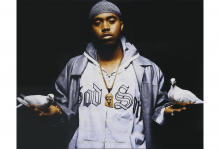
IT'S ALMOST DECEMBER, and in a few weeks we may gather with our families (potentially via Zoom) to sing “Away in a Manger” and “Hark! The Herald Angels Sing.”
Each of these songs depicts baby Jesus in a different way, from a poor, defenseless child to a newborn king. Each contributes to our faith in a different way. That tiny baby reminds us of Jesus’ humanity and his solidarity with the poor, while the incarnated Lord reminds us of God’s splendor and glory.
From these hymns to the latest Hillsong chorus, most songs about Jesus have been written by Christians for their fellow believers. Over the past 50 years, however, this has changed. Songs about Jesus no longer show up just in church, but also in discos, honky-tonks, blues bars, and strip clubs. Over the past 50 years, Jesus has appeared in hundreds of songs in every secular genre. These artists explore in their own unique ways the question that Jesus asked his disciples: “And who do you say that I am?”
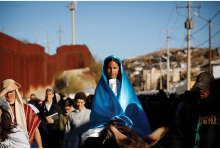
Jennifer Guerra Aldana helps organize the annual Posada Sin Fronteras in San Diego/ Tijuana. She spoke with Sojourners’ Jenna Barnett about the tradition, which reenacts Mary and Joseph’s travels as described in Luke’s gospel.
“Las Posadas is a Catholic tradition in which community members set up a pilgrimage. People go door to door singing songs, wanting to be let in. And at every door, the innkeeper does not let them in. At the last home, the people do get let in, and there’s a party with tamales and candy. Posada Sin Fronteras [The Inn Without Borders] takes place at the San Diego-Tijuana border. We treat San Diego as the innkeeper and Tijuana as the one who is asking to be let in.
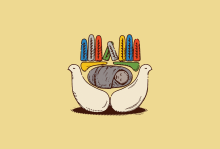
When I was in labor with my third child, my older sister was bewildered by my pain. As I walked the hall of our two-story row house in southwest Philadelphia, seeking moments of comfort between birth pool and bed, couch and floor, she said to me, “But, you’ve already done this before. Why is it so hard?”
“I haven’t birthed this baby!” I cried out to her. Then I settled into a deep silence, preparing myself for the next wave, the next earth-shaking moan.
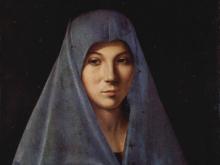
Mary’s example is an especially powerful one in these troubled times when people insist that their truth is the only truth.
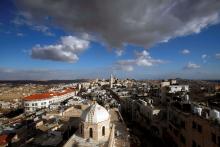
Gazan Christians will be granted permits to travel abroad but none will be allowed to go to Israel and the occupied West Bank, home to many sites that are considered holy to Christians.

In 1980, for the first time in 1,000 years, more believers following the babe in Bethlehem lived in the global South than the North, and in four decades since then this has accelerated. Growth in Latin America means 600 million exchange “Feliz Navidad,” or “Feliz Natal” (Portuguese) during these days in crowded Catholic cathedrals, megachurches, and Pentecostal storefronts. This is an increase of 10 million in the past year.
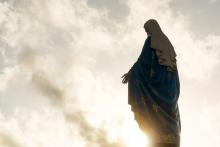
The Jesus story begins with a young woman who also hears many critical voices around her. Mary lives in a culture that tells women they’re more property than persons. Galilee is considered the armpit of her society. Her religion portrays God as mostly a distant and disinterested deity.
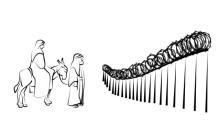
Every year from Dec. 16 to 24, Las Posadas begin in many Latin American countries and immigrant communities in the U.S. Roughly translated, posadas means “inn” or “shelter.” Las Posadas recalls the events in Luke’s Gospel leading up to Jesus’ birth. It’s a Catholic Christian observance with a sung liturgy that’s performed on the streets rather than in church.
A posada begins with a street procession that reenacts Mary and Joseph’s search for shelter at an inn. Those playing the protagonists of the story, Mary and Joseph, are dressed in costume and carry candles as they follow along a prescribed route, knocking on doors. At each door they ask, through special posada songs, for room at the inn. In rural areas, Mary may even ride on a donkey.

Everyone is supposed to love Christmas and the holidays. It’s supposed to be a time of family and gratitude. But I dread them. I dread the weeks leading up to Christmas, starting the day before Thanksgiving when Christmas carols begin permeating the radio and stores and build to a crescendo through Christmas Eve. The growing darkness in the absence of daylight saving time doesn’t help.

“The last will be first, and the first will be last.” —Matthew 20:16
I know what I am:
an earthen vessel guiding cows, goats, and sheep’s
chaotic feeding, their chorus of maws bleating,
baying, snapping open and shut a celebration

I'M TOO OLD, and so are my children, to set out cookies and milk for you. But I’m still hopeful enough to write you another letter.
Last year, with all the earnestness I could muster, I asked you for a white people intervention—many white progressive and evangelical Christians in the same room for a cleansing flood of white tears, some deep breathing and healing prayer, and time to plan to dismantle white supremacy from the inside.
But I have not received word that an intervention took place. I assume invitations to it went out or it got canceled, postponed, or taken over by the announcement of Supreme Court Justice Anthony Kennedy’s retirement. (Was that supposed to be a Christmas-in-summer gift?)
IN THE PAST, the bulk of my Christmas shopping has usually been done between 10 a.m. and 3 p.m. on Christmas Eve. There’s something about waking up on the day before Christmas in a sheer panic that propels me straight into the open arms of every electronics, sporting goods, and department store within a 10-mile radius. While my family spends the morning sipping coffee, making red velvet cake, and cutting intricate little gift tags, I’ve spent the day with folks I’ve come to recognize as my extended family—a dysfunctional, wild-eyed bunch with a procrastination problem.
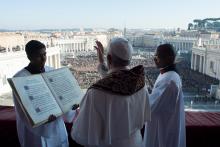
Francis, leader of the world's 1.2 billion Roman Catholics, urged people to see the defenseless baby Jesus in the children who suffer the most from war, migration, and natural calamities caused by man today.
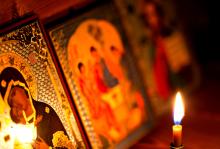
We feel the darkness all around and need to see some light. We feel hopelessness every day and need some hope. We feel despair for our nation’s life and future and need to see and hear some truth. We see authoritarian political leadership on the rise, a White House that literally puts democracy at risk, and feel the need to make clear where true authority lies.
But Christmas says ...
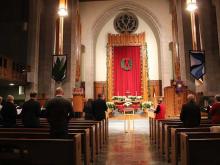
“We’re all born to live, to love and to die,” he said. “Between the birth and the dying the question is what do we make of it?"
This Christmas season, we need to remember that Jesus was not white. And in solidarity with that truth, we need to make space in our Advent season for the church to openly lament that American Christianity has often stood on the side of the oppressor and not on the side of the oppressed.

When nations turn toward trouble
and hope seems all but gone,
when threats and conflicts double,
what can we count upon?
Our only hope is that light does come into the darkness, that this child born in an animal stall is still more important than all the kings and rulers, that the “lowly” are closer to God than all the “high”-placed people that we are forced to watch and listen to all the time. I needed last night to remind me again.