abolition
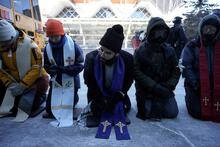
It might seem like the mission to abolish Immigration and Customs Enforcement is unique, but there are important parallels between this movement and the 19th-century fight to abolish slavery. As we seek to follow the gospel and make a new world, it is worth turning to abolitionists from the 19th century as we look for examples of how to win the fight against tyranny and wickedness, even if it takes longer than our lifetime.
The Fugitive Slave Act of 1850 required U.S. marshals in free states to capture people who were attempting to liberate themselves from slavery. While the act was meant to assuage the Southern malcontent at the admission of California as a free state in the same year, it prompted widespread protests in Northern cities from abolitionists who sought to prevent the enforcement of what they saw as a fundamentally evil law.

In Against Me!’s song “I Was a Teenage Anarchist,” Laura Jane Grace sings, “I was a teenage anarchist / But the politics were too convenient.” The song is a catchy tune that has stuck with me, even if I’ve outgrown the punk-rock-emo scene. But unlike Grace, I have not outgrown my anarchistic impulses.
Popularly, anarchy is associated with “chaos,” but I think of it more in terms of avant-garde jazz, where everyone is working together in their own unique way to create a sort of consensus.
So, when I recently heard of a new book focused entirely on the nexus between anarchism and Christianity, I had to investigate.

Anyone who has spent even a second in a prison knows it’s hell. Growing up in church, I noticed people who participated in the church’s prison ministry were both respected and feared. Respected because they were doing what the writer of Hebrews admonishes believers to do regarding those in chains: Remember them as though you were in prison with them (13:3). But they were feared because many of them had actually been in prison. Rather than the prison system or the criminal legal system being classified as barbaric, it was the prisoners who were typically understood to be barbarians.
Joe Ingle has spent a lot of time in prison. Ingle is a writer and death row minister who has been active in prison ministry since the ’70s. A native of North Carolina and a graduate of Union Theological Seminary, Ingle has dedicated his life to being present with and advocating for the 1.9 million people incarcerated in the U.S., especially the more than 2,300 incarcerated people on death row.

Illinois set a historic U.S. precedent on Sept. 18, when it became the first state to abolish cash bail.
Cash bail, or the practice of imprisoning people accused of crimes before their trial unless they can pay a certain amount of money set by a judge, has a pernicious history. In the United States, cash bail has led to high rates of pretrial incarceration. Consider these statistics: There are more than 400,000 people in the United States who have been incarcerated without a trial. In Illinois, the problem has been especially sobering, with the Center for Criminal Justice of Loyola University Chicago reporting that in 2020 and 2021, 173,000 people were held in jail before a trial.

One of my favorite passages in the Bible is from in Isaiah 61:1: “The spirit of the Lord God is upon me, because the Lord has anointed me; he has sent me to bring good news to the oppressed, to bind up the brokenhearted, to proclaim liberty to the captives, and release to the prisoners.” Christians will be familiar with this passage as Jesus quotes it when he stands up to read in the synagogue during the early days of his ministry (Luke 4). It’s a passage that gives me some hope for Christianity, since the central character of our religion believed that even the worst-of-the-worst deserve forgiveness.
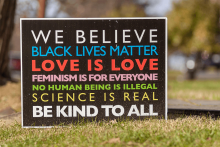
My shtick on Twitter is taking pictures of myself with kitschy signs that I find wherever I go. You know the signs I’m talking about. They are the signs that embody the motto of “Live. Laugh. Love.” If you go to your local Hobby Lobby, there is an aisle dedicated to this, um, décor.

IN THE EARLY months of the pandemic, the “Care Bears” team of my local chapter of Southerners on New Ground (SONG), a Black, queer-led community of carceral abolitionists, reached out to members of the SONG family by phone. A small box arrived in the mail a few weeks later. The Care Bears had decided I’d benefit from a “a gift of love in a trying time”—tangerine tea, a candle, colored pencils, a notebook, and a tiny bottle of dandelion tincture made by the resident SONG herbalist.
I was drawn into the extended SONG family in 2017 when I joined the Black Mama’s Bail Out Action campaign. For Mother’s Day, SONG members paid the bail of mothers and caregivers held in the Durham, N.C. county jail because, like tens of thousands of people imprisoned in the U.S., they couldn’t afford their release. As a minister familiar with the jail’s protocols, I was called on to help obtain consent from the women being held. SONG raised the funds as part of a practice of mutual aid through paying off bail debt. “Money kept you in,” Pat Hussain, a co-founder of SONG said. “Black love got you out.”
My involvement with SONG has taught me the interconnections of Black feminism, prison abolitionism, and mutual aid—all as part of movements to create everyday institutions that nurture life. Abolitionism is about undoing the violence of incarceration, Angela Y. Davis writes in Abolition Democracy, “but it is also about building up, about creating new institutions.” And abolitionist Ruth Wilson Gilmore asserts that “abolition is about presence, not absence.”
Both Davis and Gilmore center the need for organized community to sustain life in a destructive world. They call for the creation of new institutions of mutual care while eroding the carceral system’s grip on society. With exceptional clarity, organizer and educator Mariame Kaba recently reissued this call: “Our work isn’t just a movement against cages and cops. It’s a movement for different ways of living together.” In this movement for a shared life where everyone can experience wholeness, “mutual aid exposes the failures of the current system and shows an alternative.”
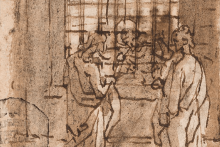
Jesus’ “mission statement” when he begins his public ministry in Galilee includes a promise of liberation and release for those who are incarcerated. While the New Testament context of “captivity” wasn’t entirely the same as modern imprisonment, Jesus’ promise aligns liberation of prisoners with healing and good news for the poor and oppressed. Taking Jesus’ words in this text seriously forces us to ask: If God’s reign is characterized by freedom for prisoners, why are we supporting incarceration now?
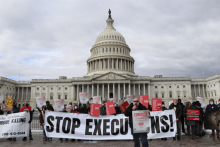
The Abolitionist Action Committee was marking the 45th anniversary of the first execution in the modern era: Gary Gilmore was executed by firing squad on Jan. 17, 1977; he had been convicted of murdering two men in Utah in 1976, and the Supreme Court ruled the death penalty legal that same year.

In one America, an insurrectionist is granted permission by a judge to take a trip to Mexico with charges pending. In the other America, the National Guard is deployed in response to Black Lives Matter protesters organizing at the Lincoln Memorial. One group’s humanity is seen and validated, while the other group’s humanity is ignored and questioned.

The United States, regrettably, is still struggling to right the longstanding racial bias in our courts and policing. But one area we have entirely failed to examine is who gets labeled as a “gang” and what gets labeled as “gang activity.”
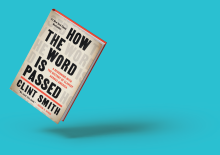
THE STATUE OF Liberty, author Clint Smith tells us, was supposed to celebrate the abolition of slavery. Early models depicted the iconic copper lady holding a raised torch in one hand and a pair of broken shackles in the other, but the final version included only a piece of broken chain at the lady’s feet. With slavery shifted to the periphery, Ellis Island’s visitors could imagine liberty was, and is, possible without abolition.
In How the Word Is Passed, Smith visits multiple historic sites to offer a mosaic portrait of how different places tell, or do not tell, the truth about slavery. The book meditates on the capacity of our collective symbolic infrastructure to prepare us to rectify persistent material inequalities. If we frame slavery as something that “happened a long time ago” or leave unchallenged the warping of the Confederate commitment to enslavement into myths of honor and heritage—if, in a word, we misremember the wound—then we will not summon the will nor the proper know-how to heal it.

Nicole Thomas-Kennedy, who placed first in the primary race for Seattle city attorney, said that while voters have embraced more progressive ideas, she thinks moderate voters are still “freaked out” by the term abolition because of misconceptions about what it means. Her campaign was motivated in part by working as a Seattle public defender, where she saw the city “mostly prosecuting poverty and disability,” including, she said, a case where a person stole a block of cheese and a beer.

Muslim detainees at Guantanamo are “indefinite prisoners of war,” held on suspicion of crimes they may or may not have committed. It would be easy to believe that Guantanamo is unique in regards to how it treats those the United States has deemed its enemies. But in reality, Guantanamo is an extension of the U.S. prison system.

Director Anthony Mandler's movie Monster, focuses in on a myriad of social issues — race, class, mass incarceration, crime, and the U.S. penal system — but it also is a monster movie of sorts.

The U.S. prison system is an afront to human dignity and in sharp contrast with God's vision for justice on earth. Christians' commitment to love, hope, and justice should inspire us to work toward abolishing the prison system.

The U.S. Bureau of Prisons has no immediate plans to send thousands of inmates released during the COVID-19 pandemic back to prison, but to prevent that from happening in the future, Congress needs to change the law, its head said Thursday.
"We're going to use good judgment and common sense and work within the law," said BOP Director Michael Carvajal in testimony before the Senate Judiciary Committee, noting the agency has no desire to "arbitrarily" disrupt peoples' lives by forcing them to return to prison.

Lawmakers in Virginia voted on Friday to abolish the death penalty. The Democratic-led House of Delegates voted 57-41 Friday, after the Senate passed the measure earlier this week. Gov. Ralph Northam, a Democrat, said he would sign the repeal into law.

THESE SCRIPTURES move with us from Christmas to Epiphany, drawing us into the mysteries of the divine life in the world. The incarnation is a call to notice where the Spirit surprises us with God’s presence. Dominican theologian Herbert McCabe guides our vision: “Christ is, indeed, to be found in the present but precisely as what is rejected by the present world,” he writes. Christ “is to be found in those who unmask the present world, those in whom the meaninglessness and inhumanity and contradictions of our society are exposed.” God’s mysteries are revealed among the rejected and despised, the people who expose society’s promises as the hypocrisies of political brokers who ensure the prosperity of the millionaires and billionaires—and, soon, the world’s first trillionaire.
To believe these scriptures about God’s presence is to realign our solidarities, to become conspirators with the One whose justice is liberation from the economic, political, and social patterns that are destroying life. These structures that organize our world for the benefit of the powerful are in the midst of collapse. They are “passing away,” as Paul claims. We’re always living through human self-destruction, with the United States as an instance of history’s cycles of cataclysm. If we want to go on in hope, then we must love those God has created, and give ourselves to the despised and rejected, to our neighbors caged in prisons and segregated from us by the border. There, God will astonish us with epiphanies: life’s survival on the underside of history.

I don’t begrudge Ethan Hawke for wanting to play John Brown and producing this project. John Brown’s life was vast and exciting; his willingness to take up arms to defeat injustice mirrors conversations we still have in the church today about nonviolence.