Women and Girls
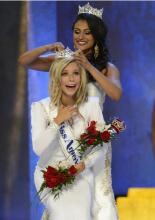
Sunday night, 23-year old Kira Kazantsev proved two things when she was crowned Miss America for 2015. First, she can make a nationally television audience “happy” by using only a red plastic cup. Second, domestic violence knows no bounds.
That’s right. This year’s Miss America is one of the every four women who has experienced domestic abuse in her lifetime. During college, Kazanstev was in an abusive relationship that left her “isolated” and “hopeless,” she recently told NPR. In the same interview, Kazanstev says she wasn’t aware of the resources available for victims of domestic violence: "I very well may have Googled it," she says. "But that's not the mindset that you're in when you're in that situation. You just feel alone. You feel helpless. You don't feel like anyone could possibly understand."

New Jersey is often dismissed as a cultural wasteland of traffic jams and suburban sprawl, mobster graveyards and lost dreams — source material for native son rockers like Bruce Springsteen and Jon Bon Jovi.
But soon the state may also be known as home of the latest American saint, a Bayonne-born nun who is to be beatified in Newark next month.
The beatification of Sister Miriam Teresa Demjanovich, who died in 1927 at the age of 26, puts her one step away from formal canonization.
If Demjanovich does make the final hurdle, she would become just the second person born in the U.S. ever to be named a saint, and it would give New Jersey something to brag about — albeit humbly, no doubt.


This week, the Baltimore Ravens terminated the contract of star runningback Ray Rice after video of Rice beating his then-fiancée Janay emerged online. Rice had previously been suspended for two games for the assault. With the release of the video, media scrutiny swiftly turned to his now-wife, speculating over why she would marry her abuser.
Beverly Gooden, a human resources manager and blogger, had a different response. Herself a survivor of domestic abuse, Gooden began tweeting of her own experiences, each one a vulnerable explanation: #WhyIStayed.
Gooden wrote, “I can't speak for Janay Rice, but I can speak for Beverly Gooden. Why did I stay? … Leaving was a process, not an event. And sometimes it takes awhile to navigate through the process. ...I hope those tweeting using #WhyIStayed find a voice, find love, find compassion, and find hope.”
We would all do well to listen. Some of the most powerful tweets below.

There’s something romantic about a pair of lovebirds on the lamb, fleeing the authorities to keep their love alive. But add a few more wives, and not so much. When the first episode of “Sister Wives” aired on TLC featuring the poly-union of Kody Brown and his four co-star wives, Utah police announced the very next day that they would investigate the illegal union. Brown promptly relocated his brood to Nevada, leaving one intolerant state for another where polygamists are allowed to run free, and from there filed a complaint in a U.S. district court challenging the law that spurned their love.
After years of struggle, last month a Utah judge struck down the state’s polygamy law , decriminalizing poly-unions in the state that has endured a relentless barrage of polygamy punch lines, even during the decades where it was expressly verboten. The case will now advance to an appeals court, but conservative harbingers are already offering “I told you sos,” largely bemoaning the slide down the slippery slope of morality opened by same-sex unions.
But is morality the only way to talk about marriage and sex? Certainly the American judiciary thinks otherwise as it hammers out the constitutionality of every union under the sun. The polygamy question could broaden the discussion among evangelicals to include nuances beyond morality.

When I was a university student, more and more people were getting cell phones that had cameras — a trend I only noticed when signs in the women’s locker room went up, warning that using cell phones in that space was strictly prohibited for reasons of privacy. It’s alarmingly easy to take pictures of someone without their knowing. You can pretend to be writing a text message when, in fact, you’re capturing someone’s image and then posting it on the Internet for anyone to see.
That’s bad manners, of course, if we’re talking about simply posting unflattering photos — and even more morally and ethically questionable if the subjects are in a partial or total state of undress. But even when a person consents to be photographed nude, if those private images end up on the Internet — as roughly 200 such celebrity photographs did last weekend — it can be surprisingly difficult to get them removed.
4Chan, the anonymous message boards where the images first appeared, and Reddit, where they were posted and shared widely, are able to claim that Section 230 of the Communications Decency Act of 1996 allows them to deny responsibility for the content that’s posted to their site by individual users. They certainly have the capability to remove such images, but they don’t want to — and the law doesn’t compel them to.
As Emily Bazelon noted in Slate, Reddit moved quickly to delete nude photographs of Olympic gymnast McKayla Maroney taken while she was underage.
“It’s not that Reddit is too shady to care about the law,” Bazelon writes. “It’s that there is no clear legal risk in continuing to host involuntary porn of adults.”
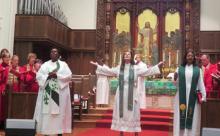
Chicago. New York. Washington, D.C. In quick succession this year, three women have been chosen to lead historic tall-steeple churches in all these cities.
In May, the Rev. Shannon Johnson Kershner became the first woman solo senior pastor at Chicago’s Fourth Presbyterian Church. In June, the Rev. Amy Butler was elected senior pastor of New York City’s Riverside Church. And finally, in July, the Rev. Ginger Gaines-Cirelli began leading Foundry United Methodist Church in Washington, D.C.
“For women to speak in those pulpits and speak boldly as public voices in these very public buildings is very powerful,” said the Rev. Serene Jones, president of Union Theological Seminary, who recently hosted a dinner party with some of New York’s movers and shakers to welcome Butler to town.
It’s been 40 years since the Episcopal Church first ordained women, and other denominations have long included women in their clergy ranks. But these new advances are occurring sooner in the lives of these three women than some of their older counterparts. The Hartford Institute for Religion Research reports that women clergy are much more likely to serve in smaller congregations.
Scholar Diana Butler Bass hailed the arrival of these women — all in their 40s and leading large, urban, neo-Gothic churches — but also wondered if they reflect the “General Motors phenomenon.”
“Are women coming into leadership only as the institutions are collapsing?” asked Bass, author of Christianity After Religion.

Today, August 26, is Women's Equality Day. The date was selected to commemorate the 1920 passage of the 19th Amendment to the Constitution, granting women the right to vote. In honor of such a day as this, we decided it’d be fitting to highlight the voices of women by sharing our top five posts (by number of page views) authored by women from the past year.
A New Normal: Ten Things I've Learned About Trauma, by Catherine Woodiwiss (Sojourners Associate Web Editor)
Not As Helpless As We Think: 3 Ways to Stand In Solidarity With Ferguson, by Rachel Held Evans
How Not to Raise a Daughter, by Sandi Villarreal (Sojourners Web Editor and Chief Digital Officer)
World Vision Reverses Decision on Same-Sex Marriage, Calls It 'A Mistake,' by Sarah Pulliam Bailey
How I Kissed Evangelizing Goodbye, by Cindy Brandt
And while we’ve come a long way over the past 94 years, we also recognize there is still much to be done. So stay tuned to our Women and Girls Leading through Faith and Justice Initiative. We hope to have some exciting updates to share soon (including a new hire — you can still apply for our Women and Girls Campaign Associate position here)!

The 2009 movie Taken throws its audience into the world of human trafficking. An American teen girl and her friend are taken while on a European vacation and sold into the sex trade through a multinational mob-ran human trafficking ring. The girl is ultimately rescued by her secret agent father played by Liam Neeson. With an estimated gross profit of $145,000,000, it is clear that audiences liked this action-packed thriller. While entertaining, unfortunately, Taken dramatizes and stereotypes traffickers. Contrary to what's portrayed in popular movies, there are many types of traffickers beyond the stereotypical pop-culture swarthy, heavily accented, and foreign organized crime ring.
First, many corporations participate in human trafficking by turning a blind eye to the working conditions of either their workers or the workers of their suppliers, vendors, contractors, and subcontractors. For example, the chocolate and fine jewelry industries are notorious for using slave labor. Beyond these well-known industries, exploitation occurs in the garment making trade, unscrupulous adoption agencies, and agriculture.

Diedrich Boenhoeffer wrote about it. Pastors preach about it. Churches strive for it.
Community.
It is a concept that has had a long history in the American church. It can come in many forms. Bringing a meal to a stressed out new mother. A church ice cream social. Youth group. Singles ministry.
But what does community look like when working on a social issue?
For human trafficking, that community comes in the form of partnerships. The 2000 federal Trafficking Victims Protection Act (TVPA) originally addressed human trafficking by creating the three 'Ps': prevention, protection, and prosecution. But after implementation occurred, the anti-trafficking community realized there was something missing. Thus, in 2008, the fourth 'P' —partnership — was added.

When Philadelphia’s St. Paul Baptist Church hired the Rev. Leslie Callahan as its first female pastor, in 2009, she was nearing her 40th birthday and the tick-tock of her biological clock was getting hard to ignore.
She delighted in her ministry but also wanted a husband and children in her life. The husband she couldn’t do much about — he just hadn’t stepped into her life.
Now Callahan is mother to 22–month-old Bella, who was welcomed joyously by what the pastor describes as “a pretty traditional Baptist church.” She describes Bella’s arrival as “a divine regrouping,” a different answer to her prayers than the traditional mommy-daddy-baby model she had envisioned.
Ever since unmarried sitcom anchorwoman Murphy Brown shocked much of the country in 1991 by deciding to raise her baby on her own, the culture has changed. Once unthinkable and later unacceptable, single mothers by choice today are met with less judgment.
In fact, according to federal statistics, more than 40 percent of births are to unmarried mothers. But what if, like Callahan, the single mom by choice is a minister, or a rabbi?

Across the country, dangerous people with records of domestic violence, stalking, and aggression have no legal restriction keeping them from obtaining guns. Today, the Senate Judiciary Committee held a hearing to explore the intersection of domestic violence and gun violence. The hearing discussed major loopholes in the landmark Violence Against Women Act (VAWA), which successfully prohibited some convicted domestic abusers from gaining access to firearms. Yet even with the prohibitions in VAWA, abusers who don’t share a home with their intimate partner and abusers convicted of misdemeanor stalking charges are free to keep the weapons they have and to purchase new weapons.
“I am here today to speak for my sister Zina. I speak for Zina and her entire family because Zina is not here to speak for herself.”
Elvin Daniel, and NRA member and gun owner, lost his sister to domestic violence with a firearm and testified today in support of Sen. Amy Klobuchar’s (D-Minn.) S. 1290: Protecting Domestic Violence and Stalking Victims Act of 2013.
The tragic loss of Zina’s life is not an isolated incident. A study about the relationship between domestic violence and gun violence released by the Center for American Progress highlights how deadly this major loophole can be for thousands of women. The statistics are stunning:
- While 2.5 percent of men who are murdered are killed by a female intimate partner, 34 percent of women who are murdered are killed by a male intimate partner.
- Of all the women killed by male intimate partners from 2001-2012, 55 percent are killed with a firearm.
- More women (6,410) in the United States have been killed by a significant other with a firearm from 2001-2012 than U.S. troops have died in the wars in Iraq and Afghanistan.

Many Turkish women were doubled over with laughter Tuesday after their country’s deputy leader said in a speech assailing “moral corruption” that women should not laugh in public and should not talk on their mobile phones so much.
Social media lit up as news of the speech spread, with hundreds of Turkish women posting photos of themselves and friends laughing in public places. Popular hashtags included #kahkaha (laugh) and #direnkahkaha (resist, laugh).
The Hurriyet Daily News offered this excerpt from Arinc’s remarks: “Chastity is so important. It is not only a name. It is an ornament for both women and men. [She] will have chasteness. Man will have it, too. He will not be a womanizer. He will be bound to his wife. He will love his children. [The woman] will know what is haram [sin] and not haram. She will not laugh in public. She will not be inviting in her attitudes and will protect her chasteness.”

In a perfect world, women can choose to be whomever they want. But there is not yet a country on earth in which that is actually true. That is why we need feminism.
That there’s disagreement over how we talk about women’s empowerment in the U.S. isn’t surprising — feminism is a collection of unique people with unique visions of a good life, trying to figure out how to preserve past and present good, correct past and present wrongs, and forge a new way ahead together.
But it is tragically, perennially clear why speaking up against male-controlled narratives in church or school or novels or movies or business or government, against generations of excused behavior for men and oppression for women, against ongoing systemic injustice is still so crucially necessary.
From reading what these “anti-modern-feminists” have written, I don’t believe any of them would take umbrage with that. It’s a pity, then, they are rejecting the term feminism — their challenges would be great additions to the dialogue. More education and conversation about what feminism is, and how we do it, and where it can go, is clearly needed. Without it, I’m not at all sure how much farther forward we’ll be able to go.

I've always been one who feels guilty easily, so being a mom and a pastor—and a Lutheran—comes naturally to me. It's silly really, but there are ample opportunities to feel guilty in two of the singularly most deified and diminished roles modern society has to offer.

I met my wife, Joy Carroll, at Greenbelt, a summer festival of faith, arts, and justice held annually in England. It was August 1994. A few months earlier, in May, Joy was one of the first women to be ordained as a priest in the Church of England. We were both speakers on a panel one day at Greenbelt, in a tent with 5,000 young people. Afterwards, we met for coffee. Joy had been an ordained deacon in the church for six years and was a leader in the movement to recognize all the gifts women had to offer both to the church and the parishes they served. She was the youngest member of the General Synod that decided to ordain women, and she was there for the historic vote in Church House Westminster in London. That cup of coffee eventually led to our marriage in 1997.
I have a vivid memory of returning to Greenbelt as speakers in 2002 with our almost 4-year-old son Luke. It was Sunday morning, and Joy was up on the worship platform celebrating the Eucharist for 20,000 people. My little boy was sitting on my lap watching his mom lead worship up on the stage. Luke looked up at me and said, “Daddy, can men do that too?”

Editor’s Note: We at Sojourners thought it would be nice to share first-hand reflections on our inaugural annual conference, The Summit: World Change Through Faith & Justice, from participants. Our first post comes from Sara Johnson, who hails from Ennis, Mont. and is the founder of the Million Girl Army, a brand new non-profit launching this year focused on engaging middle school girls in the U.S. on gender justice advocacy. Sara is an emerging leader who was able to attend The Summit because of a sponsorship from one of our Change Maker donors. The donor covered all of Sara’s costs, from registration to travel and had a tremendous impact on Sara’s work, as she shares below.
Although nervous to be a founder of a non-profit that hasn’t officially launched yet attending a conference with heavy hitters in the non-profit world, within seconds of walking into the initial Summit gathering I was glad I came.

After 20 years of turmoil and angry debate, on Monday the General Synod of the Church of England said “yes” to women bishops.
The first could be named by the end of the year with the appointment of at least three additional women sometime in 2015, say senior church officials.
The General Synod is the three-tier governing body of the Church of England and it is made up of bishops, clergy, and laity.
At a meeting in York, the General Synod gave final approval to legislation introducing the changes by the required two-thirds majority.
Overall 351 members of the 433 Synod voted in favor of the measure.