New York City
 If you are a 12-year-old baseball player, it looks like a field of dreams. There are huge bleachers wrapped around home plate, and extending into left and right field. Behind home, there is a high official box where the game is announced, scores are kept, and reporters watch and write their stories. The field itself looks carefully tended with freshly cut green grass, and a flat-raked dirt infield without potholes, bumps, or ditches. And the beautiful grass of the outfield extends to actual fences, which each player hopes to reach as they gaze at the most perfect baseball diamond any of them have ever played on.
Where has all the sanity gone?
I, for one, never expected in my wildest dreams to pine for the days of Ronald Reagan. But I'm there.
And for everyone who is blaming "everyone" on this debt ceiling debacle, you're just dead wrong. The Democratically controlled House and Senate in the 80s did not hold President Reagan hostage when he had to raise the debt ceiling. And that is exactly what is happening. And the problem is that this is a train wreck that has been months in the coming. The only thing that we don't know is how bad the carnage will be.
As I celebrated my freedom on Independence Day, I found myself considering the promise that my country boasts about: "liberty and justice for all." In particular I was struck by the many freedoms uniquely absent from the lives of so many American workers.
When trying to make sense of the changes that new media have brought to us, we can use either supplementary or substitutionary logic. With supplementary logic, Facebook et al. extend the range of our embodied relationships; with substitutionary logic, social media replace them. Those who want to use social media to enhance their churches' outreach implicitly use supplementary logic. Those who want to worship online and don't want to change out of their pajamas or meet other people in their messy particularity ... well, you get the idea.
A recent trip to New York City for a first meeting of the New Media Project Research Fellows reminded me of the superiority of supplementary to substitutionary logic. This happened because the neighborhood around Union Theological Seminary is so deliciously, specifically, embodiedly particular. Union itself is a marvel: its gothic architecture makes it unmistakable that this is a place with history. Niebuhr taught here; Bonhoeffer smoked and worried and decided to go home here; James Cone and Christopher Morse teach here; Serene Jones leads here. The neighborhood extends this particularity; the Jewish Theological Seminary, down Seminary Row, has a glorious crest above its door: "And the bush was not consumed." A tunnel under Union leads you to the grandeur of Riverside Church, where Fosdick and Forbes thundered. Go a few blocks south and east, and you're at The Cathedral of St. John the Divine, the largest interior church space in North America. The morning I visited, the light shone blue through the rose window, filling the clerestory with incandescent beauty. The chapel at Columbia University, with its stained glass above the altar depicting St. Paul preaching on Mars Hill, is a perfect image for situated Christian truth vis-à-vis the gods on campuses and in Manhattan.

As a Sojourners intern last year, I, along with my community-mates, had the opportunity to request speakers to invite to address us during weekly seminars. Peace activist and poet Fr. Daniel Berrigan was on the top of my list.
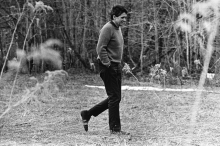
Here is a list of books written by and about Daniel Berrigan. This list is by no means exhaustive.