Israel

The images of civilian deaths and escalating violence in Israel and Palestine are heartbreaking. As this moral, political, and humanitarian catastrophe continues, we must urge our elected leaders to call for an immediate cessation of the current wave of violence, while also building the political will to interrogate the root causes of the crisis.
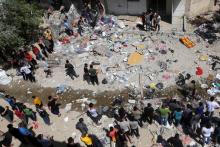
“Pray for the peace of Jerusalem!”
Palestine and Israel are back in the news. So again, we Palestinians hear this common refrain. But such calls are no longer enough. I say this as a pastor who believes in prayer, leads prayer services for peace, and genuinely values your good intentions.
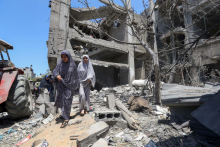
By May 14, reports indicated that at least 122 Palestinians, including 31 minors, had been killed and more than 900 wounded since May 10. In Israel, at least seven people were killed, including one child. While the immediate violence must be brought to an end, the realities of the ongoing Israeli occupation of Palestine cannot be ignored.

THE TRUMP administration was an utter catastrophe for those who care about justice and peace in Israel/Palestine. U.S. policy was entrusted to right-wing settlement supporters such as Ambassador David Friedman and Jared Kushner and Christian Zionists such as Secretary of State Mike Pompeo.
The administration applauded—and legalized—settlement expansion, showing utter disdain for international law. They displayed blatant antagonism to Palestinians by moving the U.S. embassy to Jerusalem, cutting off financial aid to Palestinian hospitals and the U.N. Relief and Works Agency for Palestine Refugees, and closing the Palestinian Liberation Organization office in Washington. They capped it all by promoting fake “peace” alternatives, such as Trump’s disastrous “Peace to Prosperity” plan and the normalization agreements with Gulf countries. These policies aimed to appease the most hard-right policies of Israel and the eschatological fantasies of evangelical Christian Zionists, rather than seeking genuine peace or justice.
The Biden administration is likely to reverse some of these extreme steps. Biden has already signaled, however, that he would not reverse the embassy move, nor support any measures for conditioning aid to Israel based on its behavior. Biden’s policy will likely be marked by a return to the traditional policies of the Obama era, which included anemic objections to renewed settlement expansion, verbal support for a two-state solution, and vague references to international law, while resisting any pressure on Israel to actually comply with international law or create a sovereign Palestinian state.
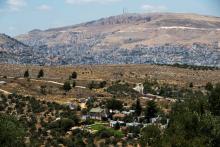
The government of Israel could soon begin formally annexing a significant portion of the West Bank. As the leader of an ecumenical and nonpartisan organization focused on advocating for a just and lasting end to the conflict in Israel-Palestine, I am deeply worried annexation will entrench inequalities and abuses of Palestinian human rights.
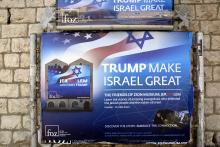
Trump’s latest executive order is yet another chapter in the spiritual story created by evangelicals.
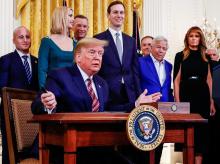
Trump's executive order undermines the freedom of Jewish self-definition.
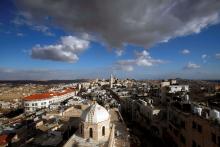
Gazan Christians will be granted permits to travel abroad but none will be allowed to go to Israel and the occupied West Bank, home to many sites that are considered holy to Christians.

As a Palestinian Christian who grew up in Jerusalem, I have a hard time knowing where, if anywhere, my narrative fits among the pictures evangelical Christians paint of Israel. I was reminded of this recently when an acquaintance of mine did a “holy land tour,” and posted travel updates that showed up on my social media stream.

Violence in the Gaza Strip has been raging for more than two months, with more than 115 casualties in the "Great March of Return" protests organized by Hamas, a militant group that controls Gaza. Since the end of March, Palestinians have been protesting to shed light on on the Israeli-Egyptian blockade on Gaza, and also call for the “right of return” for Palestinian refugees displaced since the 1948 war.
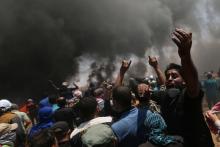
U.S. President Donald Trump announced last December plans to relocate the U.S. embassy from Tel Aviv to Jerusalem, in a move to recognize Jersualem as the capital of Israel, upending decades of U.S. policy and outraging Palestinians.
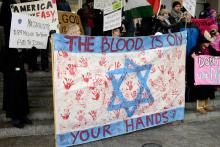
Portman’s protest touched a raw nerve not just because of who she is – a world-famous Jewish celebrity and a well-known supporter of Israel – but also because of whom she is seen to represent. Her outspoken opposition to Netanyahu has been portrayed as typical of her generation of young American Jews whose attitudes toward Israel tend to be more critical than that of their parents and grandparents.

MANY OF THE VOICES in this month’s readings seem to have “no filter.” They say what they think without adjusting it for politeness or theological correctness. In so doing, biblical paragons are presented as identifiably human, and God is seen as a God who welcomes our unvarnished truth. Here the raw human emotion acknowledges the complex terrain that is the human heart. The texts assume we feel, hurt, and occasionally want revenge; that we transgress and fear revenge; that we want forgiveness for ourselves but not necessarily for others. We can feel that God had gotten the better of us. Our experiences of God can be frustrating and painful. Like Jeremiah and Jonah here and Hagar (Genesis 16:7-14; 21:15-19) and Hannah (1 Samuel 1:9-11) elsewhere, these texts invite us to tell God about God and take our frustrations to God.
The scriptures call us to interpret them with regard to their ancient contexts and our contemporary ones. Israel/Judah, in any of its configurations, was one of the smallest and least powerful nations in its world. The scriptures were compiled and received their last edit when what was left of Israel was completely subjugated by a foreign power. That is not our contemporary situation as Americans. We may have been conditioned to read from the position of Israel, but we also need to read from the position of empires that subjugate. If God can bear us without filters, surely we can scrutinize our own imperial impulses.
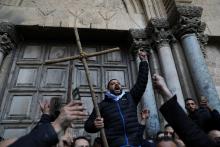
“It is absurd for Jerusalem residents to fund municipal services for the churches … on their own, and for the municipality to be prevented from collecting enormous sums that could significantly improve the city’s development and services,” Barkat said.

"We ask from you Mr. President to help us all walk towards more love and a definitive peace, which cannot be reached without Jerusalem being for all. Our solemn advice and plea is for the United States to continue recognizing the present international status of Jerusalem. Any sudden changes would cause irreparable harm.”

Peacemaking isn’t a passive withdrawal from conflict — it’s an intentional movement toward it with tools to understand, heal, and transform. It’s time for Christians across the U.S. to engage in this conflict in a helpful, curious way. I know there is a lot of confusion and complexity around this and, for the sake of my friends (Jews, Christians, and Muslims) in the region, as well as our collective wellbeing, I feel compelled to offer a few brief observations on today’s announcement by President Donald Trump on the U.S. embassy and the status of Jerusalem as the capitol.
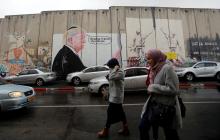
President Donald Trump will announce on Wednesday that the United States recognizes Jerusalem as the capital of Israel and will move its embassy there, breaking with longtime U.S. policy and potentially stirring unrest.

Trump announced the major shift in U.S. policy in a speech in which he detailed a more aggressive approach to Iran over its nuclear and ballistic missile programs and its support for extremist groups in the Middle East.
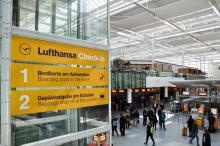
On Monday, five members of an interfaith delegation traveling to Israel/Palestine were prevented from boarding their flight. The reason? Their public criticism of the Israeli government’s treatment of Palestinians. “Very quickly we were given a list of names by the airline of people who were not allowed to board,” Alana Krivo-Kaufman from Jewish Voice for Peace told Sojourners. “They were instructed by Israeli immigration to not allow us to board the plane.”
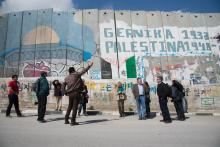
Early this month, the Mennonite Church USA succeeded overwhelmingly in passing a resolution in support of peace and justice in Israel/Palestine — and it was no easy feat. As an eyewitness and active participant to the activities leading up to this landslide vote, I can tell you the road there was tough, agonizing, and expensive.