Crucifixion
We love a good parade, don’t we? All that celebration, the noise, the crowds, the jubilation … It’s exciting and contagious and a little amazing how a good parade can impact us.
No one understood this like the Romans. These are the people of bread and circuses after all, and no one in the ancient world did empire better than the Romans. The Romans were incredibly good at subduing those people they had conquered. They celebrated the festivals of, raised up leadership from, and generally ingratiated themselves smoothly into the lives of those they ruled. But rule they did.
There certainly were people in Jesus’ time who thought Jesus’ work would be to overthrow the Roman oppressors — establish a political kingdom. Scholars surmise that Judas, the disciple who would betray Jesus to the empire, was one of these. Think of Judas as someone who saw the evils of the Roman Empire and desperately wanted Hebrew rule returned to the region. What we might today call a freedom fighter.
But throughout his ministry, Jesus talked explicitly about the Kingdom of God, the Kingdom of Heaven that is not of this world but is omnipresent, always at hand, constantly among us. And God’s. Period. A very different image of kingship, of dominion.

It baffles me when people who are deeply concerned about peace and peacemaking define themselves as “spiritual but not religious.” In pursuit of personal and/ or global peace, they shun organized religion in favor of indigenous spirituality. Celtic music, eastern spiritual disciplines like yoga and meditation, and the Native American relationship with nature all seem so attractive and obviously non-violent. I actually have nothing against any of those expressions of spirituality – allow me to offer as proof the trip my husband and I will be taking in July. We will be touring Northern Ireland to enjoy the “storytelling, music, art and peace” of Celtic culture “ancient and new. Great food, inspiring art, and beautiful journeys on foot will form the heart of this soulfully unique and transforming experience.” Sounds great, doesn’t it?
Normally this sort of description would not entice me. It sounds vaguely new age-y, all too “spiritual but not religious.” So why am I going? Because one of the tour leaders is my friend and brilliant cultural critic, the founder of the Wild Goose Festival, Gareth Higgins. Gareth understands that alternative forms of religiosity and spirituality are a necessary part of the revival of Christianity that is going on today, but he also understands that without “religion,” the pursuit of peace is at a serious disadvantage.
I am aware that such a claim runs counter to the primary reason many people give for being spiritual but not religious. They blame religion for violence and war, and there is no denying that many people have killed in the name of their beliefs. Somehow those who abandon organized religion believe that the cure for violence is to purge themselves of religious texts and doctrines that have any reference to violence in them. Why read the Old Testament or believe in a God who requires the death of an innocent victim to be reconciled to us? How could that possibly lead to a more peaceful world?

Even the winter won’t last forever. We’ll see the morning, we’ll feel the sun.
We’ll wake up in April, ready and able, Sowing the seeds in the soil.
Even the darkness cannot disarm us. We’ll see the morning, we’ll feel the sun.
-Audrey Assad
Easter is what many would argue to be the quintessential turning point of the Christian faith. The crux. The climax of the story. The thing that you must be able to articulate into carefully formed sentences depicting your belief, as though words and theology solely define your spirituality and very existence. Perhaps from all of this lies the basis for the trite messages that I, along with so many others, have heard about the Christian faith. “Jesus died for your sins.” “Jesus paid the debt.” “Jesus stood in your place and died for you so that you might have life.”
And if those words bear truth and meaning to you, I have not come to take them away, nor discredit them.
It’s just not the Jesus I’ve come to know, face-to-face in my human spiritual struggle.
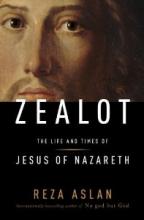
Reza Aslan begins of his book, Zealot: The Life and Times of Jesus of Nazareth, with a prescient warning: “Scholars tend to see the Jesus they want to see. Too often they see themselves—their own reflection—in the image of Jesus they have constructed” (xxxi).
I don’t think Aslan had himself in mind when wrote that statement, but you should be warned: the Jesus in Zealot is Aslan’s own false construction.
His central thesis is that the Jesus of history, and the God Jesus believed in, demanded violence in the face of political and religious oppression. Here’s one of the relevant passages:
[F]or those seeking the simple Jewish peasant and charismatic preacher who lived in Palestine two thousand years ago, there is nothing more important than this one undeniable truth: the same God whom the Bible calls a “man of war”(Exodus 15:3), the God who repeatedly command the wholesale slaughter of every foreign man, woman, and child who occupies the land of the Jews, the “blood spattered God” of Abraham, and Moses, and Jacob, and Joshua (Isaiah 63:3) the God who “shatters the heads of his enemies,” bids his warriors to bathe their feet in their blood and leave their corpses to be eaten by dogs (Psalm 68:21-23)—that is the only God that Jesus knew and the sole God that he worshipped. (122, emphasis in the original.)
The problem that I have with this passage is indicative of the problem that I have with the way Aslan constructs his Jesus. He constantly picks and chooses which verses from the Bible he uses to support his claim that Jesus was a warrior messiah whose goal was to violently overthrow the Roman and religious establishment. He peels away all passages that conflict with his construction so that he can show us what Jesus was truly like.
Well, what Aslan thinks Jesus was truly like.

IN THE PAST 150 years, the songs historically known as “Negro spirituals” have worn many costumes. They emerged, of course, from the Deep South during the days of slavery, when songs such as “Every Time I Feel the Spirit” or “Wade in the Water” were first sung by anonymous psalmists wielding hoes or pulling cotton sacks. Since that time they’ve been dressed in the style of the European art song, sung as grand opera, or even faithfully mimicked by well-meaning white folk singers.
The spirituals entered the mainstream of American culture through the performances of the Fisk Jubilee Singers from Fisk University in Nashville who, fresh out of slavery themselves, toured the North in the 1870s. In the 1950s and ’60s, the old standards were resurrected, and slightly rewritten, as marching songs for the African-American freedom movement and then echoed across the world as anthems for human rights from South Africa to Northern Ireland to Eastern Europe.
After all that, the spirituals can probably even survive being remade into “smooth jazz,” which is more or less what happens to them on Bobby McFerrin’s new album Spirityouall. Readers of a certain age might remember McFerrin as the guy who, in 1988, conquered the known pop music universe with an airheaded ditty called “Don’t Worry, Be Happy.” The tune was so infectious that it should have had a warning label from the Centers for Disease Control, but instead it dominated radio, won some Grammys, and, to McFerrin’s eternal horror, was used as theme music by the George H.W. Bush presidential campaign.

We tend to consider the crucifixion, the resurrection, and Pentecost in two ways primarily. We see them as history, stories about things that happened a long time ago. Or we consider them through theologies about what they mean for us after we die.
Yet, there is a deeper reality to all of them. The cross, the empty tomb, the moment of divine inspiration are repeated every day and everywhere. They’re ongoing and participatory.
Many experience those moments of inspiration each day. They’re moved to help someone who is hurting, inspired to care for those who are struggling, emboldened to try to change their world in some way. They sense something divine in the small moments of life. They stand up for anyone who is being treated as less than an equal child of God. They see love at work all around them.
Spirit-filled moments happen every day.

As Christians around the world gathered for Good Friday and Resurrection Sunday celebrations last weekend, I have reflected a great deal about the connection between the suffering and passion of Christ and the plight of the undocumented in our nation.
This past year, an amazing surge of activity and concern has emerged among believers in general, and evangelicals in particular focused on passing a new immigration policy in our country. This development is quite a surprise and change. In fact, 10 years ago it was almost impossible to find a recognized evangelical leader who was knowledgeable about immigration, let alone one who was willing to speak out on this issue.
At the core of why evangelicals have made such a dramatic change of heart is the reading of Scripture. While it is impossible to ignore that there are 92 references in Scripture where the word, 'ger' is used, speaking about the stranger in our land and our treatment of these individuals, it is not one single verse but the entire revelation of Scripture that points us towards our responsibility to love the most vulnerable people in our society.
Last weekend – Easter – was a time where all Christians remember the tragic end of Jesus’ life, as well as the miraculous raising of Jesus the Christ from his death. The week prior to Jesus’ death – Holy Week – is one where Christians focus on Jesus’ arrival and entry into Jerusalem, the hub of Israeli and Jewish power, amid excited and adoring crowds. As we read through and remembered this tragic story, we heard and saw the excitement and adoration of the people quickly turn, resulting in a call by the people to kill – crucify! – this man they so enthusiastically welcomed. Not only do the people cry for his death, but they answer Pilate’s question by declaring let “His blood be on us and on our children” (Matt. 27:25). The multitude, in other words, embrace the responsibility for Jesus’ crucifixion, whereas Pilate, ironically, acts like a good Israelite seeking to separate himself from a deed that violates covenant justice (Gardner, 390). The result of the people’s eagerness, which was fed, we are told, by the chief priests and elders’ ability to persuade the multitude, lead to the death of Jesus on the cross.
My fear, however, as we remember the horrible and horrific event of the crucifixion, is that we have forgotten much of its significance, both historically in Jesus’ time and for us today. What we now call the “substitutionary atonement theory” has understood the cross primarily as the beginning of salvation, and not also as the culmination of a radical life lived within an Empire. This theory has tended to disconnect the life-path chosen by Jesus from the salvation attributed to the cross. The cross, as represented in the New Testament, is both an end and a beginning. It demonstrates the predictable end of life lived in service to the Kingdom of God within an Empire. It also invites us into a future in which the power of this life-ending cross becomes the power of a cross-initiated life.

(The Controversial figure Rob Bell has created another firestorm with his latest provocative book What We Talk About When We Talk About God. Raven Foundation Education Director, Adam Ericksen and Tripp Hudgins will share our thoughts on the book in this blogalogue. We invite you to join the discussion by leaving a comment below.)
Tripp Hudgins always gets me thinking. He is right that Rob’s chapter “Open” in What We Talk About When We Talk About God is about science and religion but that it’s also not about science and religion. This is the longest chapter of the book, and it’s full of scientific information that points to the mystery of the material world. What’s the point? As Tripp states, Rob is “asking for a little humility. He’s asking for a little poetic imagination. He’s asking for curiosity.”
That’s the point of the next chapter, too. Titled “Both,” in this chapter Rob points out a major problem we have with “God-talk.” That problem is language. Tripp set me up for this at the end of his post by asking, “Are words actually enough? Ha! Write about that. Words. Words. Words.”
When I was in seminary I learned about apophatic theology, or negative theology. It tries to define God by what God is not. A 9th century apophatic theologian named John Scottus Eriugena asserted, “We do not know what God is. God Himself does not know what He is because He is not anything. Literally, God is not because He transcends being.”
The first Christians confessed that Jesus is "God from God, light from light, true God from true God." Jesus is, they finally confessed after centuries of dispute, who the Gospels and the apostles plainly tell us: God without qualification. Bethlehem's baby boy grew to be the man from Nazareth, who is also from before time and forever the only begotten Son.
Jesus tells Philip that he and the Father are one; that if Philip has seen Jesus, then Philip has seen the Father. Paul tells the Colossians that Christ is the visible image of the unseen God. The Hebrews are taught by their apostle that Jesus bears the very stamp of God's nature.
If anything we think we knew about God before Jesus arrives in Mary's womb contradicts what we see and hear of Jesus in the Gospels, then we are the ones who are mistaken, the ones who weren't paying close enough attention before he came (yes, Jesus reveals the same relationship-initiating God of holy love we encounter in the pages of the Hebrew Bible); we are the ones who have, since his decades of extravagant humility among us as one of us, forgotten the Christ.
“Liturgical celebration is a re-entrance of the Church into the event, and this means not merely its ‘idea,’ but its living and concrete reality.”
—Fr. Alexander Schmemann
You and I bring our life experiences with us when we gather with other Christ followers for worship. Everything that has happened to us on our pilgrimage in this world accompanies us, in fact, wherever we go.
Our past is part of what makes us unique persons. What we have endured and felt and accomplished informs our conversations and often helps determines our actions in the present moment. This is what it means to be human.
At the center of Christianity is a weird claim: that we have been saved by sacrifice. And it was a gruesome sacrifice at that, a snapshot of humanity at our worst, for the Christian claim is that what saved us was the torture and putting to death on a cross of an innocent man falsely charged as a criminal. Weird doesn’t begin to describe the strangeness of this idea. The talented and thoughtful writer, Colm Toibin, has taken the church to task regarding this claim. As quoted by Maureen Dowd about his one-woman show opening soon on Broadway, The Testament of Mary, Toibin says this: “The idea that we were somehow saved and redeemed by a crucifixion seems strange to me. The idea of human sacrifice is something we really have to think about, even people who are practicing Catholics, the idea of taking a single individual for the sake of any cause.”
I have been thinking a lot about the idea of human sacrifice lately. In fact, I’ve been up to my eyeballs in it because I’ve been editing a new introduction to Christianity by the Catholic theologian James Alison. At the center of his course is an insight about how a death on a cross could have redeeming qualities. Here’s how Alison understands what happened at the cross: Jesus did not invent human sacrifice and going to his death on a cross was not an endorsement of the torture and murder of innocent victims. It was an exposé. What we have in the Gospel accounts of Jesus’ Passion is a fairly complete picture of how human beings, without any assistance from God, have saved our own necks by crucifying someone else. We commit sacrifice when we scapegoat, demonize, marginalize, expel, persecute or kill others in the name of our own safety and security or to bolster our belief in our own goodness. As the Gospels tell us rather directly, enemies become reconciled when they can find a common enemy to unite against: “That same day [the day of the crucifixion] Herod and Pilate became friends with each other; before this they had been enemies.” (Luke 23:12)
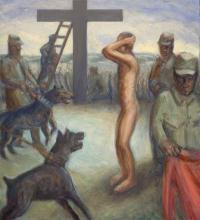
Hemorrhaging from the concertina
crown, brass knuckles, scourging, cigarette burns,
lurching the last meter of Golgotha
where He must dangle three hours in urns
of japing ether, He drops His bloody tree.
Executioners rip His clothes away,
cut cards for His keepsake convict jersey.

Writing books is a strange process. When you’re in the middle of creating something this big, it tends to consume your every waking moment in some way. I can’t watch TV or have a conversation with a neighbor without my mind searching the content for narrative or thematic threads to weave into the chapter I’m working on. It can be a little bit maddening, at least for those around us, I expect. But I love it.
One unlikely wonderful source for material as of late for me has been the show “Louie,” by comedian Louis C.K. To say he’s irreverent would be underselling his shock value. He’s a little bit like Trey Parker and Matt Stone of South Park fame in that he levels the playing field of propriety simply by making nothing off limits. Some might not be able to get past his coarse and occasionally nihilistic approach to life, but I consider him to be nothing short of prophetic in his observations about the human condition.
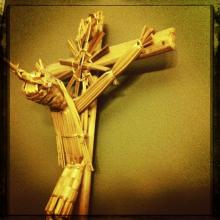
Good Friday. Is this something we can understand? What makes it so "good?"
Sure, we have theologies about this moment in history. We have systematic notions about why who and what. We tell the story every year. Some traditions reenact the tale more than once a year. If you attend a church from one of the "liturgical" traditions, you here the story told during the Eucharist every Sunday. "Christ has died. Christ has risen. Christ will come again." It's the Paschal Mystery told again and again. I also know some baptist preachers who tell the story of the Passion of Christ every Sunday. It is the Gospel, after all. This story, the Passion, is The Gospel for many of us Christian preachers. And to not share the Passion is to not share The Gospel. If their sermons don't end with the proclamation of the sarcifice of Jesus, well, then it just isn't Church.
I'm still sharing that e-unspoken part of my faith again. This is not new. Nor is it unintegrated with the rest of my Christian spirituality. It's actually essential to it. So, in the spirit of clarity, I'm sharing this stuff with you.
I have no idea what Jesus meant by giving himself over like this. We read the scripture last night at the Maundy Thursday service at First Baptist. "Not my will but your's." Lord, have mercy. Someone asked the question as someone does every year, "Why would God want Jesus to die? If it's God's will...Why would God will this to happen?" I have some practiced answers. This year I offered them as I usually do.
"First, let me tell you what the tradition says..." I give a theological gloss and watch their eyes glaze over. Right. Of course. This isn't an answer any more than a stump speech is an indication of what will actually happen if one of these people in the news are elected to public office. So, I move on.

“When you remember me, it means that you have carried something of who I am with you, that I have left some mark of who I am on who you are. It means that you can summon me back to your mind even though countless years and miles may stand between us. It means that if we meet again, you will know me. It means that even after I die, you can still see my face and hear my voice and speak to me in your heart. For as long as you remember me, I am never entirely lost. When I'm feeling most ghost-like, it is your remembering me that helps remind me that I actually exist. When I'm feeling sad, it's my consolation. When I'm feeling happy, it's part of why I feel that way. If you forget me, one of the ways I remember who I am will be gone. If you forget, part of who I am will be gone. "Jesus, remember me when you come into your kingdom." the good thief said from his cross (Luke 23:42). There are perhaps no more human words in all of Scripture, no prayer we can pray so well."
~ Frederick Buechner

Albert Camus once said that your life is “the slow trek to recover the two or three simple images in whose presence [your] heart first moved.”
Sebastian Moore recovered one of those images after he had wandered into church at vespers on the Feast of the Sacred Heart.
In his book, The Inner Loneliness, Moore describes that moment of awakening. It came one evening after lots of pasta, a lot of spaghetti, and a lot of wine. “As I entered the church, I heard the familiar words [in Latin] ‘One of the soldiers opened his side with a spear, and immediately there came forth blood and water.’ And I had what can only describe as a sense of fullness of truth. Somehow, everything that was to be said about life and its renewing was in those words. Somehow my life, my destiny, was in those words.”
The image that moved his heart became one to which he returns daily, as do I. For the piercing of the side of the helpless man hanging on the cross happened not just then and there at Golgotha; it happens here and there and everywhere when we torture our own souls or the souls of others because we, or they, have failed to measure up to what we expected. Strangely, it is in the piercing that brings blood that we are cleansed by the living water that pours from his side.
Do you see your life in the words and in the image of the spearing of his side, in the blood, but also the water that heals, restores and renews, flowing from his pierced side?
A second image came to me this week on a photography blog of religious architecture by Dennis Aubrey.
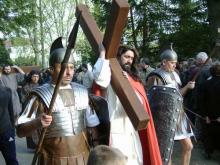
I’ve never liked the fact that we call the day on which we remember Jesus’ crucifixion “Good Friday.” What’s so good about it anyway? Personally I find the entirety of Holy Week – save for Easter – pretty depressing. Sure, the days are getting longer and things have started to grow all around us, but until Easter, the focus of the week is the suffering and death of an innocent man.
It turns out that, although plenty of folks have their own explanations, nobody actually knows why we call it Good Friday. I think the Germans are spot-on by calling it Karfreitag, which means “Suffering Friday.”
Figures the Germans would be more content to sit with suffering than the rest of us. They’re so serious! But I digress…

Here I am meditating on the broken body that holds the divine and the human in the mysterious way that only the Omniscient understands.
Today, I reflect on this body of Christ. It beckons me and I’m reminded once again that the violence and death that happened on that dark day lingers still.
It lingers still because we all are created in the image of God.

The music of Manchester, England is, for me, the soundtrack of my college years. The Smiths. Joy Division. Oasis. James. The Happy Mondays.
It was the music I danced to in Chicago nightclubs, the songs of seeming disillusionment that I walked around campus listening to (on cassettes and "cassingles" -- remember those?) on my Sony Walkman.
I love that music that put a spring in my step and gave voice to my youthful ennui. But I had never thought of it as particularly spiritual music...that is until earlier this week when my charming British colleague, Jack Palmer, brought to my attention The Manchester Passion, an hourlong 2006 BBC special broadcast of a massive public reinactment of Christ's passion and crucifixion staged in a public square in Manchester set to the music of that enigmatic northern city in England.
The Manchester Passion took the music and lyrics of The Smiths and their Manchunian contemporaries and used them -- brilliantly and powerfully -- to retell in a thoroughly modern milieu the greatest story ever told.