climate crisis

Ezra Craker 2-19-2026
Vigil, by George Saunders / Random House

LITERATURE IS PEPPERED with powerful men who, after lives of dangerous consequence on Earth, grapple with the eternal judgment of heaven. Dante filled his inferno with the writhing wrongdoers of his day. Dickens gave us Ebenezer Scrooge, whose festive ghosts spooked him into more socialistic thinking. And who can forget the time when President Donald Trump himself publicly mused that he might not make it to heaven, after all? Literature and, every once in a rare while, life.

In his crackling new novel, Vigil, George Saunders offers another such fable for the climate crisis. Unrepentant on his death bed, oil tycoon K.J. Boone receives visitors from the past, present, and future who hope to hold him to account for his sins. Species of birds wiped out by habitat loss fly over his hospice setup; human casualties of heat waves and droughts testify. Bearing witness to the barrage is Jill, a ghost-angel charged with comforting Boone as he crosses over.

Faisal Bashir 8-21-2025

AS A PHOTOJOURNALIST, I have witnessed firsthand how climate change is shaping life in Kashmir, from snowfalls and receding glaciers to scorching heat waves and erratic rainfall. I have seen rivers drying, houseboats sitting in the dried portion. [This June] when I reached the outskirts of the capital city, Srinagar, kids were playing, bathing, cooling themselves during an intense heat wave.

Liuan Huska 8-21-2025
Gerilynns / iStock

FOR YEARS, I’VE been halfway out the church door when it comes to finding spiritual resources that support my deep grief over our sick planet. While there are a growing number of faith leaders teaching on climate change, I confess it sometimes feels too late for people like me who are already losing confidence in institutional Christianity. It’s easier, often, to join like-minded people beyond church walls.

But today I still go to church. In fact, I’m working with A Rocha USA, a nationwide creation care group, to launch a yearlong program for churches in my area yearning to respond faithfully and practically to creation’s groans. Why stay here, rather than turning my energy toward other environmental efforts?

The harvest is ripe. More and more Christians from across the theological spectrum want their faith communities to do something about our environmental crises. A Rocha USA regularly receives requests from churches asking for practical creation care support. These churches might not readily partner with secular environmental groups, but having a theologically credible guide makes all the difference between concerned paralysis and meaningful action.

Churches and denominations also own a significant portion of land around the world. Changing land stewardship practices in a few churches has the potential to ripple across networks and shift norms. What if it became as normal for a church to convert a portion of their land to growing native plants as it is for a church to run a neighborhood soccer ministry?

Illustration by Franziska Barczyk

TEMPERATURES ARE AGAIN breaking records around the world, a now grimly familiar annual event. During an early summer heat dome over much of the country, a much-shared video showed a car in Missouri go airborne as it hit pavement severely buckled by the extreme heat. 2024 was officially the first year that the world eclipsed a 1.5 degrees Celsius surface temperature rise above the pre-industrial standard — busting through the ceiling for temperature rise that was agreed to in the Paris climate accords. Worse, the Trump administration seems determined to reverse as many of the Biden administration’s climate accomplishments as possible — undoing progress that, while insufficient to the scale of the crisis, was still a step in the right direction.

As Christians, how do we reckon with the reality of the climate crisis, not as a future hypothetical but a present reality? A text that comes to mind is Psalm 24:1-2: “The earth is the Lord’s, and everything in it, the world, and all who live in it; for God founded it on the seas and established it on the waters.”

When I think about this text, I feel both righteous anger and grief for what human beings, each of us created in God’s image, have wrought upon God’s world. Yet at the same time, I have long believed that we have a responsibility as believers to be prisoners of hope — followers and instruments of a Lord and liberator who is alive and continually at work in the world to make all things new. As the recently departed Walter Brueggemann put it, “God is doing something lively in the world ... it may be slow, but it is very sure ... a new world is coming into being.”

4-03-2025
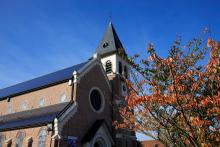
Solar panels of a photovoltaic solar power installation are seen on the roof of a church in Loos-en-Gohelle, northern France Oct. 31, 2015. Credit: REUTERS/Pascal Rossignol.

Nearly 90% of U.S. Christian religious leaders believe humans are driving climate change. When churchgoers learn how widespread this belief is, they report taking steps to reduce its effects, as we found in our research published in the Proceedings of the National Academy of Sciences.

We examined data collected in 2023 and 2024 from a nationwide survey of 1,600 religious leaders in the United States. The sample included religious leaders from fundamentalist and evangelical churches, Baptists, Methodists, Black protestants, Roman Catholic denominations and more – all recruited to match the proportions of churches across the country. The survey assessed religious leaders’ beliefs about climate change and whether they discuss climate change with their congregations.

According to that data, while the overwhelming majority of Christian religious leaders accept the human-driven reality of climate change, nearly half have never mentioned climate change or humans’ role in it to their congregations. Further, only a quarter have spoken about it more than once or twice.

Mitchell Atencio 8-13-2024
Lydia Wylie-Kellermann. Graphic by Ryan McQuade/Sojourners

Over the course of my life, I have been part of political communities that placed high emphasis on the perceived future of hypothetical children.

On the Right, “think of the children” is at the forefront of the movements to end abortion and diminish protections for LGBTQ+ people. On the Left, you’ll hear the same rally cry for movements that aim to reduce climate change or increase gun control. The invocation of children holds serious power. It makes us step outside our own self-focused considerations and instead wonder about a group with minimal power and autonomy.

Rebecca Randall 3-07-2024
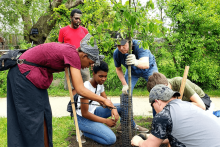
Volunteers from Calvary Reformed Church plant trees in their Cleveland neighborhood in 2019. Courtesy Calvary Reformed Church.

In a Cleveland neighborhood, a set of 25 young trees line the space between the sidewalk and the road. The trees were planted by volunteers from Calvary Reformed Church in 2019, an example of the types of actions that churches can take to address rising heat in their neighborhoods. Now, thanks to 2022’s Inflation Reduction Act, nearly $1 billion will fund similar projects across the nation.

Liuan Huska 5-18-2023
Dusan Stankovic / iStock

I NODDED ALONG with everything in the holistic permaculture course until day four, when things went off the rails. My family and I were at a farm in Bolivia, volunteering and learning about land design, groundwater recharging, alternative energy technologies, and returning fertility to the earth. Day four’s topic was community-building, which sounded innocuous enough.

Our host and instructor was a man from New Zealand who has farmed two acres in a remote Bolivian valley for nearly a decade. He talked about the importance of local decision-making, how focusing on global problems over which we have little influence can leave us feeling disempowered. Human-induced climate change, he added, is another story the oligarchs at the top are telling to stoke our fears and get us to surrender our freedoms. That and the pandemic.

Our host’s views are extreme. But he is among a growing group of back-to-the-land conservatives who don’t fit my categories. He disbelieves mainstream climate science, yet he is installing solar ovens, composting toilets, and bioconstructed buildings on his property. He scoffs at “wokeism,” which he sees as another form of top-down control, yet he deeply respects the local Indigenous community and attends the Quechua-only neighborhood meetings with surrounding farmers.

5-18-2023

The Enneagram's potential for building community and creating a more just society.

Christina Colón 11-10-2022
Illustration by Cássia Roriz.

THE IMAGE THAT first brought Ugandan climate activist Vanessa Nakate to many people’s attention is one that doesn’t even include her.

In January 2020, Nakate was invited to join five other young activists in a climate demonstration during the World Economic Forum annual meeting in Davos, Switzerland. An Associated Press photographer snapped a photo of Nakate standing with European climate activists Luisa Neubauer, Greta Thunberg, Isabelle Axelsson, and Loukina Tille. But when the AP published the photo that afternoon, Nakate wasn’t in it.

“Even now, well over a year after being cropped out of that photograph, it’s hard for me to talk about what happened,” wrote Nakate in her 2021 book A Bigger Picture: My Fight to Bring a New African Voice to the Climate Crisis. “By cutting me out of the photo they’d originally sent to global media organizations, the AP had denied an African activist a chance to be seen and, possibly, her message to be acknowledged.”

While the AP did some “soul-searching” following the incident, Nakate used the moment to ignite an overdue conversation about the whiteness that has long plagued the global environmental justice movement. “Being cropped out of the photo changed me,” she wrote. “I decided, from my perspective as a young African woman, that I would dedicate as much of my time as possible to addressing the many interlocking facets of the climate crisis, environmental justice, and gender discrimination — and to do so without apology or fear of erasure.”

Nakate founded the Rise Up Movement to amplify the voices of climate activists from Africa and launched a fundraising campaign for the Vash Green Schools Project to bring solar panels and cookstoves to schools across Uganda. At 25, she’s busy. And faced with a global climate emergency, it makes sense. “I don’t often get asked what recharges me,” Nakate told me when we spoke in early August. “But for me, it’s my relationship with the Holy Spirit.”

Raised in an Anglican family, Nakate became a born-again Christian as a teenager. “Activism can be very hard and prayer and attending services (or, in Covid times, watching online) have been extremely important sources of love, grace, and support,” she wrote in the acknowledgments of A Bigger Picture.

“If I feel distraught or disturbed by anything, I know the Holy Spirit will remind me of the peace that surpasses all human understanding,” she later told me. I spoke with Nakate via Zoom about her Christian faith, the role social media plays in her activism, and why we can’t eradicate poverty without addressing the climate crisis. — Christina Colón


Sally Monroe 11-10-2022
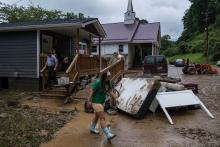
A local fire chief and his daughter drop off goods for a neighbor in July near Drushal Memorial Brethren Church in Lost Creek, Ky. At least 39 people died due to floods in eastern Kentucky. / Seth Herald / AFP via Getty Images

Sally Monroe is an elder at First Presbyterian Church of Hazard, Ky. With her husband Lawrence, she spoke with Sojourners’ Mitchell Atencio.

OUR HOUSE IS completely gutted. All the Sheetrock is gone, the flooring’s gone. It’s just a shell. The water came very quickly. Our neighbor who had a house on River Caney got about two and a half feet of water in his house, but it came very rapidly, and their house was washed away. Our situation is different. We live in the valley a half-mile from the river. We had no idea how high the water could get. We didn’t get the current, and the water came up rapidly ... some pictures from this flood where buildings were just washed off their foundations — it’s horrible to see those homes like that.

Adam Russell Taylor 11-10-2022
Illustration by Pete Ryan

IN AUGUST, President Joe Biden signed the Inflation Reduction Act (IRA), the most significant legislation ever passed by Congress to address climate change. But what happens now? After all, the days aren’t getting any cooler — a recent study by the First Street Foundation suggests that in 30 years more than 100 million Americans could experience heat index temperatures over 125 degrees Fahrenheit. In our polarized politics, there is already a great deal of confusion and obfuscation about what this historic bill will do. A related question: How will the IRA affect what people of faith do about the existential threat of climate change?

The IRA invests $369 billion over the next 10 years into tax incentives for renewable energy and electric vehicles, domestic manufacture of batteries and solar panels, and pollution reduction. The idea is to make renewable energy and electric vehicles more affordable, both to manufacture and to buy, thus encouraging more consumers to adopt them. The IRA also targets methane pollution by imposing an escalating fee on some oil and gas companies that emit too much methane in their operations and increasing royalty rates paid to the government on methane extraction from public lands. The IRA includes an unprecedented investment of $60 billion into environmental justice initiatives, including clean energy and emission reduction for low-income and disadvantaged communities, block grants for community-led projects in disadvantaged communities to “address disproportionate environmental and public health harms related to pollution and climate change,” and funding to reconnect communities divided by highways.

11-10-2022
Cover design by Cássia Roriz

Activist Vanessa Nakate on Jesus, erasure, and the climate crisis in the Horn of Africa.

Bill McKibben 11-03-2022
melitas / iStock

I’VE WRITTEN ABOUT immigration in these pages before, so forgive me if I seem to be repeating myself. However, any of us who spend time with the Bible know that repetition is among its most important characteristics. We get the same message over and over, until it sinks in. Here’s Leviticus 19:34: “You shall treat the stranger who sojourns with you as the native among you, and you shall love him as yourself, for you were strangers in the land of Egypt.” And here’s Leviticus five chapters later: “You shall have the same rule for the sojourner and for the native.” Everyone knows Matthew 25:35: “I was a stranger and you welcomed me.” But sometimes we forget the wonderfully hopeful verse from the letter to the Hebrews: “Do not neglect to show hospitality to strangers, for thereby some have entertained angels unawares.” Bottom line: This is clearly important work for Christians, or at least it was 2,000 years ago.

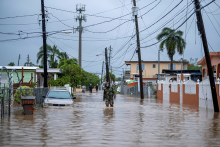
A member of the Puerto Rico National Guard wades through water in search for people to be rescued from flooded streets in the aftermath of Hurricane Fiona in Salinas, Puerto Rico Sept. 19, 2022. REUTERS/Ricardo Arduengo

O God of all creation, as ocean waters warm, / we grieve the devastation that comes with violent storms. / We pray for people struggling— who need your help and grace / on every flooded island and in each flooded place.

Hannah Spiro 9-12-2022
U.S. President Joe Biden hands his signing pen to U.S. Senator Joe Manchin III (D.-W.va.) as Senate Majority Leader Chuck Schumer (D-N.Y.) and U.S. House Majority Whip James Clyburn (D.-S.C.) look on immediately after Biden signed “The Inflation Reduction Act” of 2022 into law during a ceremony in the State Dining Room of the White House in Washington, U.S. August 16, 2022. Credit: Reuters via Leah Millis.

The Inflation Reduction Act (IRA) does not go nearly far enough to fight the root cause of climate change. These are the root causes of the global climate crisis that policy needs to address: The greenhouse gas pollution that comes from burning fossil fuels for energy and transportation, unsustainable agriculture, toxic waste, and climate-altering industrial practices. Biden must use his executive authority to address the shortcomings of the IRA and act swiftly and decisively to protect the Earth.

Rebecca Randall 8-08-2022
Photo Illustration by Mitchell Atencio/Sojourners. Original images by Michael Maasen and Aaron Burden via Unsplash.

The June release of a Climate Vigil The Porter’s Gate Worship Project aims to nudge Christians toward climate action, but it isn’t alone among contenders to inspire the climate movement. For over 20 years, Carolyn Winfrey Gillette, a Presbyterian minister from New York, has written hymns for the times, including one for the 2021 UN climate talks held in Scotland and several to recognize increasing natural disasters such as wildfires, hurricanes, and floods. Fossil Free PCUSA, a campaign within the Presbyterian Church (USA) has used hymns in protests, including songs by Christian artist Matthew Black.

Matt Bernico 7-29-2022
100 percent compostable Green recyclable coffee cups made with no plastic. Via Alamy.

Amid the avalanche of rogue supreme court decisions that have come out in the past few months, there’s one that has slid under the radar: West Virginia v. EPA.

Christina Colón 7-19-2022
Isis Macadaeg, age 7, plays in a spray park at Jefferson Park during a heat wave in Seattle on June 27, 2021. REUTERS/Karen Ducey

One hundred- and eight-degrees Fahrenheit. According to the University of Washington, that June day in 2021 was the hottest day ever recorded in the city of Seattle. And my fourth-floor apartment did not have air conditioning.

Liuan Huska 4-07-2022
In Deep Waters: Spiritual Care for Young People in a Climate Crisis, by Talitha Amadea Aho

“WHO ARE THESE young people?” I asked repeatedly while reading Talitha Amadea Aho’s debut book, In Deep Waters: Spiritual Care for Young People in a Climate Crisis. The Presbyterian pastor writes of her adventures shepherding the youth of her Oakland, Calif., church through beach trash pickups, worsening fire seasons, the pandemic, and mundane youth group activities that lead to big conversations on God’s involvement and human response amid climate emergency.

Aho recounts driving a van full of youth near the 2018 wildfire that destroyed Paradise, Calif., to get to a retreat. “Whatever, we can deal with it. Breathing isn’t the only thing in life,” says one youth. Another, like a prophet, observes, “The Earth will survive; it’s a living organism, and we are the infection on it, and the Earth is cooking up a fever to kill us off.”

It may be that these West Coast youth are more clear-eyed in their diagnoses, living through an apocalyptic reality that we are all careening toward. I can imagine having similar talks with my own children, ages 3 through 8, in a few years. Already, my 8-year-old has said about climate change, “It’s too late.”