climate crisis

Hayhoe’s passion for climate science is based in her Christian faith. Hayhoe is an evangelical, which she defines as “someone who takes the Bible seriously.” For her, faith and science go hand in hand: The more that she learns about science, the more her “awe” and faith in God increases.

THE IRRITATING THING about the Bible—well, one irritating thing about it—is that it keeps instructing us, in unambiguous terms, to do things we don’t want to.
On the first page it tells us to take care of the earth, which is quite embarrassing now that we’re fiddling with the thermostat and killing off large numbers of the creatures that we are supposed to look after.
Of course, it gets much worse once we reach the gospels and we’re told to take care of the poor and—well, I mean, come on, stop the steal. Nastiest of all is the quite specific demand to welcome the stranger. Clearly, we’re not into that—nearly three-quarters of white Christians voted for the candidate whose senior policy adviser, Stephen Miller, once said, “I would be happy if not a single refugee foot ever again touched American soil.”
These various unreasonable demands become even more unreasonable as time goes on, because they start to converge. Because we failed to take care of the earth, instead burning massive amounts of coal and gas and oil, we raised the temperature, and because hurricanes draw their power from the heat in the ocean, we now have more of them—this past season we set a record in the Atlantic, with a nonstop procession of storms that exhausted the regular alphabet and drove us deep into the Greek one. Hence, it was storms Eta and Iota that crashed into Central America in November, causing incredible wreckage: By some early estimates, Honduras saw damage equivalent to 40 percent of its GDP. (Katrina, one of America’s worst storms, cost us 1 percent of our GDP.) Not surprisingly, Honduras is now an even more difficult place to live—indeed, for many people an impossible one, given that food and shelter, which are actually necessary for survival, can’t be found.
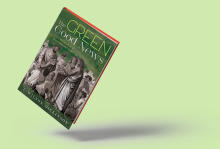
2020 WAS A YEAR of ecological breakdown. Simultaneous climate disasters have roared, including the worst wildfire season in the history of California and, as I write this, the most active hurricane season on record in the Atlantic. Meanwhile, freak wind storms called derechos plagued the Midwest and heatwaves baked the Southwest. In the midst of such devastation, it can seem downright irresponsible to search for hope. Yet, the paradoxical call of the cross is that, in the deepest darkness, joyful and beautiful transformation might be possible.
In The Green Good News, T. Wilson Dickinson does not settle for platitudes of hope. He does not affirm, as is so tempting for Christians, that all will be fine because of faith in God. Instead, Dickinson finds good news in the possibility of a beautiful and joyful set of responses to ecological breakdown. With humble writing grounded in stories of his own life, Dickinson offers a reading of scripture that does not separate the liberation of creation from the liberation of the poor but follows the vision of Jesus, in whom all creation—human and more-than-human—holds together. In a refreshing move, The Green Good News sheds the romanticism of creation care in favor of a biblically based environmental justice from the margins. Dickinson unequivocally offers a call to conversion from neoliberalism to solidarity with all oppressed creatures. This ecological conversion takes place at the heart of the Christian witness: the table.

WHILE THE CLIMATE crisis has reconfigured our relationships with each other, other creatures, and our places, fiction has not. It remains focused on the human’s internal, moral journey, as if human life is something circumscribed from the rest of creaturely life. Gun Island is a much-needed antidote to the anthropocentric ideal of the novel, one that meets the age of climate change with stories that are true to the new dimensions of relationships unfolding around us.
In his first novel since his nonfiction masterpiece The Great Derangement, in which he laid out a vision for a climate-changed literature, Ghosh illustrates the agency of nature: how in this Anthropocene age, shaped by human activity, our porous lives are intertwined with those of our nonhuman interlocutors, who become increasingly present in our lives through climate-change-driven typhoons, fires, and species migration. He tells a story of stories, not recasting the tales of modernity, but reaching back into Bengali folklore to guide us through this uncanny age. For, as one of Gun Island’s characters says, “Only through stories can invisible or inarticulate or silent beings speak to us; it is they who allow the past to reach out to us.”
ALMOST FROM THE first day of the COVID-19 crisis, the question in the back of many minds has been: How soon will this be over? When can we get back to normal?
For irresponsible people, the answer has been: Now. Schooled by a lifetime in a consumer society, deprivation of any kind seems impossible, hence the pictures of people demanding, sometimes at gunpoint, that the barber shop or sports bar be opened back up.
For more responsible souls, the answer has been: Once we have enough tests. Or once we have good treatments for the coronavirus. Or once we have a vaccine.
But the real answer, in some sense, may be never.
Because, of course, this pandemic is just one crisis buried within a much larger one: the reaction of the natural world to the demands placed on it by a species making unprecedented demands.
Before we run head first into 2020 and all of the stressors of the coming election season, we wanted first to reflect on last year — to take a look at the top 10 stories that shaped our coverage, the commentary that spurred conversations, and the reflections that stirred the soul — and how the work will continue in the new year.
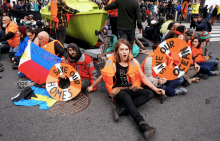
Being baptized at the Trafalgar Square protest site was not a publicity stunt for me. I had been Christened as a child, but still, receiving adult baptism was a choice I didn’t make lightly. I reaffirmed my baptismal vows at Extinction Rebellion because I needed God right beside me.
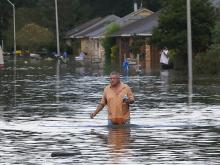
No matter where we are, the climate crisis is not far from home.
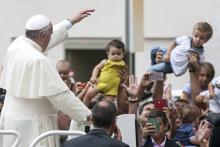
For some time it has largely been the world’s most vulnerable, in the global south, bearing the brunt of suffering and climate-induced devastation. Those who have the power to change things have so far all but ignored “the cry of the poor and the cry of the earth,” as Pope Francis wrote in his encyclical a little over a year ago.
But just this past month in the United States — one of the world’s wealthiest nations — we have seen historic droughts, unprecedented floods in Louisiana, and wildfires in California, killing many and displacing tens of thousands.
More than 300 rabbis — inspired by the climate crisis, the Torah’s call for a Sabbatical Year of releasing the Earth from overwork, and the impending Papal Encyclical on the climate crisis — have joined their voices in the Rabbinic Letter on the Climate Crisis: a call to action to prevent further climate-fuelled disasters and work toward eco-social justice.
Rabbis from across the denominational spectrum, at this writing 333 in all, signed in support of the call in less than two weeks, and their signatures continue to grow.
Expressing her opinion that climate change is no longer about energy efficient behavior but rather about national policy, spiritual leader Marilyn Sewell argues the importance of what it takes to preserve the Earth’s atmosphere. Expressing her concerns about the lack of community and church involvement, Sewell insists policy immersion is crucial toward resolving future matters surrounding climate change. The Huffington Post reports:
So where is the parish church in all of this? Mostly silent, it seems. Churches continue to be concerned with individual sin as opposed to systemic sin, even in regard to climate change. Congregants may be admonished to recycle and change their light bulbs, but not to become politically active. The fact is we're way beyond changing our light bulbs. We need to bring that unhappy, startling truth to the pulpits of our land.
Read more here.

The day after the Washington Post announced it was moving its top environmental reporter off the green beat to cover politics at the White House, this op-ed went up toeing an uncomfortably familiar line: by speaking out against the Keystone XL pipeline, environmentalists are “missing the climate-endangered forest for the trees.”
Leaving aside for a moment the uncomfortable irony of being reprimanded for missing the big fight by an outlet that is reshuffling focus on that very front: the editorial board, respectfully, is wrong. Not that it doesn’t have a point, but that point is concrete and incremental – and misses the entire meaning of the forest of protests over the last 18 months.

Good news: Evangelical Christians are stepping back up to overcome the climate crisis.
After months of careful preparation, a new national advocacy initiative called Young Evangelicals for Climate Action (Y.E.C.A.) has just gone live.
In seeking to live as Christ’s disciples, Y.E.C.A. has come to see the climate crisis not only as a pressing challenge to justice and freedom, but also as a profound threat to “the least of these” with whom Jesus identifies in Matthew 25. The early effects of climate change are already impacting many of our neighbors, both in the U.S. and around the world, and our time to act is running short.
The earth dries up and withers ... The earth is defiled by its people; they have disobeyed the laws, violated the statutes, and broken the everlasting covenant. - Isaiah 24:4-6
Today I have given you the choice between life and death, between blessings and curses. Now I call on heaven and earth to witness the choice you make. Oh, that you would choose life, so that you and your descendants might live! - Deuteronomy 30:19
During the 1980s, many Christians were at the forefront of a movement to avert nuclear annihilation. They saw this transcendent threat as a moral crisis and felt a responsibility to nonviolently resist, including acts of civil disobedience and divine obedience. Today, we face a comparable danger -- a climate catastrophe which could decimate life on earth. Yet it seems not to have been picked up on the Christian "radar screen" in the same way. For this reason, it is actually more insidious.
There's this place near our home called Kiddie Land. It's sort of this epic little corner nearish to the city that, for 80 some years, has boasted good times for kiddos. Think wooden roller coasters from the '30s, a wooden carousel, and rides that make you feel somehow like you are on a boardwalk in Atlantic City or someplace like that in the '20s.