[Match] Stand for Truth. Work for Justice. Donate

Watch for the Morning Star

February reflections on scripture from the Revised Common Lectionary, Cycle A.

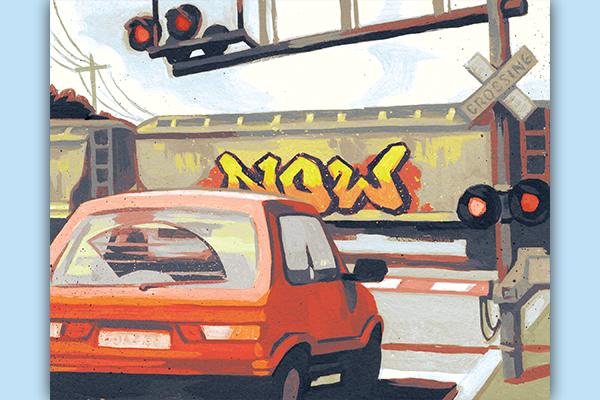
Illustration by Jocelyn O’Leary

I’M GOING TO be real with you. I experienced a good bit of religious trauma in my ultra-evangelical, fundamentalist upbringing, and I’ve spent decades healing. What has shocked me, though, is the harm I have experienced and witnessed inside progressive faith circles—places where, in theory, we shared theology and values. It turns out people of any persuasion can fall prey to the temptation of superficiality rather than depth, performance rather than sincerity. It was a rude wake-up call, but hopefully the kind of disillusionment that keeps a gal genuine.

February’s texts draw us into humble evaluation of where we are and challenge us to a depth of commitment that can’t be faked or flaunted or rushed. Imagine you’re driving somewhere in a big hurry when (with the worst luck!) you’re forced to stop for a passing train. You impatiently tap on the steering wheel until you look up and notice that each passing boxcar is painted with a word. “Take. A. Breath,” say the train cars, “Go. Ahead. You. Have. Time. The. Lesson. Is. Now. Not. At. Your. Destination. Now.”

So, you take a deep breath. And then another. Because what else are you going to do? The train is no longer wasting your time. It’s become your teacher. My prayer is that these reflections function like those imaginary train cars, slowing you down just when you were running on urgency.

February 1
Tie Me to the Mast

Micah 6:1-8; Psalm 15; 1 Corinthians 1:18-31; Matthew 5:1-12

“DO JUSTICE, LOVE kindness, walk humbly.” Micah 6:8 has long been tattoo fodder for Christians. It shouldn’t be edgy. But it is. All of these lectionary texts are “woke” enough to be banned reading in today’s America. Reportedly, some pastors have even been scolded and criticized by congregants for preaching Jesus’ own words from the beatitudes. I could wax on about the hypocrisy of some on the religious right but to what point?

Instead, I’m treating these texts as the mast to which I must bind myself because the siren song is strong, yes, even for progressives. I don’t read these justice-laden texts to feel smug about my values. I read them religiously—as an act of devotion, as a renewal of vows, as a pledge I must repeat lest I succumb to the glint of greed or the gleam of my privilege—or worst of all, fall prey to the illusion that I am already all the way woke up. I don’t read them to wallow in shame or shed white tears either. I read them to remember who I am and who we are. To remember who we are becoming even in the face of so much peer pressure to be terrible to one another. In times like ours, these are the right texts to read. But let’s not read the right texts for the wrong reasons.

In God’s economy, restoration is always possible.

February 8
Pass The Salt

Isaiah 58:1-12; Psalm 112:1-10; 1 Corinthians 2:1-16; Matthew 5:13-20

MY 7-YEAR-OLD LOVES salt, constantly sneaking extra onto her fries or chips when I’m not looking. She would appreciate it more than most, I think, to know that Jesus called us salt. She’d take it as a real compliment, not to mention she’d immediately understand the horror of salt that loses its saltiness. Of course, these are first-century problems of which Jesus speaks. Table salt today rarely loses its saltiness, but in Jesus’ day, when the salt was mixed with chemical impurities or exposed to moisture, it could, and you’d be left with tasteless powder. There is no “fixing” tasteless salt, but my daughter would have known just what to do: Grab more salt! Shake, shake, shake. Unlike her mother, Jesus wouldn’t stop her. “More! More!” they’d both laugh, watching the salt blizzard. Not religious restraint but holy, joyful abundance.

In Isaiah, the people are frustrated: “Why do we fast, but you do not see?” (58:3). They are denying themselves, but God is not remotely impressed. Why indeed? Because the ritual is empty. Saltless. With one of my favorite descriptions of right religion in all of scripture, God responds like this: “Is not this the fast that I choose: to loose the bonds of injustice, to undo the straps of the yoke, to let the oppressed go free, and to break every yoke?” (58:6). And if you do this, if you turn from empty ritual to feeding the hungry for real? “Your light shall rise in the darkness and your gloom be like the noonday” (58:10).

The saltiness of tasteless salt cannot be restored, and the bad salt would get thrown out. But not in God’s economy. Here, restoration is always possible.

February 15
Bright Morning Star

Exodus 24:12-18; Psalm 2; 2 Peter 1:16-21; Matthew 17:1-9

LET’S BE HONEST: The Transfiguration is weird. Moses and Elijah magically appear. Jesus glows. Clouds talk. Peter wants to build some tents. Even so, the author of 2 Peter encourages us to be attentive to this story “as to a lamp shining in a dark place, until the day dawns and the morning star rises in your hearts” (1:19). In Revelation 22:16, the morning star is a reference to Jesus (He’s shiny again!), and in astronomy it often refers to the planet Venus, which appears brightly in the eastern sky sometime before sunrise. Jesus as herald of the sun: a new age, the realm of God. When society’s norm is injustice and oppression, let us hope Jesus, our morning star, is very, very weird.

You know what’s also weird? The entire book of Revelation. I bring it up for a reason, because Revelation is all about John telling the people to take a stand against empire, but in metaphor so his writings don’t get burned (or banned or whatever). In chapter two of Revelation, part of the metaphor is this: Those who persevere in the face of destructive powers will receive the morning star.

I can understand Peter’s strange instinct to build tents. When hope arrives, I want to bottle it up too. Keep it safe. Stay put and protect. Instead, Jesus sent them back down the mountain to meet the world where he and his shine will be exposed to the vulnerabilities of death and defeat. They have to trust that the day will still dawn, even when things get bleakest. You and I may not spot Moses or Elijah anytime soon, but there are always glimmers of the righted world that is yet to come. The trick is to pay attention and carry on.

Let’s be honest: The Transfiguration is weird.

February 22
A Slow Simmer

Genesis 2:15-17, 3:1-7; Psalm 32; Romans 5:12-19; Matthew 4:1-11

MY FAVORITE STORYBOOK Bible, The Book of Belonging, describes eating from the tree of knowledge in Genesis like this: “It was like pressing fast-forward on their lives. Like turning four and then 44. Like going to college right after kindergarten. They missed out on the wonder of living and learning!” Have you ever encountered that—the temptation to microwave wisdom when it calls for a slow simmer? We are inundated with offers of quick fixes and “six easy steps,” and I understand the appeal, because who has the time to take it slow and “move at the pace of guidance,” as author Christina Baldwin puts it? I am reminded of a lecture I heard by Catherine Meeks, founder of the Absalom Jones Episcopal Center for Racial Healing. She said the center always got a lot of calls after big terrible events, such as the murder of George Floyd. “What can we do?” everyone wanted to know. But Meeks’ advice was to pause and listen before taking action.

Jesus spent 40 days in the wilderness before beginning his ministry. I wonder what seminary education would be like if it required that sort of lengthy and intentional pause instead of the rush to turn in term papers? If our deacons’ meetings started with extended silences and our activism flowed from contemplation rather than angst? What might change about the tenor or quality or effectiveness or sustainability of our response? Maybe God didn’t say “no” to the tree of knowledge because God is anti-knowledge, but because knowledge isn’t the same as wisdom and wisdom never comes from a single bite. No one has the time for wisdom these days. Maybe that makes it all the more important that we make time.

This appears in the January/February 2026 issue of Sojourners