‘America First’ Resurrects the Logic of Crusades in Venezuela

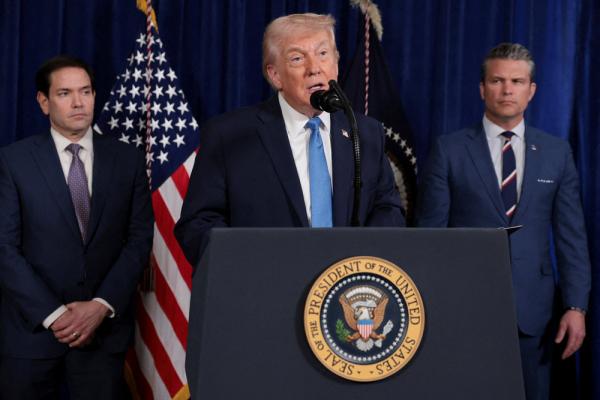
FILE PHOTO: U.S. President Donald Trump speaks as Secretary of State Marco Rubio and Secretary of Defense Pete Hegseth look on during a press conference following a U.S. strike on Venezuela where President Nicolas Maduro and his wife, Cilia Flores, were captured, from Trump's Mar-a-Lago club in Palm Beach, Florida, U.S., January 3, 2026. REUTERS/Jonathan Ernst/File Photo

During his life, Otto Maduro, the late Venezuelan sociologist and liberation theologian, lamented how the majority of Latin Americans were being treated to “fatten the bank accounts” of a small minority. This deeply troubled Maduro. As he wrote in his 1982 Religion and Social Conflicts, “I cannot submissively cross my arms in the face of certain allegedly ‘Christian’ attitudes and traditions that appear to me to be an antievangelical instrumentalization of the church in the service of social injustice.”

The abduction of Venezuelan President Nicolás Maduro (no relation) by U.S. forces in Caracas on Jan. 3 surprised many who believed President Donald Trump’s “America First” ideology precluded foreign intervention. But if there are any misgivings around foreign intervention among Trump, his administration, or his supporters, they largely revolve around the conviction that the U.S. should avoid expending its resources on aid. The situation in Venezuela shows that the Trump administration is adroit at instrumentalizing certain attitudes, traditions, and histories connected to Christianity when it comes to extracting resources for the sake of U.S. interests.

I point this out in hopes of offering a corrective to the belief that the “America First” agenda is inherently opposed to foreign intervention. What is inherent in the “America First” agenda—and what we have seen in the wake of the U.S. incursion into Venezuela—is an insistence that the U.S. has a divine mandate to claim dominion over the earth and its resources.

At a celebratory press conference after Maduro’s capture, Trump—flanked by Secretary of State Marco Rubio and Secretary of Defense Pete Hegseth—reasserted a prevailing interpretation of the Monroe Doctrine: For the sake of its own interests, the U.S. has a right to exercise dominion even outside its borders. “American dominance in the Western Hemisphere will never be questioned again,” Trump asserted.

While the legality behind Maduro’s capture and Trump’s insistence that the U.S. will “run” Venezuela for the foreseeable future are dubious at best, Trump offered a clearer explanation for how all this aligns with U.S. interests and expands its dominion. “We’re going to have our very large United States oil companies, the biggest anywhere in the world, go in, spend billions of dollars, fix the badly broken infrastructure, the oil infrastructure and start making money for the country,” and, Trump concluded, “we are ready to stage a second and much larger attack if we need to do so.”

It is neither a secret nor left-wing hyperbole to say that Trump and his administration are brazenly embracing the logic of global domination, which is the logic of the crusaders.

READ MORE: U.S. Intervention Should Never Be the Answer to Venezuela

In his 2019 book The World of the Crusades, crusader historian and Oxford professor Christopher Tyerman makes the argument that the crusaders used religious ideology to justify their ultimate objectives, which were primarily concerned with amassing land, resources, power, and reputation. Whether it is the crusades of the Middle Ages or modern crusades, Christians have long offered moral and spiritual arguments to justify the pillaging of nations.

In a December 2025 story for The Intercept, Noah Hurowitz reported on an official U.S. social media account sharing a controversial image of a Marine to trumpet the deployment of U.S. troops to the Caribbean, U.S. Southern Command, or SOUTHCOM. What made the image controversial was that on the Marine’s helmet was an image of the Jerusalem cross, also known as the “Crusader cross.” While not inherently a symbol of extremism, it has become a popular symbol among those on the Right who see themselves as modern crusaders, engaged in a battle against non-Christians and enemies of Western civilization. Hegseth has it tattooed on his chest.

Old news, you might think. We already know that Hegseth has a number of anti-Muslim tattoos, belongs to a denomination that openly embraces Christian nationalism, and frequently shares military recruiting ads on social media that baptize America’s brute force with inchoate biblical references. And yet, I think it is worth revisiting these facts because they help explain the “America First” movement’s initial foray into foreign intervention, and they reveal how the mythology of the Christian crusades is, in real time, being (re)deployed to justify dominance and resource extraction.

Whenever we encounter unjust versions of Christianity, there’s an understandable impulse to claim that these “alleged” Christians are, in fact, not Christians at all. I am not interested in that sort of parsing. Rather than attempting to establish definitive boundaries around who is and isn’t a Christian, or exclusively fixating on Christians who behave badly, I find it useful to highlight Christians who are working to positively impact society.

The Venezuelan liberation theology and Jesuit priest, Father Numa Molina, is one such example. In November 2025, Molina, who is 68, was profiled by The New York Times. He grew up as the son of poor farmers in the Andean foothills. When he was 11, his mother died in his arms after complications due to childbirth. Molina has not forgotten those difficulties, as he continues to advocate for the Venezuelan poor even when it puts him in opposition with the Venezuelan Bishops’ Conference. “They are religious officials, not pastors,” he told The Times.

And while Molina has been forthcoming about providing pastoral care to President Maduro and his family—even leading private Masses for the president and his sons—I am mostly interested in his attention to the working class and poor. Whether it is providing financial assistance to more than 3,000 people, overseeing a canteen that provides 1,400 free daily lunches, or securing a hospital for the neighborhood of Ciudad Caribia, Molina’s Christian faith stands in stark contrast to the faith of crusader Christians.

This is not a carte blanche endorsement of everything that Molina has said or believes. And to be clear, none of this should be taken as a defense of Maduro, an autocratic leader who has embraced a strongman persona. Crucially, the real issue here is that the U.S. initiating a regime change in Venezuela last Saturday demonstrates that the “America First” ideology does not bind their interests to U.S. borders. Ultimately, the “America First” ideology is a redux of the crusader mentality, openly using religious ideology to justify the fattening of bank accounts.

Trump and his administration are brazenly embracing the logic of global domination, which is the logic of the crusaders.