Advent
For many of us who were raised Christian, our earliest memories of Christmas may have featured the town of Bethlehem. Whether through songs or the stories in scripture, this quaint town that welcomed the Christ child took on a central role in our faith.
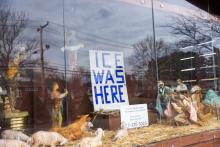
On Thursday, Dec. 11, a man dismantled a nativity scene depicting Immigration and Customs Enforcement arresting the Holy Family at a Charlotte church. The now-viral video depicts the man knocking over the mannequins in ICE uniforms who appear to be detaining a kneeling Mary and Joseph.
I remember the first time I asked Mary to pray for me. It was at the height of the George Floyd protests in June 2020.
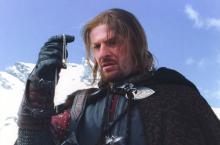
This Christmas, I’m looking forward to curling up on a snowy morning with one of my favorite stories: J.R.R. Tolkien’s The Lord of the Rings. Whether in book or film, Tolkien’s high fantasy remains politically relevant and holds a prescient message for the Advent season.
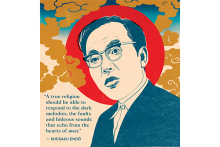
ADVENT IS A season of waiting. In Israel and Palestine, political hostages have been waiting for a release that finally has come for many. We rejoice when captives are freed. But the “pacification” of Gaza is not the same as God’s shalom. Palestinian Christians John and Samuel Munayer, brothers and theologians, bring a Christmas message from the Holy Land. Liberation also comes in many forms. Rebecca Randall investigates how a “forgiveness therapy” program at a Wisconsin prison has loosened the grip of past abuse for some people.
Sojourners editor Julie Polter interviews Chuck Collins on his new book, Burned by Billionaires. Collins is a dependable moral guide on the economy. When he says that the world has a “billionaire problem,” we listen.
Don’t miss “The Best Faith and Justice Books of the Century (So Far)” by our editors. You will be reminded of ones you’ve already read and want to give as Christmas gifts—and discover others to add to your list. Last (but never least), our gift to you is humorist Ed Spivey Jr.’s “reporting” from the frontlines of occupied D.C., while armed only with footlong subs and fashion critiques. Take time to laugh.
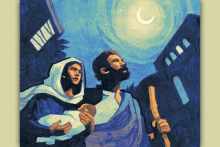
IN ADVENT, I remember and am grateful for all the prophets who show us the way of the divine. They invite us to remember and live out God’s command to love each other as much as we love God. I call to mind biblical scholar Walter Brueggemann, who passed away this year. He was a mentor, teacher, and colleague to many, including me. He taught us to prophetically reimagine a world where we challenge dominant and oppressive ideologies while compassionately re-envisioning a more just world. His magnanimous presence and prophetic words will be missed.
I also remember the young—led by Mary, the mother of Jesus—who invite us to be prophetic during adversity. With the guidance of Osvaldo D. Vena, we are invited to dream dreams in the joyous playground of God. Grounded in the abundance of God in our lives, I celebrate with Son Kyung Min’s praise song “Grace,” which I highly recommend for personal devotion and corporate worship services. The music grounds me in my faith and prompts me to remember how surrounded I am by God’s love.
As we approach the season of Christmas, let us pay close attention to the needs of our neighbors, especially our international students and immigrant neighbors. Every moment provides an opportunity for us to share the gift of the redemptive love of God.
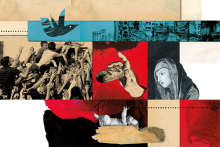
FOR THE THIRD year in a row, Advent in Palestine is not a season of joy. Even with the tenuous ceasefire, Advent is lived in the shadow of genocide, walls, checkpoints, ethnic cleansing, dispossession, and fear.
For many Palestinians, these days of waiting and preparation are overshadowed by mourning for loved ones lost, for homes demolished, for lands taken. In Bethlehem itself, where the Christian story began, streets that should be filled with song and light are burdened with grief and lament. The hymns of waiting mingle with the cries of the bereaved, displaced, imprisoned, and the starving.
In the land where the gospel of Jesus first unfolded, the nearness of Advent is most real. The Christmas story doesn’t look like comfort, plenty, and “toys in every store.” The original narrative bears a much closer resemblance to the times in which we, Palestinians, currently live.
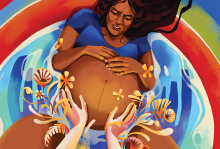
A LOT OF BEGGING happens at Christmas. There are pleas in the toy aisle and hints left open on laptops. But no one begs to be in labor. Not even a woman who is pregnant. Unless, of course, she is at the bitter end of her pregnancy.
In the language of King James, Luke tells us that Mary is not just pregnant, but she is “great with child” (Luke 2:5). She is on the cusp of birthing, of being the first one to slide her hands up under the armpits of the warm, slippery flesh of God. No one before or after will have God in quite this way.
In Mary, the Word became flesh and was born in the most mundane, most primal human act. This flesh must count for something. The extremely pregnant body of Mary — great with child — reveals the nature of our waiting for Christ and what it might mean to cry out for Jesus’ coming.
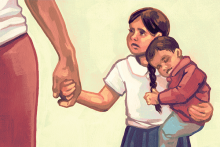
THERE IS MUCH anticipation in the air. During Advent, we eagerly await the Christ child among us and all the blessings and transformations this infant brings. Our readings during this season remind us of the Christ child’s vision for our world — and of God’s power to upend existing political orders. This is the child whose mother proclaims that he will “cast down the mighty,” “lift up the lowly,” and change the course of history for God’s people. We welcome the arrival of new life in Christ, imbued with hope and reminders that life is never fully defeated by empire’s death-dealing designs.
But this Christ child comes in many guises. This child appears as an unhoused person, a racial other, an incarcerated person, a foreigner. Will we receive every child of God as we receive the Christ child and honor their hopes and full potential? Will we give to all of God’s children the gifts of our time, energy, joy, and relationship so that our communities become hospitable places for the Christ child and every child?
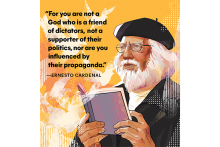
POET MARY OLIVER describes the world calling us “like the wild geese, harsh and exciting.” As we approach Advent, Christians ponder words like annunciation, waiting, and hope. Midwife Julie Dotterweich Gunby plumbs the theological depths of expectation and asks if we are truly “ready for Christmas.” Before we celebrate Christ’s birth, we must wade through the consequences of a U.S. election. (This issue went to print before November.) If we zoom too far out, our vision becomes binary — red/blue, us/them, win/lose. If we look more closely, we see active civic engagement, and a robust obligation to protect the democratic process. We also glimpse ties that bind us around the world. Stephen Schneck chronicles Nicaragua’s fall into autocracy, a cautionary tale. Chris Hedges and Mae Elise Cannon take readers to Palestine and Jerusalem’s Armenian Quarter, respectively. Liuan Huska travels to Ann Arbor, Mich., to report on a “farm-to-altar” Communion bread project reminding us that we are what we eat. “Whoever you are, no matter how lonely,” concludes Oliver, the world is “announcing your place in the family of things.” Welcome. You belong.

For many Christians in the West, Advent is a time of preparation infused with prayer, anticipation, and reflection. This year, Advent is painfully marked by more than 18,000 Palestinian deaths — including more than 7,000 children — as a result of Israel’s brutal military retaliation for the Oct. 7 Hamas attack. But the violence stretches beyond the borders of Gaza and the West Bank.

My first experiences of Christian sacraments, including baptism and the Eucharist, were mysterious and somewhat confusing. As a Catholic little girl, I didn’t remember my infant baptism and could never quite wrap my head around eating Jesus’ flesh and drinking his blood. What’s more, these solemn events happened within the confines of a giant, cavernous church — a place where I had to be still, quiet, and serious. During weekly Mass, I learned implicitly from the nuns that reverence and fun do not go together.
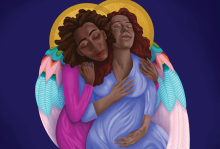
“THE CONTEMPLATIVE ON her knees well knows the messy entanglement of sexual desire and desire for God,” writes theologian Sarah Coakley. If she’s right, then attending to what arouses us sensually can teach us something about how God lures us through our longing and, even, how we can attract God’s intimacy. This month, we’re exploring how queer theology can invigorate (dare I say, stimulate?) the anticipation we build throughout Advent. This approach may seem blasphemous to some who aren’t familiar with a queer-affirming lens ... and perhaps uncomfortable to some who are. Many of us are steeped in Christian body-denying theologies and moralities. We are uncomfortable meeting God in ways that are playful, erotic, unnerving, and always cognizant of power dynamics (though scripture is steeped with such sexual innuendo). Queer theology starts from (rather than argues for) not just queer affirmation, but queer celebration. It can expose the erotic dimensions of our sacred stories to reveal God’s wild and promiscuous desire for all creation.
December is a season for sending Christmas cards depicting the Holy Family — perhaps the most heteronormative image in the church year: A mom and dad stare lovingly at their beautiful baby. This static image can obscure the mess of desire, power, submission, and surprising gender fluidity required to incarnate this Holy Child. What moves in us as we ponder the design of different Christmas images that don’t shy away from this beautiful mess? What images help us face the wonder and terror of what it feels like to be undone and remade by God’s overcoming?

THE FERVOR AT church during the Advent season is a remarkable sight. Both clergy and laity work like the shepherds, tending to their flocks late into the night. And many move like the wise men, traveling to foreign places and spending extensive resources to celebrate Christ’s arrival with family.
This time of heightened activity makes sense given the story of scripture and the story of our current world. The shepherds could not help but tell others once they learned of the Savior’s birth. And as we now await his return, we shouldwork hard to share the riches of the nativity with a world that is a little more open to matters of faith at this time of year.
But if increased activity is the only melody we pick up from the nativity story told in Matthew and Luke, we neglect a needful counterpoint: the importance of rest. The nativity story is replete with theological, familial, and political lessons about rest that quietly proclaim God’s goodness to this weary world. With exhaustion rampant in the church — perhaps especially so at Christmastime — we would do well to hear notes of rest sounding from the manger.
1. Listen to your sleep
God uses sleep as a vehicle for saving Joseph’s family (Matthew 1:18-25). God instructs Joseph to honor his marriage to Mary because her pregnancy was not a sign of infidelity. To the contrary, it was a sign of immense devotion to God. Furthermore, this miracle child would save all his people, including his parents, from their actual sins, as opposed to their alleged ones. In obedience, Joseph listened to the message heard in his sleep and thus participated in God’s saving of his family.
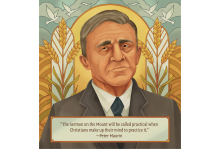
As we go to press, violence again erupts in the Holy Land. In the season of Advent, we prepare for the birth of the Prince of Peace in a rough shelter in a Palestinian village and hear again God’s ancient promises first given to the Hebrew people. But all is not calm in Bethlehem, Jerusalem, Gaza, or Ashkelon. The agitations of injustice and fear have turned a season of dreams into one of nightmares.
ACROSS THE UNITED STATES, people will soon be preparing for Thanksgiving. We’ll name what we’re grateful for and then, in an ironic turn, let “Black Friday” convince us we need more. “Cyber Monday” will catch all the credit cards that made it, un-maxed, through the weekend. “Giving Tuesday” lets us pay the virtue toll to keep spending guilt-free on the yet-to-be-named following Wednesday. Whew! The consumerist drive in November and December makes the temporality of liturgical living difficult. But let’s try. November marks the end of both Ordinary Time and the church year. Ordinary Time is the day-in, day-out rhythm of everyday life as we await Christ’s second coming. In these final weeks, we’re not quite waiting on Christ, then — as we do during Advent — so much as we’re preparing ourselves to wait.
Come Advent, the scripture readings will be filled with anticipatory hope. But, as the old church year ends, the passages are full of anxiety and dread. The Hebrew Bible selections spotlight the escalating threat of the coming judgment. Paul’s letters pour out end times panic. Or, as songster Leonard Cohen put it, “Everybody knows it’s coming apart.” In Matthew’s gospel, Jesus forces us to ponder which side we are on. It’s not easy to sit with all this. I want to skip over to Advent hope (or even Christmas joy). But I invite us to hospice the old year’s death throes before welcoming new life at the stable door.

God’s promise in Advent is about meeting us wherever we are. We, too, can go out and build relationships with all our neighbors — housed or unhoused, incarcerated or not — as we prepare for a future where all people can be comforted.

I can’t deny the unbridled excitement that this global phenomenon unleashes every four years. And since this year’s tournament is taking place in November (to avoid Qatar’s crushing summer heat), the international fervor coincides with the start of Advent. Somehow, it all feels fitting.
A FEW YEARS ago, I set out to knit a baby blanket as an Advent prayer practice. Knitting is incredibly meditative and allows me to pray with focus and clarity. Knitting a baby blanket seems appropriate as the church awaits the arrival of the “newborn king.” I wish I could say I finished the blanket in time for Christmas. I did not. However, even that seems appropriate, as so much remains unresolved for Jesus’ community at his birth. Their political occupation continued, and even Jesus’ birth story reflects the impositions placed upon his family by the Roman Empire. God’s inbreaking happens under serious duress — but it happens nonetheless.
My favorite lines from the poem “Christmas is Waiting to be Born” by Howard Thurman are: “Where fear companions each day’s life, / And Perfect Love seems long delayed. / CHRISTMAS IS WAITING TO BE BORN: / In you, in me, in all [hu]mankind.”
Thurman reminds us that God was born into our sorrow and among those who are brokenhearted and struggling. That truth is so important to hold on to as we process years of our own collective trauma. No matter how unresolved things are, Christmas is born in us, too! In December we continue our journey through Advent and arrive at Christmas. We might not have received what we’re waiting for by that time, and very little may make sense. Yet, because of who God is, we open our hearts to the improbable, trusting that we won’t be put to shame.

IN THE EIGHTH season of Call the Midwife, set in post-war east London, nuns and nurse midwives of Nonnatus House assist a woman with severe complications from a “backstreet” abortion. Sister Julienne says to a young nurse, “The word ‘midwife’ means ‘with-woman.’ A woman in that situation needs somebody by her side.”
I’m pro-choice, which was an unpopular stance in the Catholic community I grew up in. For my views on reproductive rights, people in youth group called me a “baby killer” and “Pontius Pilate.” During Advent, specifically, I loathed the hollow teachings on Mary and childbirth. We sanitized the Nativity into a cute story — the equivalent of a Disney movie featuring a white family and a manger crowded with men. Only recently did I learn that some scholars believe that midwives attended Jesus’ birth. As reproductive freedom and care are further undermined in the United States, this is an apt time to reclaim a more feminist view of the Nativity and rethink Advent as the season of the midwife.