South Korea

LISTENING IS ONE of the most important postures in engaging with the gospel. As Jesus says, “If you have ears to hear, then hear!” (Mark 4:9). This month, we listen to the cloud of witnesses who have shared with us their encounters of the divine. We listen not as passive recipients who accept what is presented unquestioningly; only oppressive systems demand that people listen without asking questions. Rather, Jesus invites us to listen (as we ask and question) because doing so acknowledges the presence of the divine in each one, no matter how different their thoughts may seem from ours.
These reflections open by listening to African American ancestors who have taught us how to read the Bible in ways that are liberating and just. We will also listen with the biblical Samaritans, considered “outsiders” at the time, who provide us with opportunities for self-critical reflections. Next, we recall the breath of God, the Holy Spirit, who inspires us to do good works. Finally, the wise words of the so-called Korean “comfort women” also teach us to listen.
In our world we are bombarded by noise and loud opinions that smother the soul. Listening these days may seem an overwhelming task. We crave quiet and peace. But Jesus calls us to listen carefully and intentionally to voices that are silenced and suppressed. We also must listen wisely.

Ruth Padilla DeBorst told her audience: “There is no room for indifference toward all who are suffering the scourge of war and violence the world round, the uprooted and beleaguered people of Gaza, the hostages held by both Israel and Hamas and their families, the threatened Palestinians in their own territories, all who are mourning the loss of loved ones.”
Less than 48 hours later, the director of the Fourth Lausanne Congress emailed all attendees, issuing a lengthy apology for Padilla DeBorst’s speech.
Rev. Jim Wallis talks with Myungsung Church's lead pastor Rev. Hana Kim about South Korea's response to COVID-19 and the moral, ethical, and religious imperative we have to help the most vulnerable as Jesus commands, many of whom are more at-risk during this global crisis.
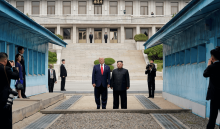
Today, the space to negotiate peace on the peninsula remains accessible as both Koreas and the United States are not only aiming for peace and denuclearization, but on genuine economic cooperation.

Bong-Joon-ho’s film is about what happens to those living below sea level when the rain comes.
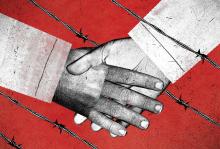
N ANY DEEP national division, political peace is critical. The absence of a formal peace treaty between North Korea and South Korea and the U.S. is an enormous barrier to a new future. Yet easily overlooked is that lasting peace also requires decades-long work of people-to-people engagement.
Novelist Chimamanda Ngozi Adichie has spoken of “the danger of a single story.” In few places is that danger more real than between North Koreans and Americans who are profoundly misinformed about each other after 70 years of mutual isolation.

Like Torrey, Korean Christians who support reunification see it as a political and religious goal. And although it’s an uphill struggle, they believe with faith anything is possible.

The historic meeting was set for June 12 in Singapore, but was cancelled by Trump this month. The U.S. approach to this meeting was concerning. Trump felt that the U.S. did not have to do anything to prepare for the June meeting. He continues to keep a military presence in South Korea with joint U.S. and South Korean military exercises that have always been a threat and irritation to North Korea. The mere presence of 25,000 U.S. Troops in South Korea heightens the suspicions and anxieties of Kim Jong un and the North Korean people. Trump has become blind to the need for diplomacy.

Even though many view this summit with cynicism, it is an important step towards any possibility of peace on the Korean peninsula. The summit was historic because Kim Jong-un and Moon Jae-in met for the first time and agreed to end the Korean War. They also agreed on the Panmunjom declaration which seeks a denuclearization of the peninsula. Russia, China and Japan have also welcomed the agreement.

Moon greeted Kim at the military demarcation line where the men smiled and shook hands. In an unplanned move, Kim invited Moon to step briefly across into North Korea, before the two leaders crossed back into South Korea holding hands.
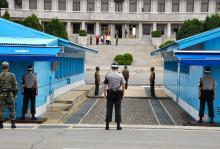
Lawmakers from North and South Korea are reported to be negotiating the details of a joint statement that could outline an end to the 1950-1953 Korean conflict that ended in a truce, not a peace treaty.
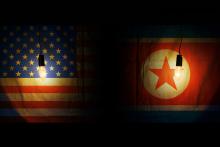
As Trump and Kim Jong-un approach possible conversations, here are 3 truths for American Christians to keep in mind.
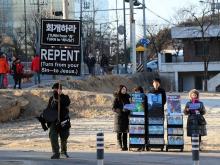
The Winter Games have attracted teams of Baptists, Presbyterians, and Methodists. Jehovah’s Witnesses and Mormons also abound, each group sharing the gospel in its own way. The United Christian Churches of Korea, a coalition of 144 local congregations, is helping foreign mission groups to arrange housing and ministry sites and learn about Korean culture.
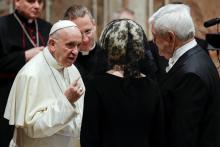
"Nuclear weapons must be banned," Francis said, quoting a document issued by Pope John XXIII at the height of the Cold War and adding that there is "no denying that the conflagration could be started by some chance and unforeseen circumstance".
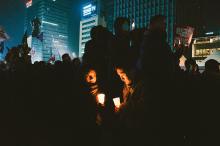
We cannot leave the fate of our world and our future generations exclusively to the political leaders of our time. As Christian citizens of every nation, we have a responsibility to bear witness to the things that make for peace.

The center of Christianity has dramatically shifted, and that means the agenda was very different from the northern and western agendas of the older white evangelicals in America and the issues they think most important. Korea could play a particular and convening role as a bridge between the churches of the global north and south.
In sharp and grateful contrast to the old ideologies of global North evangelicals, these global South evangelicals spent their time together wrestling with issues of global economic inequality, the realities of climate change, the imperatives of racial justice, and the need for Christians to wage peace instead of war. Since these are the issues that global evangelical and Pentecostal constituencies are facing in their own lives — and of course, the Bible addresses all of them as the central issues Christians need to confront today — the narrow, white American evangelical agenda had no interest in this global evangelical and Pentecostal forum. The fact is that they represent a different evangelical world.

Addressing journalists on his return from his intense five-day visit to South Korea late August 18, Pope Francis bantered with reporters and lightheartedly said he may only have “two or three” years left to live.
The 77-year-old pontiff covered a range of topics on the flight back to the Vatican—from war-torn Iraq and his desire to visit the U.S. next year to his personal health, hinting he may retire early.
He was asked how he lived with the immense popularity he has generated around the world, evident when crowds chanted his name on the streets of Rio de Janeiro during his first official visit to Brazil last year.
“I try to think of my sins, my mistakes, so as not to think that I am somebody,” he said. “Because I know this will last a short time, two or three years, and then (go) to the house of the Father,” he said during an in-flight media conference.
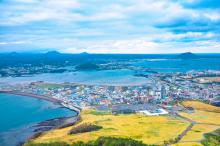
Jeju Island, South Korea — For the past two weeks, I’ve been in the Republic of Korea (ROK), as a guest of peace activists living in Gangjeong Village on ROK’s Jeju Island. Gangjeong is one of the ROK’s smallest villages, yet activists here, in their struggle against the construction of a massive naval base, have inspired people around the world.
Since 2007, activists have risked arrests, imprisonment, heavy fines, and wildly excessive use of police force to resist the desecration caused as mega-corporations like Samsung and Daelim build a base to accommodate U.S. nuclear-powered aircraft carriers and submarines for their missions throughout Asia. The base fits the regional needs of the U.S. for a maritime military outpost that would enable it to continue developing its Asia Pivot strategy, gradually building towards and in the process provoking superpower conflict with China.
“We don’t need this base,” says Bishop Kang, a Catholic prelate who vigorously supports the opposition.

Today marks Korean-American Christian missionary Kenneth Bae’s 500th day in a North Korean prison. Bae was arrested in November 2012 while leading a tourist group. State-run media reported that he was convicted of attempting to lead a religious anti-North Korean religious coup. He has been sentenced to 15 years of hard labor. Bae is a reminder to all of us that Korea remains divided. Brothers and sisters are separated and friends are divided between the 38th parallel.
I was born in Seoul, South Korea. My mother and father were children during the Korean War, and my mother told me a few stories of how they had to flee during the war. She was a young child, one of eight. My grandmother would gather the children and walk for miles and miles making their way down into southern Korea. As they were fleeing one day, a bullet went through my grandmother’s thigh and created permanent damage to her leg. As a young child, I thought it was a wonderful war story of heroism and courage. I didn’t realize then the agony, fear, and suffering that my parents or my grandparents went through to keep safe and keep alive.
As the Korean War lingered on, it ended with the division of Korea at the 38th parallel. That division is a stark reminder of how a beautiful, lovely country can be filled with pain, sorrow, animosity, and suffering. The 38th parallel has kept family members and loved ones apart for almost 60 years. Many divided families are unable to reunite or unable to know if their relatives are still living and doing well. The heartbreak of living apart in their own country has brought lots of anger, tension, loss, and suffering.
In Korea, people have a term for such suffering: han. Han is a difficult word to translate into the English language. The best way to do so may be through ‘unjust suffering’ or ‘piercing of the heart.’