South Korea
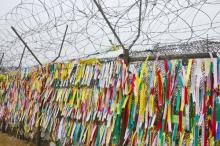
Walls exist between U.S. and Mexico. A few years ago, I took a class to the Mexico-U.S. border through BorderLinks, an organization that provides educational experiences to connect divided communities, raise awareness about border and immigration policies and their impact, and inspires people to act for social transformation. We visited the metal wall that separates the United States from Mexico at Nogales, Mexico.
The walls went up in 1994.
The North American Free Trade Agreement (NAFTA), established in 1994, was supposed to help with trade and the economic status of Mexico. However, it failed to do this. It backfired and made the economic situation worse for the people of Mexico. Rich corporations and companies that benefited from the Free Trade Agreement as they were able to move their factories down to Mexico where the labor was cheap and profits higher. As the economy of Mexico suffered, more people made their way, without documents, to the United States to seek work so they could support their families.
In 2006, the United States responded with the Secure Fence Act. As President George W. Bush signed the bill, he stated, “This bill will help protect the American people. This bill will make our borders more secure. It is an important step toward immigration reform.” The act included provisions for the construction of physical barriers — walls — and the use of technology to these ends.
This wall is under constant surveillance to prevent people from entering into the U.S. illegally. Ironically, it is a wall built from the remaining metal landing scraps of the Gulf War. The border is highly militarized with patrols who treat migrants as “prisoners of war.” It symbolizes militarization, greed, xenophobia, hatred, pride, nonsense, and fear of the other, a reminder of wanting to protect what is yours and not sharing what God has given you. Walls continue to go up along the border as the people of the United States continue to fear that undocumented people will take away jobs. These fears may devastate the lives of the poor in both countries.

Recently, I had the opportunity to visit the DMZ (Demilitarized Zone) between the two Koreas along with a group of students and faculty from George Fox University. As the most fortified border on the entire planet, the DMZ contains an arsenal of tanks, land mines, watchtowers, razor wires, artillery, and nearly two million armed troops ready to face off within a moment’s notice. Former President Bill Clinton described the DMZ as the “scariest place on earth,” a description more eerie coming from one of the few people in history to have had direct access to the “button.”
While observing the various sites within the DMZ, I thought about how the pacifist Quakers, who founded my school in 1885, would have reacted to such an experience.

The Rev. Sun Myung Moon, revered as a messiah within his Unification Church but regarded by many others as a vain and enigmatic man who blessed mass weddings, built a sprawling business empire and presided over a personality cult, died on Monday in South Korea. He was 92.
Moon had been in intensive care at a Seoul hospital since Aug. 7, according to his church. The cause of death was complications from pneumonia, including kidney failure.
Moon was born in 1920 in what is now North Korea, and rose from a home in which five siblings starved to death to become an ambitious man who harbored a lifelong hatred of communism, craved respect from the rich and powerful and professed a divine mandate to restore a fallen world.
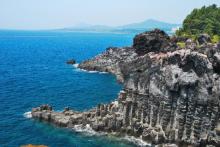
IF YOU HAVE ever been to Jeju, you will understand why it is called a paradise. Lying in the waters south of the Korean mainland, this volcanic island is stunningly beautiful, from its clean mountain streams to its placid coral reefs. Jeju’s legendary female deep-sea divers harvest clams, abalone, and seaweed, relying on lung power alone. The island is also a spiritual place, said to be the body of Korea’s creation goddess, Mago. Jeju has been designated a UNESCO World Heritage Site and a World Biosphere Reserve.
Since January 2011, it’s also been the site where a $970 million naval base is being constructed by the South Korean government, with the help of giant construction corporations such as Samsung. The base, located in the small farming and fishing village of Gangjeong, will occupy a unique three-quarter-mile stretch of coastal wetland, threatening an ecological system that harbors several endangered species. The naval base construction also contributes to increasing military tensions in Asia, raising the risk of a devastating war in the region. Today, islanders, religious leaders, and peace activists are calling attention to dangers caused by joint U.S.-South Korean militarization.
The base is slated to be home to 20 warships, including submarines, aircraft carriers, and destroyers, several of them equipped with missile defense technology with the stated goal of protecting South Korea’s sea lanes and shielding against attack from North Korea. Civilian cruise liners will also be able to dock, according to the government. South Korean naval official Ku Okhyoe told a press conference last fall that U.S. military ships will be allowed to dock at the base only temporarily; Ku insisted, “The base is not intended for a certain country.”

South Korean Christians are trying to pray away Lady Gaga.
According to AFP, a group of Christians gathered Sunday night to pray and protest Gaga’s concert, scheduled for April 27.
Each day leading until Christmas we will post a different video rendition of the "Hallelujah Chorus" for your holiday enjoyment and edification.
Today's installment comes from the Daejeon Handbell Choir of South Korea - a quartet (!) of handbell players who impressively play all of the myriad parts while dressed in satin formalwear — without breaking a sweat.
Phew! Hallelujah indeed!
If we look at what is happening this week – elections in Egypt and the Democratic Republic of Congo, an aid effectiveness conference in South Korea, the continuing Arab Spring in Syria and beyond, World Aids Day Thursday – and in the coming weeks -- the U.N. climate change conference, COP17 -- we cannot pretend that these events have no impact on our lives here and now.
Every one of these events is a matter of justice. The citizens of Egypt and the Democratic Republic of Congo deserve the opportunity to express freely, without fear of intimidation or violence, how they believe their country should be governed. Having spent some time in the region, I believe that the people of the DRC deserve more than any other to live in a country where they are safe and secure.
How we assist other countries in their development is an issue of justice.
Hackers. Slow Motion. Snow. Here’s a little round up of links from around the web you may have missed this week:
- Random Hacks of Kindness: a two-day competition of more than 1,000 software engineers solving problems that arise during humanitarian crises.
- Marvel at some of the entries to National Geographic’s photography contest.
- Restaurateur Jean-Gorges Vongerichten’s half-Korean wife, Maria Vongerichten, has a new PBS show called “The Kimchi Chronicles,” in which she eats her way through South Korea.
- What happens when you put a slow-motion camera on a fast moving train? Watch.
- What did people google search in 2010? (Also, in list form.)
- Have you had your first snow of the year yet?
- Jim Wallis says it best: DREAMS should not be illegal.
As I set foot in China, many emotions invaded my thoughts. I guess you could say I was somewhat nervous. My last visit to China involved being detained for a day on suspicion of helping North Korean refugees -- an "offense" punishable in China with up to three years in prison.
"Who is going to harm you if you are eager to do good? But even if you should suffer for what is right, you are blessed.
I've been following the news story of New Zealand Olympic hopeful Logan Campbell. If you haven't heard, he's the taekwondo athlete who said he was forced to open a brothel to cover his training expenses for the 2012 London Olympics.