Women and Girls

As the proliferation of pink points to October as Breast Cancer Awareness Month, shades of purple warn us not to forget Domestic Violence Awareness. The story in the Gospel of Luke sheds light on what tenacity, in any form, can accomplish. The widow did not cease in her efforts. Someone had wronged her; and she wanted the situation to be made right. We must be equally diligent in our determination to obliterate domestic violence. We must not become comfortable with reporting abuse after the fact. Our judicial officials, police personnel, school counselors, religious institutions to name a few, must take even the slightest whisper of harm seriously. We must not succumb to the foolish reasoning that “snitching” will put more African American men in prison. If we keep talking, teaching, sharing, and behaving as good stewards of God’s creation, there is nothing or no one to prevent us from getting a handle on domestic violence — and not putting an abusive hand on each other.
Survivors of domestic violence cope in many ways. Some engage in substance abuse while others tend to “over-spiritualize” their experiences. My mother chose to commit suicide to deal with her pain. Today, Yvette Cade travels the country speaking about her life. She is on the mend physically, but she is still afraid. Nonetheless, through her fear, she lifts her voice. Not one more person should have be battered or bruised before someone dares to help. Before we dare to help.
Setting an away email with no date of return was almost as odd as leaving work and not and knowing when I’d be back. This unexpected time off gave me the opportunity to do everything on my to-do list and spend ridiculous amounts of time at the dog park. Naturally, it also gave me time to catch up on reading and visiting with other furloughed friends. But this past Wednesday I was beginning to feel a bit hopeless about the whole situation.
Scrolling through Facebook I noticed Sojourners updates on its #FaithfulFilibuster and it truly made me ashamed of my hopelessness. I was ashamed because I forgot who was in charge. I was ashamed because I forgot where my hope lies. And I was ashamed because I was so wrapped up in my own struggles of furlough I forgot about the families that were already struggling and now also dealing with a loss of paychecks.
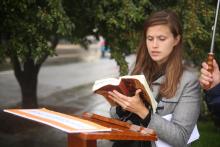
On Thursday I saw another update from Sojourners, and despite the rain, I felt compelled to go check it out. I expected to do nothing but observe and admire faith leaders stepping out to reclaim hope and speak for the millions of silenced voices in this country. However, when I arrived, something different happened. I was asked if I wanted to participate, handed a Bible, and stepped to the podium to read.

Editor’s Note: A national study of women in leadership among evangelical nonprofit organizations has been launched by Gordon College. The advisory board for the study is co-led by Emily Nielsen Jones of the Imago Dei Fund and D. Michael Lindsay, President of Gordon College. This essay is adapted from an interview with Emily Nielsen Jones about why this study matters which can be read in its entirety at http://www.gordon.edu/womeninleadership/interview.
I grew up in an evangelical setting, and have been very familiar with gender role ideology that affirms women’s human equality yet still circumscribes women to a “role” at the margins of decision-making. Nonetheless, I was always inspired by the culturally radical way Christ treated and honored women as well as Paul's proclamation in Galatians that in Christ, there is no distinction between slave and free, male and female, Jew and Gentile. So at this stage in my life, I have become increasingly aware of, and distressed by, how some religious-based ideas are contributing to the dangerous mix of cultural ideas, norms, and humanitarian problems that continue to wreak havoc on the bodies and souls of girls and women around the world. That’s primarily why our foundation, Imago Dei Fund, began using a “gender-lens” to guide our decisions.

Just as she left the world speechless when she addressed the United Nations in July, Malala Yousafzai, the 16-year-old Pakistani advocate for women’s rights and access to education, rendered America's jester Jon Stewart tongue tied when he hosted her this week on The Daily Show with Jon Stewart. Her new book I Am Malala is just released.
"Education is the power of women. That's why the terrorists are afraid of education. They do not want women to get education because then women would become more powerful," said Malala, who is nominated for the Nobel Peace Prize to be announced this week.
The Taliban first targeted Malala on "Googlenet" in 2012, she said. But she decided that it was better to not respond to the threats with violence, even in self-defense.
"If you hit a Talib with your shoe, then you will be no better than the Talib," she told a star-struck Stewart.
"Can I adopt you?" Stewart asked.
The Daily Show
Get More: Daily Show Full Episodes,The Daily Show on Facebook
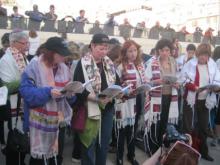
JERUSALEM — In a stunning reversal, a feminist Jewish prayer group said it will consider a government proposal to allow a mixed-gender prayer space at the Western Wall — but only after the government agrees to their conditions.
For 25 years, Women of the Wall has demanded access to pray at the sacred site that is home to the remnants of the Jewish Temple and is overseen by the Orthodox religious establishment. The group objects to the restrictions placed on them when they pray in the women’s section. They want to continue to pray in that section but will consider a compromise.
After a “comprehensive and emotionally trying decision-making process,” the group’s executive board on Monday overwhelmingly decided “to create a future in which, under the right conditions,” its members will pray “in an equal and fully integrated third section of the Kotel,” the Hebrew word for the Western Wall.
Women of the Wall has demanded the right to pray directly from a Torah scroll, wearing prayer shawls and phylacteries — practices and rituals that strict Orthodox Judaism reserves for men.
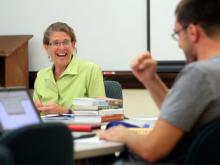
ST. LOUIS — Kristen Leslie began her 2003 book, When Violence Is No Stranger, with a verse from Psalms, a nod to her training as a theologian.
“It is not enemies who taunt me — I could bear that; it is not adversaries who deal insolently with me — I could hide from them. But it is you, my equal, my companion, my familiar friend…”
The book’s subject was acquaintance rape, and it got the attention of a chaplain at the Air Force Academy. The school was then reeling from a Pentagon report indicating that 7 percent of its cadets reported being the victims of rape or attempted rape. Nearly 90 percent of the perpetrators were their own classmates.
Leslie, now a professor of pastoral theology and care at Eden Theological Seminary in Webster Groves, Mo., was invited to Colorado to consult with academy leaders on how to train Air Force chaplains to deal with sexualized violence on campus.
Now, a decade later, the U.S. Navy has come knocking.
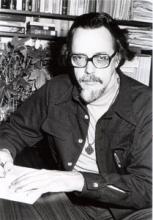
JOHN HOWARD YODER, who died in 1997, was a theological educator, ethicist, historian, and biblical scholar. He is best known for his 1972 masterpiece The Politics of Jesus, his radical Christian pacifism, his influence on theological giants such as Stanley Hauerwas, and his advocacy of Anabaptist perspectives within the Mennonite community and beyond. Many testify that Yoder’s exposition of the gospel allowed them to grasp radically good news in the life and teaching of Jesus Christ.
There is a dark cloud over Yoder’s legacy, however, that refuses to dissipate. Survivors of Yoder’s sexual abuse and other advocates have renewed their calls for the Mennonite Church, including Anabaptist Mennonite Biblical Seminary (AMBS), to revisit unfinished business with his legacy.
On Aug. 19, the executive director of Mennonite Church USA, Ervin Stutzman, announced the formation of “a discernment group to guide a process that we hope will contribute to healing for victims of John Howard Yoder’s abuse as well as others deeply hurt by his harmful behavior. We hope this work will lead to church-wide resolve to enter into lament, repentance, and restoration for victims of sexual abuse by other perpetrators as well.”

Considering a move? Think twice if you are female, single, and headed toward any of the states below. According to data recently released by the Violence Policy Center, these are the states that have the highest murder rates of women by men.
...
What’s being used to murder us? Take a guess.
A 2002 study from researchers at the Harvard School of Public Health found that although the United States represented only 32 percent of the female population among 25 high-income countries, it accounted for 84 percent of all female firearm homicides.
The study’s lead author, Dr. David Hemenway, concluded that “the difference in female homicide victimization rates between the U.S. and these other industrialized nations is very large and is closely tied to levels of gun ownership. The relationship cannot be explained by differences in urbanization or income inequality.”
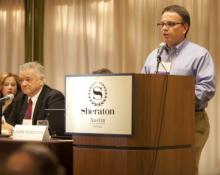
The Christian mission field “is a magnet” for sex abusers, Boz Tchividjian, a Liberty University law professor who investigates abuse said Thursday to a room of journalists.
While comparing evangelicals to Catholics on abuse response, ”I think we are worse,” he said at the Religion Newswriters Association conference. But it’s harder to track.
“Protestants can be very arrogant when pointing to Catholics,” said Tchividjian, a grandson of evangelist Billy Graham and executive director of Godly Response to Abuse in the Christian Environment (GRACE), which has investigated sex abuse allegations.

After hardline Islamists voiced opposition to the Miss World contest now being staged in Muslim-majority Indonesia, a rival World Muslimah beauty contest exclusively for Muslim women will announce its winner on Wednesday in the capital of Jakarta, though the U.S. candidate suddenly dropped out.
“Muslimah World is a beauty pageant, but the requirements are very different from Miss World,” the pageant’s founder Eka Shanti told Agence France-Presse.
“You have to be pious, be a positive role model and show how you balance a life of spirituality in today’s modernized world,” she said.

The decision by the Church in Wales to consecrate women bishops means the Church of England — the mother church of the worldwide Anglican Communion — will be the last in Britain to admit women as bishops.
Cheers erupted in a hall at Lampeter, Ceredigion in Wales, when the 144-member governing body of the Welsh church announced the result of the vote on Thursday. A similar bill failed narrowly in 2008.

A new public campaign in India uses powerful images of three Hindu goddesses with bruised faces to raise awareness about violence against women.
The ad campaign is titled “Abused Goddesses” and portrays the beaten faces of three Hindu female deities: Saraswati, Durga and Lakshmi.
“Today more than 68 percent of women in India are victims of domestic violence,” the caption reads. “Tomorrow it seems like no woman shall be spared. Not even the ones we pray to,” the posters say.
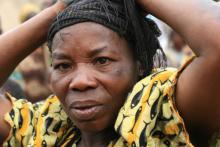
I can still see in my mind’s eye the vibrantly colored wraps draping the hundreds of displaced women I met at Joborona Camp in Northern Sudan. The stories they told, of blazing huts in Southern Sudan and their men burning alive inside; of their boys forced to fight and kill at ages as young as six or seven; and of their girls taken and forced into sexual slavery seemed impossible to be true. Yet I heard them again and again.
And if these stories weren’t horrific enough, it was the stories the women chose not to share that haunt me the most. Their empty eyes and void expressions told me all I needed to know.
I know empty eyes. I have gazed into them in Bosnia and Croatia. I remember Rwanda, Sierra Leone, and Liberia. I have witnessed them in the Democratic Republic of the Congo — where it is believed that one million girls and women have stories to tell of the gender-based violence they have endured. I have been confronted by the eyes of our sisters from Darfur, who risk their dignity, their bodies, and in some cases their very lives by leaving their refugee camps to collect firewood for their small cooking stoves (those who are lucky enough to have one). It is in the bush, often, that they are victims of sexual and gender-based violence. These are the countless women who risk being raped so their children can eat.

Eight years ago I left my dorm room, humming the hook to “Till I Collapse” on my walk to the bathroom. When I returned a new song was playing on my laptop. Ludacris’ “P-Poppin’” pierced through the thin walls and echoed down the hallway. I bobbed my head along and then sat down to finish my homework. I looked at the screen, and I thought I saw my sister.
One of the women on the screen in the strip club swinging around a pole trying to seduce Ludacris looked like Jennifer – my older sister.
And something began to shift.
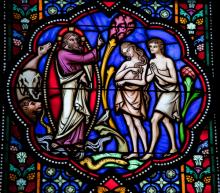
Two things are clear in both creation stories: 1) both men and women are created to exercise equal dominion, and 2) according to Genesis 1:31, this relationship between men and women was “very good.” This is what right relationship between men and women looks like. It is only after the fall of humanity — when we decided not to trust God’s ways, when we decided to grab at our own way to peace and gratification — that women were subjected to men. And I see nothing in the text that says this is the way God wanted it. Rather, I see this is the natural result of choosing to exercise a human kind of dominion rather than one that reflects the image of God. Humanity grabs at its own peace at the expense of the peace of all.

Ever since the most recent MTV Video Music Awards aired, there has been a breathless competition online to see who can be more offended by Miley Cyrus’ highly sexualized performance. Yes, I watched it, and yes, much of it made me pretty uncomfortable. It was hard for me not to imagine my own daughter a dozen or so years from now, longing to replicate the gyrations and sexual gestures of another – but similarly overt – pop idol.
Basically, it was lowest-common-denominator entertainment: hardly anything new in the music industry. Madonna did as much and then some decades ago, so why is this particular incident such a big deal?
For one thing, one of the most lurid moments of the performance had her grinding in a compromising position with a married man nearly twice her age. Interesting, though, that the criticisms of Miley online have far outweighed those of Robin Thicke, the married man in question who participated in said grinding. Suffice it to say that women historically have been held to different standards of sexual expression than men, and when in doubt, blame the woman. Not that her dance was appropriate, but it tells us more about ourselves when we obsess about the shenanigans of the young woman than the borderline adulterous displays of a much older man.

One week after unveiling an expanded prayer platform near the Western Wall, Israel’s Minister of Religious Affairs reached out to Reform and Conservative Jews in the days leading up to Rosh Hashanah, which begins Wednesday evening.
But while the non-Orthodox leaders welcomed the new platform that can accommodate up to 450 worshippers, a group of Jewish feminists called it nothing more than “a sun deck” designed to marginalize anyone who is not Ultra-Orthodox from praying at the Wall.

As a teen, I was taught abstinence-only sex education. I pledged purity, and I made it known to all the boys around me. In my freshman year of high school, I was even voted “Most Likely to Wait Until Marriage” by my peers. The very next year, at age 15, I became pregnant.
Today, nearly half of American high schoolers, aged 14 to 18, are sexually active, according to a Centers for Disease Control survey. Even Christians aren’t waiting until marriage. Among unmarried adult evangelicals under 30, 8 in 10 have had sex.
Somebody has to say it: Our approach isn’t working, and it’s time to rethink “the talk.” It’s time to expand the conversation into territory where many evangelical parents dare not go.

More than 40 years have passed since Sally Priesand was ordained as the first female rabbi in the U.S. Since then, more than 800 female rabbis — including 647 in the Reform movement — have graduated from several seminaries, including my daughter Eve.
Even so, Jewish and Christian clergywomen still face visible and invisible obstacles in their careers. Call it the persistent stained-glass ceiling. Some barriers are major in nature; some minor.
A male rabbi, minister or priest might be praised for being “assertive” and “ambitious” as he climbs the slippery ladder of success in American religious life. But women who possess similar qualities are dubbed “brash” or “arrogant.” Male clergy can be “dynamic,” while women with the same qualities are often termed “strident.”
POPE FRANCIS HAS created a new environment in the church. Beginning with asking all the people in St. Peter’s Square to bless him, living in a humble apartment and not the papal palace, placing his own phone calls, paying his own bills, giving simple daily homilies, having conversations with many people, and joyfully mingling with people: These all characterize an incredibly different pope. What has been even more attractive about Pope Francis than his style has been what he has said.
Pope Francis is clearly not on a mission to preserve the status quo. He’s been outspoken about the need for change in the world and in the church. In this he has not been a “professional denouncer.” Rather, he always contrasts what needs to change with the opportunity to be so much more than we are now. Whether it is oppressive global economic policy or clerical ambition, Pope Francis points out that we are called to something more noble and satisfying. The call of Christ is to be our best self. Francis reminds us, “God always forgives. Don’t forget this. God always forgives.”
Another striking aspect of Pope Francis is his constant and passionate concern for people who are poor and vulnerable and his reminder of our responsibilities to them. Whether he is talking to world leaders, bishops, or general audiences, his love of poor people and his firsthand knowledge of their challenges and how we should respond is profound.