Global Issues
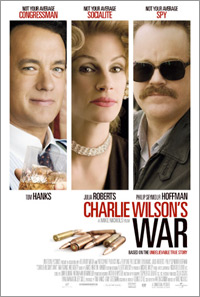 Coinciding with the visit of a dear friend who's spent the past few years working in Afghanistan for both development NGOs and (non-U.S.) government agencies, the DVD of Charlie Wilson's War recently arrived from Netflix. My friend recommends it. Also, I [heart] Philip Seymour Hoffman. And I can tolerate Tom Hanks in appropriate doses. But an
The "cake" vs. "crumbs" power-sharing struggle continues in Zimbabwe. One of the reasons for the breakdown in the talks is that the government (ZANU-PF) wants the "whole power cake" and wants to give the opposition "crumbs." The intention of negotiations was to divide the "power cake" evenly so that a transitional government could be installed to stabilize the country and pave the way for fresh elections in two years. The memorandum of agreement signed by all parties agreed to this [...]
What have you heard about the paramilitary leaders extradited to the U.S. on drug trafficking charges? As formally demobilized paramilitary, they were being processed under what is known as the "justice and peace law" and were in the midst of hearings. Their confessions of macabre acts, partial at best, evolved to include naming ties with the Colombian government and international corporations. [...]
One of the stories I first heard on my recent visit to Australia was about what helped swing the vote last November to Kevin Rudd, the new Labor prime minister. I read some new political data by veteran pollster and researcher John Black, who is respected across Australia's political spectrum. Black reported that the pivotal swing vote to Labor this time was among evangelicals and Pentecostals, especially in [...]
Last weekend in Australia, I had the opportunity to have a four-hour dinner conversation with Kevin Rudd, the new prime minister. I have written about Kevin as a new-style Labor political leader who talks openly about his faith in a secular country.
I asked him about the "apology" he made to the [...]
Last weekend in Australia, I had the opportunity to have a four-hour dinner conversation with Kevin Rudd, the new prime minister. I have written about Kevin as a new-style Labor political leader who talks openly about his faith in a secular country.
I asked him about the "apology" he made to the [...]
When approaching a conflict, any world statesperson would consider trying to break up the logjam. A Christian leader who has always stood for justice and human rights and who takes the issue of the sancity of life seriously has no choice but to try and see what he or she can do to stop the bloodshed. In a protracted conflict, adding new ideas from a high-profile figure can help shake up the status quo. While it is unlikely for an ex-president to be able to extract major concessions, what [...]

All of us remember the dramatic events that occurred in the Philippines in February 1986.
In early July, 290 people aboard a regularly scheduled Iranian airliner were killed because a top-of-the-line U.S. Navy cruiser was unable to identify it correctly.
"THE LORD ANSWER YOU in the day of trouble! The name of God protect you!...Some boast of chariots, and some of horses; but we boast of the name of the Lord our God. They will collapse and fall; but we shall rise and stand upright."
Allan Boesak Jr., age 9, read slowly from Psalm 20 at the conclusion of the family dinner. The words that appeared in the lectionary reading that night were particularly poignant. Just the day before, Allan's father had publicly announced to a packed cathedral that the Botha regime had signed its own death warrant.
Three nights before that, a large brick came flying through the Boesaks' living room window, sending shattered glass in all directions; a death threat over the phone followed. Allan Jr. and his 12-year-old sister, Pulane, had decided to sleep on the floor of the large walk-in closet in their parents' bedroom for a few nights, while a group of theology students kept watch through the night outside the house.
But conversation at the dinner table that evening was anything but somber. In spite of the threats that surrounded it, the Boesak home was full of joy and life. There was fear, to be sure, but laughter was a more frequent expression.
What I remember most about that evening, our second in South Africa, was not the spicy curry or the swelling background music of "Mozart's Hornpipe Concerto," but the faces around the table—the delight on Pulane's, mirrored in her father's; the compassion in Dorothy's; and the warmth from Leineke and Belen. But especially the intent look on Allan Jr.'s face as he read from the psalm the promises of God to us all in a difficult time.
On April 28, 1986, Chernobyl became a household word. On that day the world learned some frightening new lessons about nuclear power.
The Cold War between the United States and the Soviet Union, the focus of this issue of Sojourners, is the most pervasive historic fact of our time.
The eight-day crusade, attended by more than 150,000 people and involving 630 churches from Washington, D.C, Maryland, and Virginia, took place in late April and early May. Nearly one-third of those attending came from Washington's black community.
Chernobyl's radioactive cloud had not yet reached the shores of the Pacific when official U.S. government pronouncements began assuring citizens that there was no danger to the public health. The same message had already been delivered by governments of other countries to their citizens as the radioactive cloud passed overhead.
Socialist and capitalist countries alike could agree that the radioactive release was safe for everyone living outside the immediate area of the Chernobyl plant. Radiation levels increased by more than 500 percent in some areas hundreds of miles away from the accident, but citizens were still assured this was safe. And in what can only be viewed as political double talk, some governments actually told their citizens the air was perfectly safe to breathe, while the fruit and vegetables in the same places might be unsafe to eat.
The Chernobyl reactor meltdown was predictable. The location and time were unknown, of course, but a nuclear disaster of this magnitude was bound to happen once, and unfortunately, it's bound to happen again.
The response of governments throughout the world has also been predictable. Hasty assurances of public safety were followed with detailed explanations of why a nuclear power disaster could not occur in their countries. And most predictable of all was the nearly unanimous silence about the victims of this accident.