economic inequality
This week's viral video is a must-see. The six-minute "Wealth Inequality in America," released Friday, presents the shocking, true size of the wealth gap in the country.
In a series of animated infographics, the video lends a visual punch to numbers that are hard to wrap one’s head around. The top 1 percent of Americans hold 50 percent of all investments in stocks and bonds, for example – while 80 percent of Americans share a paltry 7 percent of the nation’s wealth.

When I was growing up, the only thing that could be said about clothing was that it should be “modest,” and ideally not too “worldly.” “Modesty” was proof-texted from 1 Timothy 2:9: “I also want women to dress modestly, with decency and propriety, not with braided hair or gold or pearls or expensive clothes.”
Not looking “worldly” usually meant not being too fashionable — neither dressing in accordance with what was popular in the mainstream nor wearing anything with strong counterculture associations: no skater pants for boys, no ripped jeans for girls. This is what was meant, apparently, by 1 John 2:15-17: “Do not love the world, or anything in the world.”
While it seems that fewer churches are pushing the second issue — except, perhaps, to offer OMG-wear and other Christian versions of whatever is popular — modesty continues to be a topic of interest. Most American Christian definitions of modesty involve “not showing too much skin.” The question of male lust is often a part of the discussion. But in context, that doesn’t seem to be what Paul is talking about at all: modesty, in 1 Timothy 2:9, is about not flaunting your wealth, which is a surprisingly important thing in the Epistles as well as the Gospels. Braids and gold and pearls have nothing to do with not looking like the other, non-Christian, worldly women. The opposite of “modest” is not “sexually provocative,” but “flashy.”
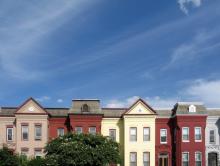
Annie Lowrey's recent New York Times magazine article "Washington's Economic Boom, Financed by You" provides a stimulating look into Washington, D.C.'s "economic boom" of the last few years. As D.C. residents, many of us encounter the ongoing transformation of our city every day. We know the area's economy has grown about three times as much since 2007 as the country — largely a result of expanded government spending (primarily in the form of two foreign wars). We also know that the greater metropolitan region is one of the richest in the country. As Lowrey noted, the Washington metro area has seven out of the top 10 highest-income counties in the U.S., including the three highest.
However, Lowrey only tells one side of the story — the rich side. The "economic boom" has largely passed by D.C.'s poor and working people. By not mentioning D.C.'s grossly high poverty rates, the article is misleading.
Amid Washington's economic boom, there is also massive economic displacement, increased economic inequality, and higher rates of poverty.
Economist Joseph Stiglitz contends that the growing inequality in the U.S. makes an economic recovery more difficult and is leading to the death of the American dream.
“Politicians typically talk about rising inequality and the sluggish recovery as separate phenomena, when they are in fact intertwined. Inequality stifles, restrains and holds back our growth. When even the free-market-oriented magazine The Economist argues — as it did in a special feature in October — that the magnitude and nature of the country’s inequality represent a serious threat to America, we should know that something has gone horribly wrong. And yet, after four decades of widening inequality and the greatest economic downturn since the Depression, we haven’t done anything about it.”

As the Faith Based Organizer for the Federation of Protestant Welfare Agencies (FPWA) — a citywide coalition of more than 300 member agencies and faith institutions — I have the privilege of working with a diverse group of faith leaders. Last spring we were thrust into an important struggle for childcare and after school funding led by the Campaign for Children (C4C), a citywide coalition of organizations advocating for childcare and after school funding. Some may wonder why clergy would be concerned about this issue, but for the clergy I work with, the reason is clear: budgets are moral documents, and what is funded reflects our values. Our clergy know that children are the greatest in God’s kingdom and our investment (or lack thereof) in them will have consequences for our future.
In New York City obtaining quality education is a serious struggle for parents of all classes. This struggle includes waiting lists that upperclass parents place their unborn children on, intelligence test for 5 year olds, interviews and hustling from one open house to another. Finding childcare is a daunting task, especially for low-income parents. As a child in New York City I knew how important it was to not end up at my “zone school,” which are schools for children who could not get in anywhere else. Growing up in one of the 12 poorest communities in New York City, my zone schools were the worst. From junior high on I had to take buses and trains to get an education. The process of finding childcare is one of the clearest depictions of the greatest lie that controls New York City: “that some people are worth more than others” (NYFJ Faith Rooted Organizing Core Lie Exercise March 2011).

Much has been said by politicians and the press in this campaign. In three presidential debates alone, we've heard the two contenders for our nation's highest office speak of tax cuts, deficits, jobs, and the middle class literally hundreds of times.
But much has also been left unsaid. In those same presidential debates, poverty was hardly featured and the word "inequality"didn't appear at all.
How can it be that the Holy Bible refers to helping the poor and vulnerable more than 2,000 times, yet two professing Christians running for president of the United States disregard this unholy scourge?
As we did not hear in the debates, nearly 50 million Americans are currently living in poverty – more than at any other time in our nation's history – and between a third and half of all Americans are within a few lost paychecks of the poverty line. When a quarter of all American jobs pay less than poverty line wages for a family of four, systemic poverty and inequality become more than abstract economics: they are moral and Constitutional concerns.
So they should be treated by the men and women who aspire to lead our country.
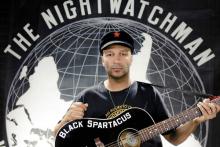
IF YOU EVER wondered what you would get if you crossed Woody Guthrie with Jimi Hendrix, you might want to check out guitarist and activist Tom Morello, also known as The Nightwatchman, whose work combines very modern flurries of feedback and distortion with old-school Popular Front politics. Last year, Morello played a prominent role in the occupation of the Wisconsin state capitol in support of public employees’ unions, and this May Day he led a “guitarmy” through the streets of New York, singing “This Land Was Made for You and Me” in support of Occupy Wall Street.
Morello first made his name playing with Rage Against the Machine, a 1990s band that blended a potent Molotov cocktail of rock, rap, and revolution. For most rock stars, getting political means promoting Amnesty International or Greenpeace, but Rage’s favorite organization was the Mexican revolutionary Zapatista Army. After Rage fell apart, the guitarist had another successful band, Audioslave, fronted by former Soundgarden singer Chris Cornell. Audioslave was a great rock band, but it lacked a political agenda. Morello is a great rock guitarist, but one with a political science degree from Harvard who said he finished his degree because he wanted to “learn how to get my hand on the levers and be an effective revolutionary.” So simply making cool noises couldn’t possibly keep him satisfied for long. Soon Morello was turning up for open mic nights at folkie clubs, disguised as his alter ego, The Nightwatchman.
The Nightwatchman’s singing made it pretty clear why Morello had always worked behind a front man. He often sounds like an unfortunate cross between Woody Guthrie and Lou Reed. But The Nightwatchman found his niche in political contexts, such as Madison and Wall Street, where the point was to get the people singing. This new role on the street has also given a new direction to Morello’s music. Last fall he released a Nightwatchman album, World Wide Rebel Songs, that included a full rock band and found Morello beginning to integrate the Hendrix and Woody sides of his musical personality.
CHUCK COLLINS’ new book does exactly what an introduction to wealth inequality and all its faults needs to do: summarize without oversimplifying, and provoke dialogue and action about the urgent problem of what Collins memorably dubs the U.S.’s “inequality death spiral.”
Newcomers to the topic will find a concise overview of how wealth inequality has skyrocketed since 1980, how a small elite has changed the rules to enable still higher inequality, the many seen and unseen ways that’s a problem for us all, and the beginnings of a solution. Those more familiar with the subject can benefit from Collins’ overview, well-selected statistics, and well-honed, direct turns of phrase. Those who want deeper reading will find excellent footnotes at the end of the slim volume. Everyone will find her experience livened by the stark words Collins quotes from people identifying as part of the 99 percent—and those who are part of the 1 percent.
Collins’ many years as an advocate against inequality show in the book’s graceful balance: It emphasizes the usefulness of the 99 percent-vs.-1 percent idea, while also making clear that neither side is monolithic. He acknowledges very real economic, class, and racial divisions among the 99, but makes a compelling case against letting those differences be the basis of divide-and-conquer political strategies: “It is important that the 99 percent see that they have some important common ground, rather than be peeled into a hundred subgroupings.” And Collins, who himself grew up in the 1 percent, refuses to demonize it or to accept the demoralizing falsehood that it is unified against those below. Rather, he quotes multiple allies within the economic elite, while decrying how “a small segment of the 1 percent—with an organized base in Wall Street’s financial institutions—has worked over many decades to rig the rules of the economy” in the areas of “taxation, global trade, regulation, and public spending.”
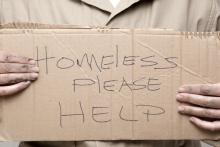
My students had questions about the central character in the story Fly Away Home written by Eve Bunting and illustrated by Ronald Himler. And even as 2nd graders, they knew something about the problem.
"Homelessness is mean," said James.
"I pass the Salvation Army on my bus on the way to school every day. I know homeless people sleep there," Billy added.
Fly Away Home tells the story of a boy who lives in an airport with his dad because they have lost their home. They move through the terminals to avoid being noticed by passengers. The story places you in the boy’s shoes and helps you see the world through his eyes. You feel the pain of the dad who can no longer provide a home for his family. You experience what it’s like to have all of your possessions in two blue bags. This is just the right book to help students and teachers think about how we view people who are homeless.
After reading the story to my students, I asked a few questions about homelessness.

This weekend, amid key discussions on the future of Afghanistan and media attention on the strained relationship between the United States and Pakistan, members of the Group of Eight (G8) announced its commitment to the New Alliance for Food Security and Nutrition which will seek to “lift 50 million people out of poverty over the next 10 years through inclusive and sustained agricultural growth.”
In a speech given at the Symposium on Global Agriculture and Food Security last Friday (May 18), President Barack Obama laid out his vision for what the Alliance could achieve, in co-operation with the private and non-profit sectors, in terms of seeing global hunger eradicated in the next decade.
And we are not going to let him forget this moral duty.
Occupy has already succeeded, its legacy already established: It has changed the conversation.

You've Heard Of Evangelicals, But Who Are They?; Radical Solutions To Economic Inequality; Playing Fair In Love And Climate Change; Jeremy Lin Says Faith In God Triggered 'Lin-Sanity'; 800,000 Americans Tell Senate: Stop The Keystone XL Pipeline; 5 Things You Might Have Missed In Obama's Proposed 2013 Budget; 'Plug In Better': A Manifesto; Render Unto Caesar; Are You A Real Christian?; Hundreds Rally Against Alabama Immigration Law.
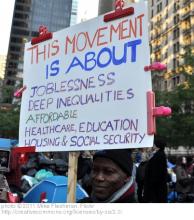
I was also struck by their refusal to simply announce a set of demands. Occupiers aren’t dumb—they’ve read and heard the many calls from the media and politicians that they simply say what they want. It would be easy enough—but in some sense it would detract from the greatest usefulness of the campaign, which has been to articulate a sense of despair bordering on rage. Because they didn’t quickly say “we want this bill passed,” commentators have had to grapple with the actual message of many Occupiers: Our economy is unfair. It gives too much power to corporations who abuse that power for their own ends. They’ve not just cheated us financially; they’ve cheated us of our democracy.
 #OccupyWallStreet (the New York-based protest against social and economic inequality, corporate greed, and the influence of corporate money and lobbyists on government) has moved to a new location, a street where the air is far sweeter than on Wall Street.
Won't you tell me how to get, how to get ... there?
That's right, folks, the occupation has taken over Sesame Street.
Morally and economically, it's wrong for federal budget makers to go after the poor.