Yesterday, I spoke at the Sojourners Summit at Georgetown University in Washington D.C. It's a diverse gathering focused on engaging the faith community in different aspects community engagement and service.
domestic violence
9-18-2014

Most pastors these days are at least a bit wiser both theologically and practically in how they deal with someone facing domestic violence. That’s one result from a groundbreaking survey released last week by Sojourners, a national Christian social justice organization.
9-18-2014
Sojourners and IMA World Health (on behalf of the WeWillSpeakOut.US coalition) recently released a new report, Broken Silence: A Call for Churches to Speak Out, based on a LifeWay Research survey of 1,000 U.S. Protestant pastors. According to the report, U.S. faith leaders seriously underestimate the prevalence of sexual and domestic violence experienced by people within their congregations. They also lack the tools to address it in constructive and helpful ways. The good news is more than 8 in 10 said they would take appropriate action to reduce sexual and domestic violence if they and the training and resources to do so.
Jim Wallis 9-17-2014

NFL logo, Matt McGee, Flickr.com
When Baltimore Ravens running back Ray Rice was suspended for only two games for beating his fiancée (now wife), it became a dramatic public example of the lack of accountability for professional athletes. Only when a video came out showing Rice punching his fiancée so hard it knocked her unconscious, and then dragging her limp body from the casino elevator, did the NFL take further action. As new incidents of domestic violence and child abuse come out, many are calling for Commissioner Roger Goodell to resign or lose his job.
But this epidemic is about so much more than Goodell, whose lack of leadership is typical in professional sports. It’s about more than one team, one league, or sports in general.
Kaeley McEvoy 9-16-2014

Miss America 2015 Kira Kazantsev and Miss America 2014 Nina Davuluri, via Disney, ABC Television Group.
Sunday night, 23-year old Kira Kazantsev proved two things when she was crowned Miss America for 2015. First, she can make a nationally television audience “happy” by using only a red plastic cup. Second, domestic violence knows no bounds.
That’s right. This year’s Miss America is one of the every four women who has experienced domestic abuse in her lifetime. During college, Kazanstev was in an abusive relationship that left her “isolated” and “hopeless,” she recently told NPR. In the same interview, Kazanstev says she wasn’t aware of the resources available for victims of domestic violence: "I very well may have Googled it," she says. "But that's not the mindset that you're in when you're in that situation. You just feel alone. You feel helpless. You don't feel like anyone could possibly understand."
Joey Longley 7-30-2014

Across the country, dangerous people with records of domestic violence, stalking, and aggression have no legal restriction keeping them from obtaining guns. Today, the Senate Judiciary Committee held a hearing to explore the intersection of domestic violence and gun violence. The hearing discussed major loopholes in the landmark Violence Against Women Act (VAWA), which successfully prohibited some convicted domestic abusers from gaining access to firearms. Yet even with the prohibitions in VAWA, abusers who don’t share a home with their intimate partner and abusers convicted of misdemeanor stalking charges are free to keep the weapons they have and to purchase new weapons.
“I am here today to speak for my sister Zina. I speak for Zina and her entire family because Zina is not here to speak for herself.”
Elvin Daniel, and NRA member and gun owner, lost his sister to domestic violence with a firearm and testified today in support of Sen. Amy Klobuchar’s (D-Minn.) S. 1290: Protecting Domestic Violence and Stalking Victims Act of 2013.
The tragic loss of Zina’s life is not an isolated incident. A study about the relationship between domestic violence and gun violence released by the Center for American Progress highlights how deadly this major loophole can be for thousands of women. The statistics are stunning:
- While 2.5 percent of men who are murdered are killed by a female intimate partner, 34 percent of women who are murdered are killed by a male intimate partner.
- Of all the women killed by male intimate partners from 2001-2012, 55 percent are killed with a firearm.
- More women (6,410) in the United States have been killed by a significant other with a firearm from 2001-2012 than U.S. troops have died in the wars in Iraq and Afghanistan.
7-03-2014
Co-sponsored by the Christian nonprofits Sojourners and IMA World Health, the survey also found that pastors were more likely to believe domestic violence was an issue in their community (72%) than an issue in their church (25%).
7-03-2014
The good news is that this is a fictional scenario. Most pastors these days are at least a bit wiser both theologically and practically in how they deal with someone facing domestic violence. That’s one result from a groundbreaking survey released last week by Sojourners, a national Christian social justice organization.
7-03-2014
On a brighter side, 80% of faith leaders state that they would take the right steps in trying to reduce the violence if they were given the right training and resources to properly serve their congregations. “This is a conversation the church needs to be having but isn’t,” said Jim Wallis, president and founder of faith and social justice advocacy group Sojourners. “We cannot remain silent when our sisters and brothers live under the threat of violence in their homes and communities.”
7-03-2014
Those are among the findings of a new telephone survey of 1,000 senior pastors of Protestant churches from LifeWay Research. The survey was co-sponsored by two Christian nonprofits: Washington, D.C.-based Sojourners and Maryland-based IMA World Health.
7-03-2014
Here is a Huffington Post story about our domestic violence research released at the Sojourners Summit. You can find the LifeWay release here or, if you are a good Charismatic, you've already read it at Charisma!
7-02-2014
The research co-sponsored by the seat of Sojourners, a national Christian organization in Washington, DC, points out that 29% of pastors do not address the issue, believe that domestic violence is not a problem concerning the church.
Phil Haslanger 6-25-2014
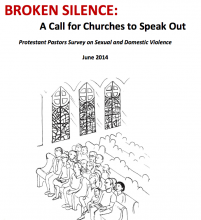
I thought at first that it was a fictional scene, conflating in one example some of the problems those of us in Christianity face when confronted with issues of domestic violence. The scene was set up as a call to rethink how we articulate our theology in areas like sacrifice and forgiveness and commitment and gender roles.
Here’s what I wrote in The Capital Times in Madison, Wis., that was posted on Sunday:
“A woman has been suffering physical abuse at the hands of her husband. She finally summons up the courage to talk to her pastor about it.
“His advice: First, you need to recognize that your suffering is like Jesus’ suffering. Next, you need to forgive like Jesus forgave. Then remember that you made a commitment to marry this man for life. He is the head of your family, so you need to make sure you are doing what he wants so as not to trigger his anger.
“And then an offer: Let me meet with the two of you and help you patch up your marriage.”
I described it as a fictional scenario. And then I heard this from a friend: “that was the response from my minster regarding my first husband 30 years ago ...”
I’d like to think that many pastors these days are a least a bit wiser both theologically and practically in how they deal with someone facing domestic violence. That’s reflected in a groundbreaking survey released last week by Sojourners at The Summit: World Change Through Faith & Justice.
Lisa Sharon Harper, Andrea Smith 4-22-2014

Woman worshiping, John Wollwerth / Shutterstock.com
The women were there at the foot of Jesus’ cross.
The women were there when they laid him in the tomb.
The women walked through the desolate graveyard in the darkest hours of the night — the hours just before dawn, carrying sweet spices prepared to anoint Jesus’ dead body for proper burial. But they never got the chance.
They witnessed the earthquake, talked to the angel, and ran to the other followers announcing the resurrection of their beloved.
And Jesus’ mother, Mary, huddled in the upper room praying with the other women and the rest of the disciples in the days following the resurrection. Until that day, 50 days later, when tongues of fire fell on them all and Peter reminded the crowd of Joel’s ancient prophecy: “Your sons and daughters will prophesy.”
From the cross to the upper room, the women are lifted up! As the church stands in the light of Easter Sunday and now sets its face toward Pentecost, let us remember the women. And, as we do, let’s also remember the women in our pews and surrounding communities — the challenges, fears, and the very real dangers women face every day.
Elizabeth Gerhardt 4-03-2014
THE CULTURAL explanations and defenses for women undergoing genital mutilation, female infanticide, domestic violence, and other atrocities crumble under the weight of the cross. The involuntary suffering endured by millions of women is not redemptive; it is a suffering borne out of opposition to a God that desires to crush such bondage. An orientation of the cross emphasizes the importance of maintaining a precise language for a Christian perspective and application. According to Gerhard Forde, our modern culture has been so sensitized and psychologized that we are afraid to call a spade a spade. We often act many times “on the assumption that our language must constantly be trimmed so as not to give offense, to stroke the psyche rather than to place it under attack.” Our language can ultimately decline to a type of “greeting-card sentimentality.” Forde claims that when this happens we have lost our theological courage and legitimacy. A theology of the cross provides a paradigm or conceptual framework for a language that always speaks truth to power.
The language and meaning of the cross provide the most relevant and useful foundation for creating a practical social ethic for the work of ending violence against women and girls by identifying oppression, abuse, and violence as sin, and by providing a direction and necessary focus for the church. By using the language of the cross, the church embraces the gravity of violence against women and girls. It is not a “women’s issue” or merely another “social problem.” It is sin that violates the integrity and humanity of God’s creation. The work of Christ on the cross demands that the whole of the church respond to the ongoing evil and sin at work in the world. The power of God can be expressed through this language of the cross.
Suzanne Ross 2-07-2014

Woman in church, fztommy / Shutterstock.com
Sojourners is offering an important opportunity for Christian churches to examine their attitudes towards women. Following up on an article by Michelle A. Gonzalez entitled “Breaking the Habits of Machismo,” Gonzalez and Jim Wallis, president of Sojourners, will conduct a live video discussion on Wednesday, Feb. 12 to “discuss what the Bible really says to encourage, affirm, and empower women and girls in their call to be leaders.”
Judging from Gonzalez’s article, this conversation will focus on what it means to affirm that both men and women are created in God’s image. She begins her article with the Common English Bible translation of Genesis 1:27: “God created humanity in God’s own image, in the divine image God created them, male and female God created them.” Though she points to important changes taking place in Christianity today, Gonzalez traces the legacy of Christian thinking on womanhood that has elevated men and devalued women, instilling “habits of machismo” in our churches and our culture that are difficult to break.
But break them we must, Gonzalez argues, if we want to free both our theology and our practice from “male-oriented power structures.” Amen, sister. Because this is about more than equal employment opportunities for women in church administrative structures, of whether we are allowed to “preach, lead from the altar, celebrate communion, administer rites, pastor congregations, or teach.” What’s at stake in this conversation is whether Christians — and I think this is a call to American Christians in particular — whether American Christians are willing to dismantle a long-held justification for violence against women, not just in our country, but around the world. Gonzalez herself points out that patriarchal “attitudes can lead to greater violence against women, such as we see in the increasing exploitation and attacks on young women and how social media is used to perpetuate and document these horrific acts,” but this is her only nod to the issue of gender-based violence. Let’s add to the picture a look at the violence perpetrated by men against female bodies that has become to typify conflict zones around the world.
Janelle Tupper 11-12-2013

Pastors are encouraged to speak out against sexual violence on Speak Out Sunday, Nov. 24 Artem Furman/Shutterstock
In the United States, more than 1 in 3 women (and 1 in 4 men) havereportedly experienced sexual assault, physical violence or stalking by an intimate partner during their lifetime.
These are not numbers that disappears when you walk in to a church. Christian women are subject to sexual and gender-based violence, too – but when is the last time you heard about this issue in a church?
Talking about the pain and fear of intimate partner abuse can seem daunting, but there are resources to help faith communities get started. On Sunday, Nov. 24, faith communities have an opportunity to speak out against sexual and gender-based violence in the aptly named Speak Out Sunday.
Elaina Ramsey 11-11-2013
Check out these resources to help you and your faith community address the sin of domestic violence.
Tony Lapp 11-05-2013
IN THE PAST, programs like Menergy were often described as “batterer intervention.” Today we prefer to situate battering behavior within the broader definition of abuse, and work with our participants to change abusive behaviors, big and small.
In 30 years of work with men and women who act abusively toward an intimate partner, Menergy has had thousands of people of faith go through the program. Sometimes their faith community helped them get to our door; other times they came in spite of messages they received at church.
A faith community that seeks to encourage change for abusive members can have a dramatic impact. Here are a few suggestions for how to start:
1. Embrace the secular programs in your community. “Groupthink” often supports abusive beliefs. Don’t try to keep it in-house. In Menergy’s counseling groups, we see that diversity in life experience, culture and ethnicity, economic class, and religious belief aids group members in challenging each other’s ideas.
2. Learn more about domestic abuse. Contact the National Coalition Against Domestic Violence (1-800-799-SAFE) to get a list of local victim-advocacy programs. Send several members of your church to a training for people interested in learning more. Effective support that allows a survivor to grow stronger and safer can often be the fastest path toward holding the abusive partner accountable.
Michelle D. Bernard 11-05-2013

Zwiebackesser / Shutterstock
JULIE OWENS had no way of knowing that, within days of saying her marriage vows, she would become a victim of domestic violence. She grew up in a Christian home. Her father was a pastor. Her brother was a pastor. Her uncles were pastors. Her parents had a beautiful and enduring marriage. She was well educated. She was well traveled. And she was deeply in love.
During her honeymoon, Julie quickly realized that her husband now believed he owned her, a belief that would soon be followed by verbal abuse and, toward the end of their marriage, physical abuse.
The abuse began with an irrational jealousy. Then the name-calling began, along with accusations of infidelity. He isolated her from her friends and family. He showed up at the school where she worked as a special education teacher to “check on her.” Later, he started taking the car keys away from her. He even cut the spark-plug wires in their car so that he would always know her whereabouts. He threw dishes at her, disconnected the phone in their rural home, and threatened to harm her, their pets, friends, and even their unborn baby.
Three months into the marriage, Julie knew that his behavior was not normal and the couple separated.
Over the course of the next three months, she went to marriage counseling while her husband went to substance-abuse counseling. In search of help, she spoke with counselors, pastors, and others—yet not one of them ever uttered the words “domestic violence.” Instead, she was told that her husband was dealing negatively with “stress” and that he was “acting out” because he was raised in an abusive family.