
In the months leading up to the U.S. midterm elections and in the shadow of today’s headline-dominating Christian Right, a lost gospel is getting a new hearing. In red states across the country, devout Christians running for office on the Democratic ticket are making the case, as Jesus himself once put it, that “The laborer deserves to be paid” (Luke 10:7).
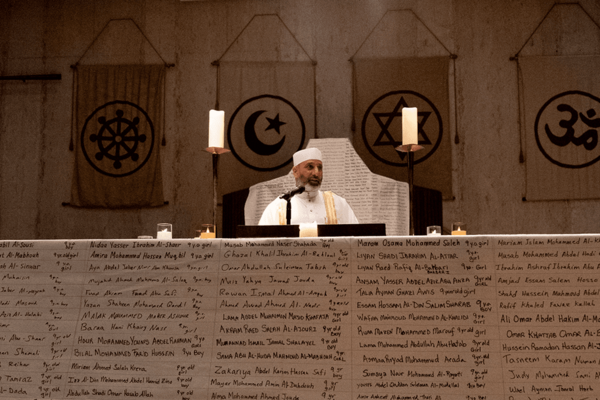
Earlier this month, a coalition of advocacy groups unveiled the Gaza Children’s Shroud, a linen assemblage bearing the names of 20,000 children killed in Gaza between October 2023 and August 2025—a staggering physical testament that when laid end-to-end, is 328 feet long. The names were handwritten by nearly 50 congregations and organizations across the U.S. and nine in Ireland, including churches, mosques, Buddhist centers, interfaith, and secular groups.

“You know what happens if you don’t vote?” President Donald Trump asked the crowd gathered at the Republican midterm convention in Dallas. “You go to hell!”

The Emperor Constantine, who in the fourth century made Christianity an instrument of Roman imperial cohesion, valued Christianity for its capacity to unite an empire under his authority. For many oppressed Christians, this use of Christianity to build empires still exists today, yet in a different form. Today, empire-building is deployed through the language of protecting what many call “Western civilization.” And it is an empire-building strategy that has brought many Christians together across the religious lines that once divided them—Roman Catholic, Protestant, and even “cultural Christians”—as a new ecumenical movement.
Scholars like Leonard A. Schuette call this political ideology “Western Civilizationism.” In this ideology, the primary unit of belonging is not the nation, the state, or the country, but a broader Western civilization: “the West is defined by a specific geographic territory, a shared ancestry, and Christianity.” For adherents of Western Civilizationism, Christianity is a crucial component for organizing a civilization’s culture and values. Any threat to their version of Christianity must be considered a threat to the West itself.

Annie Dillard, one of the greatest American writers, considered her own first book on writing a failure. At least, she called it “dull” and told an interviewer that she “never should have published it.”

The walls are covered in shiplap paneling. Over by the spare toilet paper, an essential oil diffuser hums quietly as it emits Young Living’s “Purification” into the air. Two wide-eyed Precious Moments figurines watch you from the windowsill. A framed Bible verse declares, “As for me and my house, we will serve the Lord,” but you already knew you were in the bathroom of a white Christian woman; the signs and wonders were all around you. In Live Laugh Love: The Secret History of White Christian Women and the World They Made, Kristin Kobes Du Mez dissects those signs—and their political implications.
Du Mez, a professor of history and gender studies at Calvin University, landed on The New York Times’ bestseller list for Jesus and John Wayne: How White Evangelicals Corrupted a Faith and Fractured a Nation, her scorching dissection of white evangelical masculinity. With Live Laugh Love, Du Mez turns her eye to white Christian femininity. Because, “demographically speaking, women are the center of American Christianity,” writes Du Mez, “we should look beyond denominational seminaries and theological treatises and read Christian romance novels instead.”

In a 2023 sermon, Texas Democratic Senate candidate James Talarico called Christian nationalism “a cancer on our religion” and denounced Republicans for trying to transform America into a “Christian theocracy.”
Yet, at the same time, Talarico—a Presbyterian seminary student—has made his Christian faith a core message of his campaign. He mentions biblical teachings like “love thy neighbor” when discussing partisan division. He talks about the angel Gabriel appearing to Mary as a model for consent and a justification for abortion rights.
To some, these positions may seem to be in tension. If you oppose Christian theocracy, how can you use Christian theology to justify your political positions in the public sphere? When Christian beliefs are presented as the moral arbiter of politics, isn’t that the definition of Christian nationalism?

Thinking about writing an opinion piece for Sojourners? Great! We're always looking for new voices.

Most people remember exactly where they were on the morning of Sept. 11, 2001. I was in Nairobi, Kenya, a full day removed from the moment everyone else calls “that morning.”
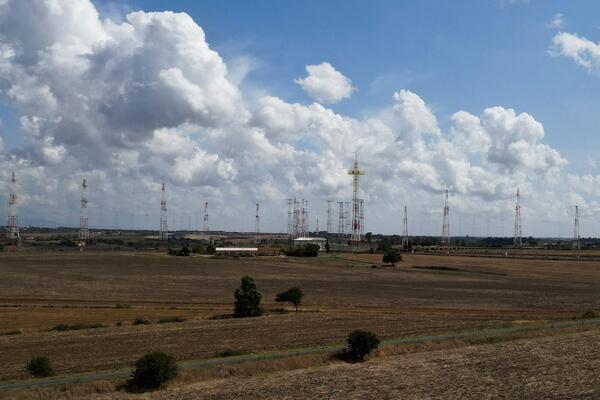
The Vatican will build a roughly $117 million renewable energy plant that could power the Holy See within two years via a system combining solar power and agriculture, sources involved in discussions on the project said.
The agrivoltaic plant is expected to have a capacity of 80 to 90 megawatts, making it one of Italy’s largest such installations, the sources added. In such plants, solar panels are mounted several meters above the ground so crops can grow beneath them, with the shade helping to reduce evaporation and shielding plants from extreme weather.
A joint Italian-Vatican commission met earlier this month to launch the project at the Vatican-owned Santa Maria di Galeria estate on Rome’s northwestern outskirts, after Italy ratified a 2025 bilateral agreement for development of the site this year.