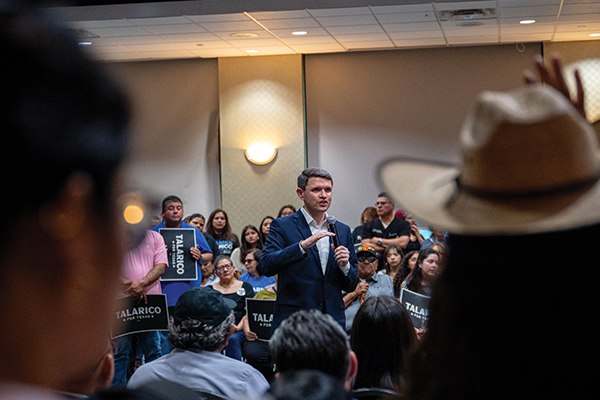
WE’RE APPROACHING ANOTHER polarizing election, with major implications for our future as a nation. As candidates try to appeal to prospective voters, one method is to bring their personal faith beliefs into their campaign. For example, in a 30-second ad for his congressional campaign, Florida Republican Austin Rogers tells voters: “In high school, I had a real encounter with God. It changed everything. Since then, my foundation is simple: faith, family, freedom.”
This kind of faith-infused language has largely been used by Republicans. However, this year, we’ve seen high-profile instances of Democratic candidates drawing heavily on their faith backgrounds, from Presbyterian James Talarico’s candidacy for U.S. Senate from Texas to United Methodist pastor Adam Hamilton’s senate campaign from Kansas, and many others. These campaigns have the potential to shake up the perception of Democrats as anti-religious while challenging the misperception that Republicans have a monopoly on God-talk.
But faith can easily become abusive on the campaign trail, such as the blatantly Islamophobic attacks by Texas candidate Aaron Reitz, who used his first ad running for state attorney general to promise voters he would “stop the invasion and defend our Christian values” from Muslim immigrants. Yikes. Which is why I’ve been thinking about what it looks like when candidates for office—regardless of political party—engage their faith in a healthy way.
Voters appreciate honesty and openness.
First, it’s always valuable for a candidate to tell their own faith story. Doing this honestly and earnestly offers voters a window into a candidate’s priorities, thought process, life experience, and values. Voters appreciate honesty and openness.
Second, I hope a candidate’s personal faith story becomes a stepping stone to inclusive values that shape their platform. It should flow naturally for a candidate to say, for example, that they care about climate change because of their belief in the sacredness of God’s creation. Yet it’s equally important that candidates broaden their ideas to be applicable to people of all faiths and none. With climate change, that could mean saying something like “many world religions and belief systems agree that all life is precious and worth protecting.”
Faith can easily become abusive on the campaign trail.
Third, candidates can assert their own spiritual convictions while also upholding the commitment to religious pluralism and religious freedom outlined in the First Amendment. This is one reason white Christian nationalism poses such a threat: Its proponents often want to impose their particular brand of Christianity on the rest of us. We should want candidates who are committed to protecting people of all religions (and no religion) from discrimination or repression.
As candidates campaign this fall, pay attention to how they invoke faith. Ask yourself what purpose that invocation is serving and whether they are acting in line with the principles above. In a nation in which 87% of members of Congress identify as Christian, we have a special responsibility to stay vigilant about how our faith is used or misused on the campaign trail and beyond.

Rev. Adam Russell Taylor is president of Sojourners and author of A More Perfect Union: A New Vision for Building the Beloved Community. Follow him on Bluesky @revadamtaylor.

Did this article have an impact on you? Tell us how! Whether you’re moved to take action, have a question, or want to share a comment (good or bad), we value your feedback!