The Hungry Spirit

SUICIDE IS A SIN. As a Catholic, that’s what I was taught. Life is a gift from God; only God can take it away. Suicide chooses despair over God.
But I’ve never understood suicide to be an individual sin. It’s a communal one—based in a profound failure of love.
This past spring, two young men committed suicide while in the custody of the Department of Homeland Security. Beyond individual and communal sin is structural sin—when lovelessness is made into policy and enacted with cruelty. Note all the places where love failed.
In May, Marco Antonio Muñoz, a 39-year-old Honduran refugee, died in a south Texas jail cell of apparent suicide a few days after being forcibly separated from his wife and 3-year-old son at the U.S. border. And I mean “forcibly.”
When Border Patrol agents told Muñoz that the family would be separated, he “lost it,” according to The Washington Post. “‘The guy lost his s—,’ an agent said. ‘They had to use physical force to take the child out of his hands.’”
Muñoz was transferred to a county jail and placed in a padded isolation cell. Guards checked on him every 30 minutes. Reportedly, every time the guards passed during the night, they noted him praying in the corner of his cell. By morning, Marco Antonio Muñoz was dead.
THERE IS NOTHING new under the sun, as the author of Ecclesiastes reminds us. In this, theologian Elsa Tamez said, we can “find solidarity in our discontent.”
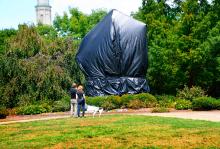
I visited Charlottesville in May, nearly a year after the “summer of hate.” I heard from young Christians who had been on the frontlines at Robert E. Lee Park (now called Emancipation Park). I stood in the presence of their discontent, listening and witnessing to the ongoing, traumatizing effects of last summer’s “fascist lollapalooza,” as one University of Virginia professor put it.
Still reckoning with the memory of Aug. 12, one leader in his 20s shared how he had tried to be a nonviolent defender amid multiple “armed actors,” including the Ku Klux Klan, neo-Nazis, anti-fascists, and police. By the end of that day, two state troopers were dead, one woman was murdered, dozens were injured, and the whole community was emotionally, spiritually wounded.

WHAT DO YOU do when the democratic process delivers the power of the presidency to an authoritarian leader with the strategic impulse control of a 2-year-old?
Here are a few responses I’ve observed.
OPTION 1: The Ostrich. Bury one’s head in the sand until the annoyances pass. The virulent rhetoric of Mr. Trump’s campaign, combined with his appointees and advisers, make this option available only to men of European decent. (White women may cover their heads, but shouldn’t bury them completely.)
OPTION 2: The Spaniel. Fluff up one’s coat and appear clean and eager on the doorstep of the new master. Hope for the best; hope for a bone. This option is supported by many who are well-meaning, are part of the political elite, or are dangerously naive.
OPTION 3: The Cockroach. When the light comes on, scatter into the street with a sign saying “Not My President.” Or simply hide in a dark corner hoping to pass the coming wrath undetected. This escape behavior is instinctual in creatures that are startled or undeveloped.
Since the wee hours of Nov. 9, I’ve exhibited most of these behaviors myself.
But as a Christian, I’m not allowed to live in illusions for long. In Paul’s “letter of tears,” written to the fledgling church at Corinth, he wrote, “We cannot do anything against the truth, but only for the truth” (2 Corinthians 13:8). Therefore, existing in a “post-truth” state is not an option.
Americans are deeply disillusioned about the state of our nation. The fundamental optimism of the “American dream” has not matched reality for at least three generations. American optimism has always been partly delusion, as evidenced by the experiences of those defined outside of it or on whose backs the “great good” was built.
An election, however, is supposed to be a tool for the nonviolent transfer and distribution of power, not a therapy session to deal with disillusionment.

ROBERT HARVEY had a problem. The church he pastors was vandalized after the election: “Trump Nation. Whites only” was scrawled across its sign. His congregants, nearly 85 percent of whom are immigrants from West Africa, Latin America, and the Caribbean, were shaken.
The Southern Poverty Law Center reported 1,094 bias-related incidents across the country in the month after the election. The greatest number of these types of events are against women in public spaces who are also immigrants, Muslim, or African American. These are assumed to be a “small fraction of hate-related incidents,” as the Bureau of Justice Statistics estimates that two-thirds of hate crimes go unreported.
Harvey, rector of Episcopal Church of Our Saviour in Silver Spring, Md., decided to take action. First, he reached out to the local community and other religious congregations. Second, he signed up for a nonviolence and “active bystander intervention” training.
To understand how to be an “active bystander,” one must first understand the “passive bystander” effect. Research shows that when someone needs help and they are in a crowd, bystanders are less likely to act. The more bystanders there are to an event, the more each one thinks someone else will help.

OUTSIDE, A HELICOPTER circles this D.C. neighborhood, a dog barks anxiously in the alley. Inside, a woman sits in a straight-backed chair reading the Beatitudes. She adjusts her glasses. “Bienaventurados los que lloran, porque ellos recibirán consolación.” Blessed are those who mourn, for they will be comforted. “It’s a beautiful prayer,” she says.
My neighbor Lola cleans office buildings during the week, takes English classes on Saturdays, goes to Mass on Sundays. Her husband operates a jackhammer for a construction crew. On the “Day Without Immigrants,” Lola’s boss said because it wasn’t organized by the union, workers should not stay home. So she went to work. Her husband stayed home. “We have to stand together,” he said.
Lola and her husband sometimes share their one-bedroom apartment with a man who was their neighbor in El Salvador. He works days, nights, weekends. He sleeps on a mattress in their main room for a few hours in the afternoon. Lola leaves pupusas for him, wrapped and warm. Sometimes he drinks too much, turns up the radio, dances. They quiet him so he doesn’t disturb the neighbors. He feels safe there.

THIS WON'T HAPPEN again until 2045. On Aug. 21, the thumb of God (with a little help from the moon) will smudge out the sun. A total solar eclipse will mark the brow of the United States with a Stygian darkness so deep that stars will unmask in midday. From Lincoln City, Ore., to Charleston, S.C., “flyover” America will go dark.
In Hebrew tradition, the darkening of the sun or reddening of the moon are markers of cataclysmic political events with spiritual consequences. In Greek, eclipse means “abandonment,” in Hebrew “defect.” God’s light is in a state of hiddenness.
IT IS HARD to tell time from inside a tomb. We cannot know how many minutes or hours Jesus’ resurrection took. Traditionally, he was in the tomb for three days. But how long does it really take for someone to rise—or be raised—from the dead?
Some resurrections start at a mundane moment. Dorothy Day, for example, was sitting at the kitchen table in a crowded apartment in New York’s East Village (writing a never-to-be published novel) when the French Catholic theologian Peter Maurin knocked on the door. “It was a long time before I really knew what Peter was talking about that first day,” wrote Day, who went on to found the Catholic Worker movement with Maurin. “But he did make three points I thought I understood: founding a newspaper for clarification of thought, starting houses of hospitality, and organizing farming communes. I did not really think then of the latter two as having anything to do with me, but I did know about newspapers.”
Some resurrections come through brutal suffering. Twenty-four-year-old Recy Taylor was left for dead in 1944 on a dark road near Abbeville, Ala., by the six white men who kidnapped and raped her as she walked home from a prayer meeting at Rock Hill Holiness Church. “A few days later, a telephone rang at the NAACP branch office in Montgomery,” wrote historian Danielle L. McGuire in At the Dark End of the Street. The president of the local branch promised to send his “best investigator” to speak with Recy Taylor. The investigator’s name was Rosa Parks. As part of Park’s organizing work on Taylor’s case, she formed what would become the Montgomery Improvement Association, the leaders responsible for instigating the bus boycott a decade later, an opening salvo of the civil rights movement.

THIRTEEN YEARS ago, on Holy Thursday, 9-year-old Donte Manning was shot around the corner from my house in Washington, D.C.
He died of his injuries four weeks later, on the Feast of Paschasius Radbertus, a ninth-century Benedictine theologian who wrote on intimacy between the body of Christ crucified and the real presence in the Eucharist. Donte’s death impacted me deeply. (I wrote a book about his murder.)
Caught in the crossfire between neighborhood rivals, Donte Manning was the real body sacrificed on the altar of this imperial city where teenage boys shoot each other over $200 Air Jordans and the Pentagon exports more than 1.45 million firearms to various security forces, just in Iraq and Afghanistan. (The Pentagon lost track of more than half of them.)
As theologian Ched Myers reminds, “Against the presence of Power is pitted the power of Presence: God with us.”
Donte Manning’s murder was never solved. It remains a cold case. Mitch Credle, the investigating detective, retired from the D.C. Metropolitan Police. In October, he decided it was time to talk about his one unsolved murder. He was interviewed by local news reporter Paul Wagner.

Pope Francis reaches to the margins. He’s washed the feet of prisoners and homeless families. Like his Assisi namesake, he’s hugged contemporary “lepers” and made common cause with garbage collectors. But I was still surprised when the pope made a 20-minute video call to the International Space Station in orbit 200 miles above the Earth.
Pope Francis wasn’t the first pontiff to make that long-distance call—his predecessor did that in 2011. But tracking stars and gazing into the heavens have been part of Judeo-Christian tradition since God asked whether Job could “bind the cluster of the Pleiades or loose the belt of Orion” (38:31) some 3,500 years ago. Despite that unfortunate Galileo kerfuffle in the 1600s over the “heresy” of believing that the Earth revolved around the sun, the Vatican has operated state-of the art telescopes since 1582.
As an enthralled 5-year-old, I made a scrapbook about the Apollo 11 spaceflight that placed the first humans on the moon. As an 18-year-old, I marveled at the elegance of physics formulas that served equally well for measuring distances in cells and solar systems. At 54, I laughed out loud when I recognized Fibonacci’s sequence in the passionflower we planted in the back alley. “The universe as a whole, in all its manifold relationships, shows forth the inexhaustible riches of God,” wrote Pope Francis.
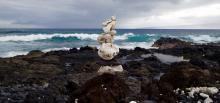
The coastal fog lifts to the height of soft bluffs and a man appears on the beach. The tide is low. I watch him hold a specially crafted staff in his right hand that he uses to poke, prod, and drag lines in the sand. He totters along like a modern Rumi, hand scribing an elegant poem on the strand. Perhaps in sand script it says: “Small birds destroyed an army, so you’d know they gained their strength from God.”
For the past six years, Denny Dyke has kept his morning ritual, creating intimately carved, hundred-feet-wide sand labyrinths—sacred circles, holy walkways, salt-soaked mandalas—on the Oregon coast. He draws for an hour, outlining 4,000-year-old designs and adding his own, creating ephemeral art.
I met Denny near Bandon, Ore., at a time I was desperate for spiritual rest. It has been an exhausting year. A year since the demon of white supremacy recaptured the White House. A year of rapacious capitalist thugs masquerading as legislators, callous political buffoonery inciting legislative chaos, greasy fingers tweeting too near the nuclear button, acts of hate rising like sea levels.
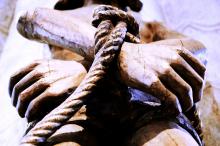
THE BASILICA OF St. Bartholomew on the Island in Rome holds the bones of the apostle St. Bartholomew, who delivered the gospel of Matthew to India, southern Arabia, and Syria. Spreading the seditious good news eventually got him killed—crucified upside down in Baku, capital of modern Azerbaijan. Bartholomew proclaimed the resurrection of Jesus until the soldiers cut off his head.
In 1999, this church nestled on an island in the Tiber River was dedicated to modern Christian martyrs. Entering its cool interior, one can walk a global Via Dolorosa—each side altar is dedicated to parts of the world where Protestants, Catholics, and Orthodox have been killed for their faith.
The relics include a letter from Franz Jägerstätter, the Austrian farmer beheaded for refusing to serve in Hitler’s army, and the missal of Salvadoran Archbishop Óscar Romero left on the altar when he was assassinated during Mass in 1980.
Christians today fall out over Christian martyrs and persecution in a right/left divide. We fight about numbers. In 2015, Christian Freedom International released an often repeated statistic suggesting that Christians are “martyred for their faith every five minutes.” This has been widely debunked. But it raises questions about definitions, methodologies, and theological perspectives.
Thomas Schirrmacher directs the International Institute for Religious Freedom, which runs a research project with several universities to measure Christian persecution. He estimates that there are 7,000 to 8,000 Christian martyrs each year, a number that roughly matches the Open Doors World Watch List, which reported 7,106 Christians killed in 2015, an increase over previous years and far less than one Christian every five minutes.

AFTER MASS a few months ago, I asked a member of my parish how her search for a new apartment was going. She said, “I’m so scared where I’m living right now that I went out and bought a gun.”
I was shocked. “I hope you didn’t buy any bullets to go with it,” I quipped. She gave me an eye-roll; I gave her a hug.
Like many Americans (dare I say most)—from President Obama on over—I despair of our country ever regaining sensible gun-ownership standards.
If I had my way, society would have no guns. Period. My motto is: The only way to stop a bad guy with a gun is ... the unarmed cross of Jesus Christ.
However, I recognize that in rural areas a gun can be a tool for wildlife maintenance.
I recognize that a well-ordered society relegates certain uses of force to the state—generally understood as police and military—for the protection of its members, especially the vulnerable.
I recognize that the U.S. Constitution has a Second Amendment—controversial as it may be—that allows for people to “keep and bear arms” (in the context of a “well-regulated militia” that was deemed “necessary to the security of a free state”). It’s a system of checks and balances built into our democracy’s operating manual.
SHORTLY BEFORE Irish poet Seamus Heaney died in 2013, he texted these last words to his wife, Marie: Noli timere. Be not afraid.
I’m not sure if Heaney, who was described by Robert Lowell as “the most important Irish poet since Yeats,” knew this was his last text and final words, but I suspect he did.
It’s a sad commentary that when the Twitterverse got hold of Heaney’s message, no one could figure out what it meant or where it was from. Many did not recognize the angels’ message to Zechariah (Luke 1:13) or Mary (Luke 1:30) or the shepherds (Luke 2:10) or Joseph in a dream (Matthew 1:20): Be not afraid.
Heaney understood words as “bearers of history and mystery.” As a distinguished translator of poetry from Greek, Latin, Italian, Irish, Anglo-Saxon, and Middle Scots, he had plenty of languages to choose from. But he chose St. Jerome’s fourth century vulgate version of the Bible. He chose the language of the angels.

ONE GAUGE OF global policies is how they affect people we may have never heard of. West Papuans, for example.
In March, I met Matheus Adadikam while he was visiting Washington, D.C. He’s the general secretary of the Evangelical Christian Church in Tanah Papua, representing 600,000 people. Located between Australia and Indonesia, West Papua shares a South Pacific island with New Guinea. It’s basically on the other side of the world from D.C.
Pastor Matheus told me about his country. Well, not exactly his country, he says. Indigenous Papuans have lived there for 40,000 years, but in the colonial era—and more recently, as a province of Indonesia—they’ve had no right of self-determination. “As a Papuan, we have no right to speak about our rights as Papuans,” he says. “Forty years ago we ‘became Indonesian,’ so we can no longer speak of ‘Papuan human rights.’”
The story is starkly familiar. Since the establishment of colonial economic forces, the land of Indigenous Papuans has been held in chattel slavery by those more powerful—English (1793), Dutch (1828), Japanese (1944), United Nations (1962), and now Indonesians (1963). “Killings, torture, and rape of Indigenous people are routine,” according to the Center for World Indigenous Studies. A conservative estimate is that 100,000 people have been killed since 1963. “Even to raise our Morning Star flag is to die or be in jail,” says Matheus. (One man is serving seven years in jail for flag-raising.)
In 1960, a rich vein of gold and copper was discovered in the Jayawijaya mountain range in West Papua. After some back-room deals, the U.N. “gave” West Papua to Indonesia. Indonesia promptly welcomed the Phoenix-based Freeport-McMoRan mining company to open what became the largest gold and third-largest copper mines in the world.
“Justice, peace, and care of all of the Lord’s creation is the main mission of our church,” says Matheus, “but our experience has been that change happens fast, and external influences are changing who we are as a people.” His main mission now is traveling the world asking for help.

AS THE FATE of the world hangs in the balance, one humble pastor—leader of the world’s smallest nation-state—offers a word. Well, closer to 40,000 words.
Pope Francis’ much awaited social teaching on ecology was released in June to global acclaim and thunderous Twitterapplause. Laudato Si’ (“Praised Be to You”) takes its name from a line in St. Francis of Assisi’s “The Canticle of the Creatures,” written in 1225. The encyclical lays out the house rules for this earthly commons we share—archaea, bacteria, and eukaryota alike. (Google it. You, me, all the fauna and flora, are part of eukaryota.) So, what do you need to know?
1. The news is not good. The world’s leading spiritual physician has diagnosed “every person living on this planet” with a progressive and degenerative disease. A soul sickness has spread through us to infect the soil, seas, skies, and even the seasons. Among humans, the poorest have the least resistance and the richest are the major vectors. This disease multiplies in isolation and loneliness, with symptoms of obsessive consumption, greed and corruption, and habitual narcissism. “The external deserts in the world are growing, because the internal deserts have become so vast.”
2. This disease is having dire consequences: objectification of the other, a failure of awe in the presence of beauty, and a defiance of reality by those who claim the “invisible forces of the market will regulate the economy” and dismiss the impact on society and nature as “collateral damage.”
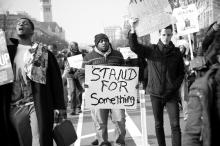
IN AN undistinguished apartment around the corner from my house in Columbia Heights, the Black Power revolutionary Stokely Carmichael honed his forceful, insistent rhetoric and organizing genius. His apartment effectively served as the Washington, D.C. headquarters for the Student Nonviolent Coordinating Committee (SNCC).
Historian Peniel E. Joseph’s recently released Carmichael biography, Stokely: A Life, traces this complicated American revolutionary with nuance and freshness critical in our era of resurging black youth-led movements. Regarding Carmichael’s D.C. years, Joseph describes the intellectual crucible that was Howard University at the time.
The Caribbean-born, Harlem-raised Carmichael lived in D.C. from 1960, when he enrolled at Howard as a philosophy major, to 1965, when he relocated to Lowndes County, Ala., as a fulltime organizer for the black freedom struggle. For five critical years, Carmichael—who was raised Methodist and would later found the Black Panthers and become a leading anti-colonial, pan-Africanist living in Guinea (changing his name to Kwame Touré)—honed his organizing skills and revolutionary perspective from his student apartment on Euclid Street.
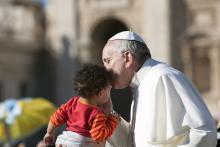
JOURNALIST Elisabetta Piqué was reporting for Argentina’s La Nacion from a conflict zone in Gaza when her phone rang. On the line was her friend, Padre Jorge. He knew Piqué, a war correspondent, was somewhere bombs were falling. He wanted to pray with her.
Piqué had known Argentina’s Catholic Cardinal Jorge Bergoglio since 2001. “He knew me first as a war correspondent,” Piqué told me when we met on a warm October afternoon in the courtyard of Hotel Helix in Washington, D.C. An affectionate friendship developed. Bergoglio even baptized her two children. Her new book, Pope Francis: Life and Revolution, investigates the history, passions, mistakes, humility, courage, and spiritual maturity of the man her friend has become.
In the rush to publish biographies of the new pope, some (see Paul Vallely’s Pope Francis: Untying the Knots) tout Bergoglio’s conversion from careful, benevolent, autocrat to radical, somewhat careless, lover of the poor. Piqué categorically challenges this portrayal. “He is a person who has been consistent all his life,” she says, “not somebody that suddenly became like that now. The theories that he had a conversion are totally nonsense and without any basis. He was always a sensitive person toward suffering.”

A new model of leadership that’s been refined in the fires of change and conflict is emerging from U.S. religious women.
In June, the Institute for Policy Research and Catholic Studies, along with Solidarity with Sisters, invited 150 people to Catholic University for an opportunity to discuss the model of leadership that has developed in Catholic women’s communities around the world over the last 50 years since Vatican II. The event coincided with the release of Spiritual Leadership for Challenging Times, an anthology of 10 addresses given by Leadership Conference of Women Religious (LCWR) presidents.
Catholic sisters are emerging as leaders ahead of their times. From Sister Simone Campbell, SSS, and Nuns on the Bus to Catholic Health Association CEO Sister Carol Keehan, DC, who helped pass the Affordable Care Act, to former LCWR president Sister Pat Farrell, OSF, who practiced authentic spiritual leadership in the face of the Vatican’s ongoing investigation of that organization (an investigation that Pope Francis should have laid quietly to rest, but has not), religious women are getting notice for their thoughtful, faithful leadership in the face of withering criticism and their own communities’ dramatic changes.
What are the marks of this new leadership?

OUR LADY QUEEN of Peace church sits atop a low bluff overlooking the Army Navy golf course. This vibrant Arlington, Va. Catholic community has a history of staring hopelessness in the eye and declaring, “Not on our standing ground!”
Queen of Peace was founded by African Americans in the midst of virulent segregation. In the 1940s, Arlington’s black Catholics had to travel two hours by buses to attend a Mass where they were welcome. There was a closer church, but black Catholics were relegated to the back pew and prevented from receiving communion before whites. In 1945, 16 families pooled their money, hired a black real estate agent, and purchased small parcels of adjoining property under various names so as to not arouse suspicion. In an era when redlining and “neighborhood covenants” protected white enclaves and economic power, this was a courageous act. A little less than two acres—their standing ground—was purchased for $14,000. The bishop blessed Queen of Peace, Arlington’s first black Catholic congregation, on Pentecost Sunday 1947.
Now, nearly 70 years later, this multicultural community is asking a new question: With global temperatures rising and changes visible everywhere in nature, how do we face the truth of climate change?
During a speaker series in March focused on “the integrity of creation,” I encouraged them to overlap the ecclesial concept of “parish” with the ecological one of “watershed.” For life to persist, there must be living water. Scientists tell us that each watershed, no matter how small, is responsive to climate change. Since human activity has destabilized the climate, changing human activity is important in undoing the harm. And since the earth’s biosphere is made up of interlinked watershed communities, perhaps restoring our particular watershed is analogous to healing the earth at its “cellular” level, which would be a positive contribution.
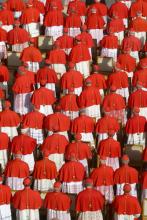
IN MINDANAO, Philippines, a cheer went up: Mayron tayong cardinal! (“We have a cardinal!”) In January, Orlando B. Quevedo, archbishop of Cotabato, was one of 19 new cardinals named by Pope Francis.
Cardinal Quevedo rose from newsboy to archbishop. He’s renowned for his interreligious work and cofounding a Catholic-Muslim peace community in the southern Philippines where there is violent ethnic conflict. Quevedo is a leader in the Federation of Asian Bishops’ Conferences, a body representing more than 100 million Catholics that has courageously pushed forward the values of Vatican II amid traditionalist backlash.
During a papal conclave, when a new pope is chosen, much of the world, Catholic and otherwise, pays close attention to the news ticker from the Vatican. For the selection of new cardinals, not so much. But with Francis, everything bears watching.
Historically, cardinals were called “the princes of the church” because of the power they wielded. Functionally, they serve in the College of Cardinals, which meets with the pope to deal with questions of major importance and elects new popes. Sadly, scoring a red hat has been for some the acme of clerical ambition. The season of cardinal picking can devolve into extravagant indulgence.
But, there’s a new sheriff in town: Pope Francis wants deputies, not darlings.