Last week, White House press secretary Karoline Leavitt threw a performative tantrum when asked about the Immigration and Customs Enforcement agent who shot and killed Renee Nicole Macklin Good in Minneapolis. During a lengthy and frankly exhausting tirade in which she berated The Hill reporter Niall Stanage as “a leftwing hack,” Leavitt unloaded with some rhetoric about the crimes of undocumented immigrants.
“I bet you never even read about Laken Riley or Jocelyn Nungaray or all of the innocent Americans who were killed at the hand of illegal aliens in this country,” she said. “And the brave men and women of ICE are doing everything in their power to remove those heinous individuals and make our communities safer.”
That last line is an interesting one. I can think of a lot of adjectives that might apply to the men and women of ICE. Brave isn’t one of them.
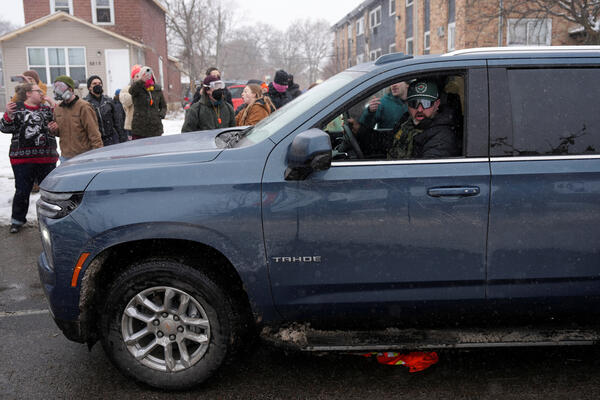
We’ve all watched ICE agents descend upon helpless communities while outfitted (if not necessarily trained) for war. They storm restaurants, high schools, and homes with guns that would make Seal Team Six jealous, and drag dishwashers, nurses, and moms off to black sites. It takes no bravery to do any of this. Still, the idea of ICE agents as brave tells us a great deal about this country and what we’ve come to see as “brave” one year into President Donald Trump’s second term.
READ MORE: Faith Leaders Amplify Demands for ICE to Repent
For all Trump’s love of pageantry and indulgence, his supporters still relish the idea of him as a bit of a cowboy. For many people, Trump flying off half-cocked in Venezuela or Ukraine is just what this country needed: someone with the gumption to make big moves now and worry about consequences later. “Sure, maybe he doesn’t do everything perfectly, but at least he does stuff,” they say. “He’s bold. He takes action. He’s not afraid to overturn the apple cart. He’s brave.”
You see the same swagger in Trump’s friends (Elon Musk and Vladimir Putin have both hailed Trump as courageous) and even his critics. María Corina Machado, the Venezuelan opposition leader who won Trump’s coveted Nobel Peace Prize before presenting it to him as a gift, hailed him as a man of “courageous visions.” She did not elaborate.
People think of Trump as brave because he’s brave-coded: a brash white guy who doesn’t listen to the experts and says what he’s thinking, however uncouth. He has this in common with his ICE agents who, wielding extraordinary firepower while decked out in camouflage and riot gear, certainly have the trappings of bravery. Plenty of presidents—from Teddy Roosevelt to Ronald Reagan—have cultivated similar public images. Clint Eastwood built a career playing this kind of guy. We think of them as brave because they don’t appear concerned with risks or consequences.
This is what I see with Donald Trump. Not bravery, but a lifetime of assurances that his wealth and privilege will cushion him from any real consequences. It is very easy to act boldly and brashly when the entire apparatus of the United States government can be marshalled to shield you from any reckoning. This is true of both Trump and of ICE agents. On Sunday, Deputy Attorney General Todd Blanche told Fox News that Jonathan Ross, the ICE agent who killed Good, will not be investigated for murder by the FBI. This comes after Ross fired on Good for no apparent reason whatsoever. This is supposed to be bravery? A man shooting and killing a woman and then hiding behind the skirts of the state? Surely, Peter felt brave when he tried to defend Jesus by cutting off the ear of the Roman soldier, but we all know better.
READ MORE: ‘Abolish ICE’ Is the Cry of the Prophets
“Courage is resistance to fear, mastery of fear—not absence of fear,” Mark Twain wrote in The Tragedy of Pudd’nhead Wilson. “Except a creature be part coward it is not a compliment to say it is brave.”
In her book How We Learn to Be Brave, Bishop Mariann Budde expands on this idea of courage as not the absence of fear but the presence of something deliberate. She writes that “the courage to be brave when it matters most requires a lifetime of small decisions that set us on a path of self-awareness, attentiveness, and willingness to risk failure for what we believe is right.”
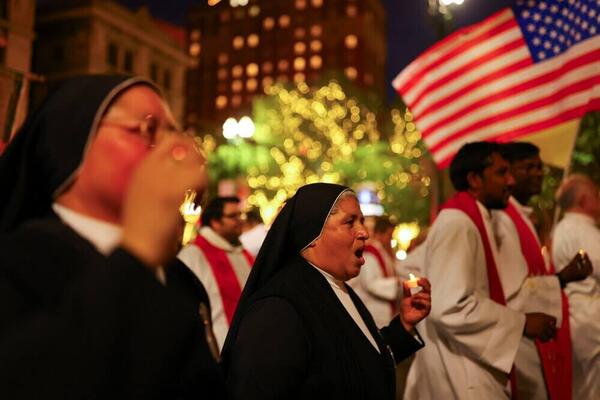
When you see real bravery, there is no mistaking it for any of its parodies, because real courage is rooted in love. Earlier this month, Bishop Rob Hirschfeld of the Episcopal Church of New Hampshire held a vigil for Good in which he announced that he’d instructed his clergy to finalize their wills and get their affairs in order. “Because it may be that now is no longer the time for statements, but for us with our bodies, to stand between the powers of this world and the most vulnerable,” he said. In an email to NBC News, Hirschfeld stressed that the sort of action he envisioned was “peaceful, non-violent resistance,” and that “non-violence and love, as Jesus himself practiced and lived, should be the way for us to settle all differences in a free society."
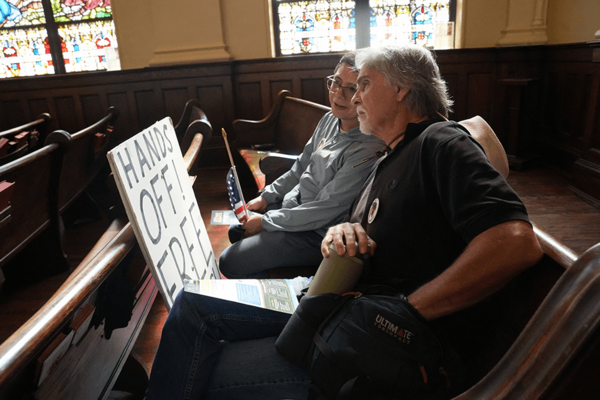
This, I think, is courage. Not people firing guns into crowds of protesters, but men and women soberly preparing in love to place their bodies “upon the gears and upon the wheels,” as activist Mario Savio said. There are many examples of this courage in Minneapolis. From Rep. Ilhan Omar (D.-Minn.) staring down a group of ICE agents with firearms drawn to unionized employees at a St. Paul, Minn. DoubleTree Hotel who refused to let their facilities be used by ICE. It took courage for protesters to disrupt a St. Paul church service where an ICE field director also serves as a pastor. It took courage for Renee Good to stand up to an ICE agent too. It’s taking courage for faith leaders to organize continued protests this weekend.
READ MORE: Faith Groups Plan for Major Protests in Minneapolis
And over the first year of Trump’s second term, there have been many examples of courage beyond Minneapolis: Churches organized to protect immigrants in their communities from deportation, forming rapid response networks that do everything from fight to secure the release of the wrongfully detained to running errands for undocumented folks who are afraid to leave their homes. Other faith-based groups have filed lawsuits to keep their churches safe from ICE raids. Still other faith leaders have been shot at and even arrested while protesting ICE. None of these actions, by themselves, will abolish ICE. But together, they take up the Trump administration’s finite amounts of time, personnel, and resources, gumming up the machinations of terror. All this takes courage. As a mixed-status immigrant in Chicago told Sojourners earlier this year: “We are full of fear, but we are not helpless.”
This is courage: holding both fear in one hand and the ability to act in the other, finding that loving action outweighs fearful inaction. The response to fear is not to pretend it isn’t there, but to face it head on with action rooted in love. Or, as 1 John 4:18 has it, “There is no fear in love, but perfect love casts out fear.” We are not motivated by promises of impunity, but to love because, as the next verse says, God “first loved us.”
It is striking how varied and diverse such displays of courage have been. A politician like Omar is going to have a different praxis for courage than a pastor, but both acts are necessary. Your courage will be necessary too.
As I write this, Trump has apparently informed the Prime Minister of Norway about his interest in the “Complete and Total Control of Greenland” in retaliation for the perceived sleight of not winning the Nobel Peace Prize; at the World Economic Forum on Wednesday, Trump berated European leaders for not supporting his quest to control Greenland, which he called “a very small ask.” This extraordinary development is compounded by his actions in Minneapolis, Venezuela, and things like the business with the Epstein files and the dismantling of USAID. The idea of enduring three more years of all this is daunting. It is, if we’re honest, a little scary. It is normal, even rational, to feel fear. The challenge for all of us will be to resist surrendering to fear—that is to say, cowardice. Fortunately for us, 2 Timothy 1:7 says that “God has not given us a spirit of cowardice but rather a spirit of power and of love and of self-discipline.” I do not think any objective observer would say Trump’s first year back in office has been marked by love and self-discipline. But together, in solidarity, we can make sure the next three years of our fight are.
The Trump administration wants us to believe that bravery is what happens when a man with a gun faces someone without one. That is not courage; it is cowardice with better branding. Real courage is costly, exposed, and unspectacular. It does not come with uniforms or legal immunity or Fox News talking points. It looks like bodies in the way, doors held shut, names spoken aloud at vigils, and people choosing love even when fear would be easier. If this country is going to be saved from its own worst instincts, it will not be by powerful people who call themselves brave—but by those who act bravely without the guarantee of protection.
When you see real bravery, there is no mistaking it for any of its parodies, because real courage is rooted in love.

Did this article have an impact on you? Tell us how! Whether you’re moved to take action, have a question, or want to share a comment (good or bad), we value your feedback!