The Department of Homeland Security’s move to suspend funding for Catholic Charities of the Rio Grande Valley—and to seek an unusually long ban on future federal grants—is prompting concern among Catholic leaders and immigration advocates who see the action as part of a broader effort to curtail faith-based humanitarian work at the U.S.-Mexico border.
CCRGV, a South Texas nonprofit led by Sister Norma Pimentel, has been given 30 days to respond to DHS’s proposed debarment, which would shut the organization out of most federal funding streams for six years.
The suspension, which applies only to the South Texas organization, not to Catholic Charities USA or other diocesan agencies nationwide, would be a major blow to CCRGV. The charity, which operates the Humanitarian Respite Center in McAllen, Texas, has been a major recipient of DHS funds through the Federal Emergency Management Agency’s Emergency Food and Shelter-Humanitarian program and its newer Shelter Services Program.
According to DHS, such allocations are meant to “provide funding to non-federal entities that serve noncitizen migrants recently released from DHS custody” so that they can temporarily provide shelter, food, transportation, acute medical care, personal hygiene supplies, and staff assistance.
According to federal filings, CCRGV received around 78% of its revenue from federal and state grants in Fiscal Years 2023 and 2024.
Although federal agencies routinely audit grant recipients, the scope and severity of the DHS’s proposed punishment stand out. Federal debarments typically last three years. But DHS is seeking twice that length, citing what it describes as “pervasive” problems in CCRGV’s internal controls, irregular intake procedures, and missing documentation.
Via a formal Notice of Suspension and Proposed Debarment, DHS alleges that migrant intake data submitted by CCRGV is so inconsistent that officials could not verify whether some individuals served had appeared in federal databases. Investigators also claim the nonprofit billed the government for services provided outside the 45-day window allowed under FEMA rules.
DHS first made accusations in November 2025, when the department initiated proceedings to cut off CCRGV from federal funds. Now, DHS has sought a rare six-year ban, a severe penalty that, if finalized, would place CCRGV on a government-wide exclusion list, effectively warning other agencies and grant partners to not work with the organization.
CCRGV has countered these claims and characterizations. In a statement, the organization said all DHS funds were used exclusively to assist migrants who had already been processed and released by U.S. Customs and Border Protection. Those funds supported food supply, shelter, transportation, hygiene assistance, and short-term care for people legally permitted to travel to their destinations while awaiting immigration proceedings.
“Those on the front lines of our humanitarian outreach know the work we do truly helps to restore human dignity,” Pimentel said in the statement, adding that she takes “very seriously every single dollar entrusted to us.”
A moral argument from the state
Beyond questions of compliance, advocates say the case is notable for the language DHS has used to undergird its action. In letters reported on by Fox News, DHS officials invoked terms drawn from Catholic social teaching—including “human dignity” and “subsidiarity”—to defend the administration’s immigration policies.
The letters argue that “illegal mass migration” undermines human dignity and social order, echoing rhetoric used by Vice President JD Vance and other administration officials who have appealed to concepts such as ordo amoris, or an ordered hierarchy of moral concern. The late Pope Francis explicitly rejected that framing, warning against using Catholic teaching to justify exclusion or indifference to migrants.
READ MORE: Wait. What Does Vance Think Augustine Said About Love?
In November 2025, the U.S. Conference of Catholic Bishops issued a "Special Message on Immigration" opposing mass deportations, calling for humane treatment of migrants, and advocating for justice—a statement publicly praised by Pope Leo XIV.
For some Catholic leaders, the use of theological language by federal agencies and government officials represents a striking attempt to challenge the church’s migration ministry on moral grounds, not merely legal ones.
Catholic lawyer and moral theologian Kenneth Craycraft said the DHS letters’ appeal to Catholic social teaching reflects a distorted reading of the tradition. While terms like “human dignity” and “subsidiarity” are foundational to Catholic ethics, Craycraft said they cannot be separated from solidarity or reduced to a defense of exclusion.
“Subsidiarity is not Catholic libertarianism,” he said in a phone interview with Sojourners. “It’s a limiting principle, not a justification for abandoning people at the margins.” Applied to immigration, he said, subsidiarity often requires large and coordinated responses, not withdrawal. “You cannot have a robust vision of subsidiarity without an equally robust vision of solidarity,” Craycraft added, warning that invoking church teaching to defend nationalist immigration policies amounts to “bad theology” that ignores the gospel mandate to welcome the stranger.
Part of a broader pattern
The CCRGV case also comes amid a wider federal pullback from funding religious and nonprofit groups. In recent months, DHS has suspended or rescinded millions of dollars in grants to Muslim organizations under FEMA’s Nonprofit Security Grant Program, as well as cuts to other initiatives related to hate-crime prevention and refugee support.
Civil rights groups, like the Brennan Center for Justice, Human Rights Watch, and numerous religious denominations and groups, have accused the agency of disproportionately targeting organizations serving politically vulnerable populations.
Earlier this year, DHS sent letters to local governments and nonprofits receiving migrant-related grants, warning they “may be guilty” of encouraging unlawful immigration and demanding detailed records of those served, a move critics described as intimidating and legally dubious. One of those organizations was the Episcopal Diocese of Rio Grande, whose Bishop Michael Hunn said the letter amounted to a not-so-subtle accusation that the diocese was engaged in human trafficking.
Meanwhile, Texas Governor Greg Abbot’s attorney general’s office has targeted religious groups that work with migrants across the state, including Annunciation House in El Paso and Pimentel’s CCRGV.
Catholic Charities across the region, which rely heavily on government partnerships to deliver large-scale humanitarian services, now find themselves navigating an increasingly threatening landscape for its work.
Craycraft said the DHS action should be understood within long-running tensions between the Trump administration and Catholic institutions engaged in immigration work. While he cautioned against reflexively framing the move as retaliatory, Craycraft said the case exposes real strain points between church leadership, government funding, and political activism.
“The Church is an important depository of funds to do good among migrant populations in the U.S.,” Craycraft said, adding that bishops might now consider exercising greater prudence in how they support nongovernmental organizations, particularly when federal money is involved.
Still, he rejected any suggestion that migrants who have already entered the country should be treated differently based on legal status. “We need to be document-blind in the way we treat immigrants who are here,” he said. “How they came does not change their dignity.”
‘Without funding, we cannot save people’s lives.’
In South Texas, reactions to the suspension reflect deep divisions over immigration policy.
Alma Ruth, founder and director of Practice Mercy Foundation, which works with women and children on the Mexican side of the border, told Sojourners the debarment is appalling for everyone working on the frontlines of immigrant care in South Texas.
“Sadly, the Rio Grand Valley is one of the most underrepresented by the faith community along our borders,” she said. “There is no coalition or strong advocacy group except Catholic Charities. Sister Norma is our most respected leader in this area.”
In a community where it is common to worship alongside Immigrations and Customs Enforcement agents or eat tacos at a table next to Border Patrol officers, Ruth said anxieties are high and the fear of government crackdowns on ministries potent.
“We are tired, underfunded, understaffed, and under fire,” she said. “We have been at this since the first Trump administration and are more afraid than ever.
“If the government is going after Catholic Charities, none of us is safe,” Ruth added. “And without funding, we cannot save people’s lives.”
CCRGV continues operating while contesting DHS’s findings. Whether the proposed six-year ban moves forward may determine not only the organization’s future, but also the extent to which faith-based groups can continue providing humanitarian care at the border without becoming political targets.
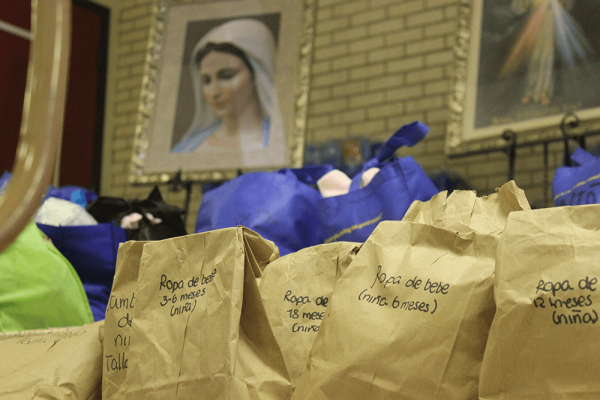
Even as the federal funding fight unfolds, CCRGV is turning to the public for help. In a Facebook postshared Monday, the organization asked supporters to contribute basic items—including bread, diapers, prenatal vitamins, and hygiene supplies—through its online wish list.
“Because of your generosity, we are able to serve our community with care and respect,” the post reads.
For now, CCRGV’s shelves, and mission, remain stocked, even if millions of dollars in federal support hang in the balance.
“Sadly, the Rio Grand Valley is one of the most underrepresented by the faith community along our borders ... There is no coalition or strong advocacy group except Catholic Charities. Sister Norma is our most respected leader in this area.”—Alma Ruth, founder and director of Practice Mercy Foundation

Ken Chitwood (@kchitwood) is a religion scholar and newswriter based between Germany and Arizona.
Did this article have an impact on you? Tell us how! Whether you’re moved to take action, have a question, or want to share a comment (good or bad), we value your feedback!