Living the Word

GOD’S JUDGMENT SHOWS up a lot in the lectionary passages this month, and in that I take great comfort. Let me clarify: God’s wrath is not usually my go-to for a cozy pick-me-up. But as I write these words, yet another innocent life was taken by violence at the hands of the state, and I am full of rage and mourning and an overwhelming sense of helplessness in the face of so much injustice. And so, I am comforted by these scriptures because they tell us that God has not forgotten the oppressed. They promise that justice will prevail, that those who climbed their way to the top with greed and exploitation will not stay on top. Their day is coming, but not, I think, because God is a God of revenge, but because God is a God of abundance, and everyone who has tried to limit that abundance for others will fail miserably in the end.
I am comforted by the promise that things will be made right and that, while I have my role to play, it is also not all up to me. I am not required to force justice along like a fish fighting upstream. Instead, I am being asked to collaborate with the flow of God’s generosity as it floods into this dry and barren land like a river shattering a dam. I am not the source of the water, but I can participate in the colossal splintering of a blockade all the same.
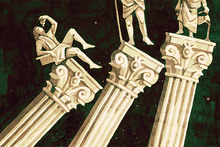
SOME TRADITIONAL INTERPRETATIONS of parables that I grew up with leave me wanting. In particular, I can’t abide a God who is depicted as a vengeful king or a landowner with slaves—and I don’t think I’m wrong to feel uncomfortable here. What if the problem is not with the parables themselves, but with the way we have historically read them? Perhaps some of Jesus’ parables are less allegory and more Grapes of Wrath exposé.
Perhaps by exposing the brokenness of systems, Jesus is suggesting this: The kingdom—kin-dom—of God is not a mere improvement on the systems we serve today but a full reversal. (The systems should serve humanity, not the other way around!) God’s vision is fundamentally relational and always concerned with the well-being of the most vulnerable. Imagine it. What if kings were more like gardeners than landlords and cities were true refuges and parties were for everyone?
Reading the Bible faithfully has economic, physical, and political ramifications that ought not be reduced to a meaning that is “spiritual” only. This month’s scripture texts invite us to contemplate how radical it really is to love your neighbor. It can be uncomfortable to reread some of these texts through a liberation lens, but I believe it is the kind of discomfort that leads to transformation. Let’s explore these texts with fresh eyes, open minds, and receptive hearts, willing to hold the discomfort and willing to be reshaped by the word of God.

FORGIVENESS CAN BE a profoundly beautiful act. And I never talk about it without offering some critical disclaimers because I know all too often forgiveness has been misused to keep victims and survivors silent and oppressed. Forgiveness is not about allowing abuse or mistreatment to continue. It is not about excusing bad behavior or insisting that you remain in relationship with the systems or person harming you. Forgiveness is fundamentally about liberation—liberation of self, and when appropriate, liberation of the repentant party.
These passages engage the theme of forgiveness, and I encourage every preacher to handle these texts with care using a lens of liberation. Preach in such a way that you are never sending a victim back to her abuser. Preach in a way that sets the people free. Make forgiveness the thing of beauty it is capable of being, not another trap for the downtrodden. How? Perhaps by letting the texts be as complex as our actual human lives—full of nuance and heartache, consequence and hope.
Our job is not to resolve the tension but to carry it well. Yes, Joseph forgives his brothers. But he messes with them a bit first. It’s not that black and white, and neither are our lives. Yes, Jesus surrenders himself to death, and it’s brave, noble, and profound. He also rises from the dead and seems to know he would. He wasn’t surrendering to his enemies so much as entrusting himself to a God who could bring resurrection from death. That distinction matters. Forgiveness can be beautiful, but it is rarely simple.

I DON’T KNOW about you, but I’m having a tough time. I look around and so much is broken that I don’t know how to fix. To make matters worse, your personal life never gives you a break just because the world is falling apart, which hardly seems fair. It’s always something, and it’s just too much for one person to hold.
We are not the first to feel this way. I found inspiration in the characters from our lectionary texts this month. They faced great challenges, too, and surely felt the same despair and fear we do. They navigated uncertainty, conflict, and circumstances beyond their control. And yet, it turns out God didn’t need them to be perfectly faithful or unshakingly stable.
When Peter gets scared and starts to sink, Jesus pulls him back up. When Moses’ life is threatened at birth, six women participate in his rescue (and it takes all of them). Peter questions Jesus to his face because he does not understand. Jesus corrects him without kicking him off the team. The heroes of these stories and of our faith are brave and also human—just like us. God is not upset about our human limitations. God sticks it out with us. Maybe faith isn’t about holding everything together. Maybe it’s about trusting that we are being held, even when we’re not sure we can hold on.
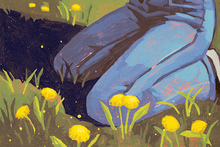
A FRIEND RECENTLY shared with me her practice of micro joy—pausing to appreciate the small things—and I can’t stop thinking about that word “micro.” When things are so very wrong on a macro level, it can be easy to neglect altogether the seemingly small stuff.
But what if the small stuff is actually the big stuff? Maybe connecting with my daughter by getting down on her level is resistance. Taking time to admire the sunset is prayer. Inviting my neighbor over for coffee is the work. I don’t suggest burying our heads in the sand about the big injustices to focus only on the here and now. I simply mean that the daily little practices and gestures contribute to a healthier soil in which liberation can sprout. These small acts prepare the ground—and that work matters.
Not all kingdom work is big or flashy or causes a system overhaul. But the little choices have ripple effects and something as tiny as a mustard seed can grow a tree. A little bit of grace, a little bit of courage, a little bit of hope, a little bit of prayer, a little bit of love can go a long way toward reorganizing the system so that everyone’s potential gets planted in equal soil.
Mary Oliver’s words keep playing on repeat in my head, “I don’t know exactly what a prayer is. I do know how to pay attention, how to fall down into the grass, how to kneel down in the grass.”
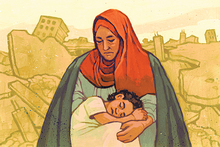
As Christian nationalism continues to plague the United States, I find myself asking the question: Who pays the price when faith separates itself from humanity? History is clear. It is the children. The mothers. The women. The foreigners. The outsiders. The marginalized.
Who reaps the reward when we reconnect faith to the unlimited compassion of Jesus? All of us. All of us. All of us.
Never in my lifetime has it felt as critical as it feels right now to make Christianity Christ-like again. Critical, as in people are dying. Critical, as in babies are starving. Critical, as in we are losing our very souls.

As we move from Easter through Pentecost, we witness the Spirit of God very much alive and showing up, often where we least expect. Taken together, these reflections pay attention to the ways God keeps speaking and the ways we are tempted to silence, dismiss, or police those appearances.
My daughter and I recently watched Zootopia 2. The utopia created there starts to show its cracks as Judy Hopps uncovers the truth about how reptiles were forcefully erased and pushed out of the land. A daring adventure and reclamation ensues, all because Judy, a rabbit, is willing to listen to a snake—the very animal everyone has villainized. I was reminded of the movie as I read these lectionary passages, because what happens to our own scriptural story if we listen to Stephen, to Mary, to Eldad and Medad, to Hannah? What happens if we stop gatekeeping who gets to have a voice? Where might we uncover God if we were no longer covering up those we have deemed unworthy?
Again and again in scripture (and in life), humans find it easier to preserve order than to risk disruption, easier to protect authority than to make room for revelation. But these lectionary texts bear witness to a Spirit who does not wait for permission but breaks through barriers in order to be heard.

Even a resurrection doesn’t eradicate suffering. People still weep and doubt and worry and fear. Friends still have to say goodbye. There are misunderstandings and missteps. There are valleys full of shadows. There are enemies. There are needs. Life keeps on “life-ing”—a fact that shouldn’t surprise us when we remember that life is alive, not dead.
Even so, in case you were tempted to believe Easter is the “happily ever after” of the Christian story, the texts in this Easter season will remind us that Easter wasn’t an ending but a beginning. There are trials yet to come. These passages aren’t only a reminder that crap will continue to happen. They are also a reminder that God is there with us in it.
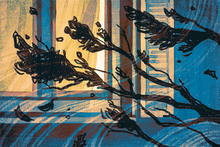
IF YOU ASKED ME how strong my faith feels, especially these days, I might tell you that I feel as strong as the leaves and twigs of a tree in a windstorm. But if you asked me what I’m connected to, I might tell you that my tiny twigs of faith are tied to a pretty solid trunk of community rooted in rich soil.
I’m sorely tempted, every day, to live in my leaf energy and cry. To “twig out” in terror. But I’m trying to remember that this faith thing is not a solitary endeavor, that because of you we have a trunk, that because of our ancestors we have roots. I’m trying to remember that even when the storm rages on, it will take a lot more than high wind to knock us flat.
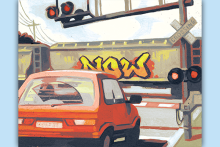
I’M GOING TO be real with you. I experienced a good bit of religious trauma in my ultra-evangelical, fundamentalist upbringing, and I’ve spent decades healing. What has shocked me, though, is the harm I have experienced and witnessed inside progressive faith circles—places where, in theory, we shared theology and values. It turns out people of any persuasion can fall prey to the temptation of superficiality rather than depth, performance rather than sincerity. It was a rude wake-up call, but hopefully the kind of disillusionment that keeps a gal genuine.
February’s texts draw us into humble evaluation of where we are and challenge us to a depth of commitment that can’t be faked or flaunted or rushed. Imagine you’re driving somewhere in a big hurry when (with the worst luck!) you’re forced to stop for a passing train. You impatiently tap on the steering wheel until you look up and notice that each passing boxcar is painted with a word. “Take. A. Breath,” say the train cars, “Go. Ahead. You. Have. Time. The. Lesson. Is. Now. Not. At. Your. Destination. Now.”
So, you take a deep breath. And then another. Because what else are you going to do? The train is no longer wasting your time. It’s become your teacher. My prayer is that these reflections function like those imaginary train cars, slowing you down just when you were running on urgency.

THE SEASON OF Advent is over, but the season of our waiting is not. There is still so much we long to see brought to fruition. Every morning’s news confirms the ache. We are pining for so much to be made right in a world that has gone so wrong. Christmas may have marked the end of Advent, but the liturgical year has only just begun. In other words, Christ has been born, but there is still a lot of story to be played out. What a great reminder as we head into yet another year that looks bleak at the outset: This story we are living in isn’t done yet. There is more to come, and some of it is very good news.
Just as it will take time for the Christ child to grow into the savior the world needs him to be, in every era of human history, the growth of justice takes time. Recognizing the slow pace at which the kin-dom of God unfolds does not mean we lie down on our backs and abdicate responsibility, but it does mean we have hope as we both labor and rest. No matter how dismal it may look out there, justice is on its way.
January’s readings take us into conversation with texts aching for justice and longing for homecoming, helping us sense when to listen and when to speak, when to hold still and when to move. We are encouraged to be tender with each other as we wait, to hold on tight to hope, and when the moment calls, to act with conviction.
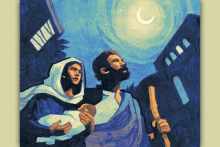
IN ADVENT, I remember and am grateful for all the prophets who show us the way of the divine. They invite us to remember and live out God’s command to love each other as much as we love God. I call to mind biblical scholar Walter Brueggemann, who passed away this year. He was a mentor, teacher, and colleague to many, including me. He taught us to prophetically reimagine a world where we challenge dominant and oppressive ideologies while compassionately re-envisioning a more just world. His magnanimous presence and prophetic words will be missed.
I also remember the young—led by Mary, the mother of Jesus—who invite us to be prophetic during adversity. With the guidance of Osvaldo D. Vena, we are invited to dream dreams in the joyous playground of God. Grounded in the abundance of God in our lives, I celebrate with Son Kyung Min’s praise song “Grace,” which I highly recommend for personal devotion and corporate worship services. The music grounds me in my faith and prompts me to remember how surrounded I am by God’s love.
As we approach the season of Christmas, let us pay close attention to the needs of our neighbors, especially our international students and immigrant neighbors. Every moment provides an opportunity for us to share the gift of the redemptive love of God.

I WRITE THIS month’s reflections with a heavy heart as the federal government’s violent attacks on immigrants continue. As a Korean-descent immigrant, I understand how scapegoating, hatred, and being blamed for things beyond our control can be exhausting for body and soul. Our communities are on the brink of despair; our hopes for a better future are shattering.
And yet, we hold on to our faith. We know we are not alone. God is our refuge. We have friends, colleagues, and neighbors who are in solidarity with us and who pray for us. As we face lawlessness geared with imperial might, we believe that our God, the only true “king,” will “judge between the nations” and “settle disputes.” Then we will beat “swords into plowshares” and “spears into pruning hooks.” God is the ultimate judge of all (Isaiah 2:4).
The transformative path of Zacchaeus inspires me. His story is a model of faithfulness. Whether or not you claim Jesus as your savior, I believe that you can change by caring for the poor and oppressed, participating in reparations, and sharing your abundant gifts. After all, the gospel says so.
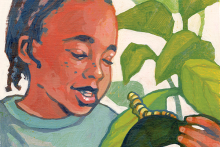
LISTENING IS ONE of the most important postures in engaging with the gospel. As Jesus says, “If you have ears to hear, then hear!” (Mark 4:9). This month, we listen to the cloud of witnesses who have shared with us their encounters of the divine. We listen not as passive recipients who accept what is presented unquestioningly; only oppressive systems demand that people listen without asking questions. Rather, Jesus invites us to listen (as we ask and question) because doing so acknowledges the presence of the divine in each one, no matter how different their thoughts may seem from ours.
These reflections open by listening to African American ancestors who have taught us how to read the Bible in ways that are liberating and just. We will also listen with the biblical Samaritans, considered “outsiders” at the time, who provide us with opportunities for self-critical reflections. Next, we recall the breath of God, the Holy Spirit, who inspires us to do good works. Finally, the wise words of the so-called Korean “comfort women” also teach us to listen.
In our world we are bombarded by noise and loud opinions that smother the soul. Listening these days may seem an overwhelming task. We crave quiet and peace. But Jesus calls us to listen carefully and intentionally to voices that are silenced and suppressed. We also must listen wisely.
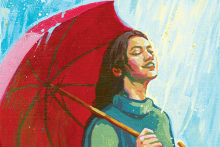
AMID RESISTANCE AND the fight for liberation, we must be humble, seek God’s mercy and love, and be willing to learn from one another. We cannot go around virtue signaling while believing we have no shortcomings.
This month’s reflections focus on repentance. I seek to confess and repent. Not with false humility or performative self-deprecation, but to be genuinely self-critical as I examine my conscience. The passages from Jeremiah and the psalms tremendously help with reorienting ourselves and our moral compass toward God. The New Testament readings strengthen us to continue doing the godly and righteous work of the Spirit. Luke reminds us that following Christ is challenging and that we are often lost due to our sins. The writer of 1 Timothy extends an invitation to repent.
We are continuously called to heal the wounds of our neighbors (and ourselves). Economic injustice creates many wounds for the poor as well as the rich. Luke’s gospel challenges us to reorient our relationship with money and economic systems in radical ways. We have heard the aphorism “For the love of money is a root of all kinds of evil” (1 Timothy 6:10). Luke challenges us to go deeper, to revisit our relationship with material excess in ways that are not only uncomfortable, but also structurally disruptive. Please join me as we seek God’s guidance in our collective journey of repentance, resistance, and reconciliation.

FOR MANY OF us, 2025 feels like George Orwell’s 1984. Some Christians profess their faith in God while cutting off support systems for people who are weak and poor. They kneel down and pray for their policies to pass — policies that will hurt the marginalized. I want God’s mighty hands to swoop down and protect us from this dystopian reality. I catch myself hoping for an extreme divine intervention. Desperation can make us long for a quick solution.
Thankfully, the passages for this month guide us to the realization that there is another way. There are “clouds of witnesses” who have shown us how to traverse the fires and divisions in our lives. Trusting in God is also learning from people (and even towns) who have shown us what it means to love God and love our neighbors near and far. I lift up the names of Ruby Bridges, my friend John, the city of Skokie, Ill., and other witnesses who have shown me how to trust in God in ways that are liberating and healing.
Who are in your clouds of witnesses? Who has shown you what it means to love God and your neighbors? Today and for this month, I hope that you will invoke their names as we journey together in this dystopian time.

WE HAVE COME to the point in U.S. Christianity when many declare that loving one’s neighbor is optional. I am not sure how anyone can read the Bible and still think that God does not mind if I care less for those who are not my immediate family.
This month’s reflections are all about caring for the other. God’s love is boundless, and we are the recipients of God’s enduring mercy; thus, we can also share a part of ourselves with our neighbors near and far. God’s bountiful love is evident in the stories of Naaman and the good Samaritan. Modern-day prophet Kendrick Lamar’s voice encourages us to be humble and to remember that we are each other’s keepers. Finally, we are invited to reflect on what it means when we hear unwelcome, and horrifying, knocks on doors.
Some public figures have expressed a preoccupation with the order of people whom we are called to love first. By advocating an unnecessary and arbitrary hierarchy, the order of love is distorted into an order of hate. Yes, we love God first as Christians. Such preferential love for God is manifest in how we show God’s love to all. We can do this because the Holy Spirit empowers us to love. If we truly have Christ’s love within us, then the sanctifying grace in us overflows because God’s love knows no bounds. God’s love traverses all concentric circles that we can imagine.
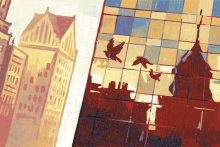
THE POLITICAL ENVIRONMENT in this country has caused great concern among many of us, Christian and otherwise. This month’s scripture passages spark various theological and socio-political hauntings that shed insight for us on how to respond.
For instance, we need to understand that God does not seek the destruction of creation to manifest God’s plan. No calamity can be justified as somehow being “God’s intention.” In addition, we need prophetic peace with all of God’s creation. This peace demands justice and reparations. I continue to pray for Palestine, Israel, and other nations where violence abounds. Third, we stand with all the queer people who are experiencing tremendous hardships because of intentional policy choices. Fourth, we will not be fooled by hate speeches that pretend to be freedom speeches. Words matter. We are responsible for what we say on any platform or in any capacity.
Our circumstances require us to respond, in whatever ways we can and on the issues that speak particularly to us. As we do so, even while we create room for self-critique, we are invited to be generous and patient with ourselves as we seek to navigate as wisely as possible these challenging times.
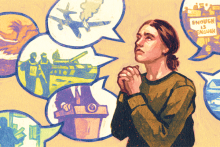
THE EASTER SEASON provokes a desire in me to find hope and joy again. I don’t want to wallow in misery just because my limited vision can see only a bleak future. Instead, I am choosing to seek hope and joy because I believe that God does indeed empower and guide us. I claim the daily practice of putting my hope in the divine, not our human condition. God seeks our well-being. We must remember this amid the onslaught of trauma brought on by humanity failing to do the right thing.
The post-Easter reflections are more positive in tone. I chose to be optimistic because life goes on, we still have good work to do, and the fight does not end. We still have to care for one another, and we hope that others will care for us. In all of these, I hope that we will find once again the power of prayer and divine love. There are resources we can seek for help, guidance, and support, and I am one of many who have received such generosity and kindness. I invite you to find your own versions of the divine and/or the mystical. The immaterial and unseen surround us, guiding us, especially in our moments of despair and need.
I end my reflection with a prayer for people and nations that are going through turmoil and upheaval. Join me in offering a prayer that we may bring peace wherever we can.
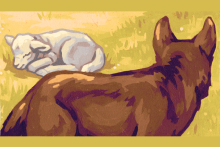
IN THESE UNCERTAIN times, I look for witnesses who will guide me to a more hopeful future. I do so because I cannot overcome my anxieties alone. I recognize the affective, spiritual, and communal dimensions of healing and recovery. When we heal and witness together, we are emboldened to witness the life-giving hope of the divine with the other more than ever.
In this month’s reflections, I see various sources of hope and witnessing. Beyond anthropocentrism, I see that nonhumans, particularly jackals and ostriches, are guiding us in our relationality with the divine and others (Isaiah 43:16-21). In responding to trauma, I seek the wisdom of women (“daughters of Jerusalem”) who have been down this road before (Luke 23:27-31). With their guidance, I hope for a peaceable kingdom that is unmitigated by false hopes and spiritual bypassing.
My last reflection engages Thomas the Twin (John 20:19-31) and the inauguration of Donald Trump for a second time. Here, I offer a weary posture of the discombobulated mind that is still trying to grasp the impact of his inauguration. I am trying to breathe amid a sense of despair. So, I hope that you will breathe as well, say a prayer or two, talk with a trusted friend, be with your animal companion, and relish your personal solitude. In all ways, I hope that you will find hope as you witness and become witnesses of social holiness.