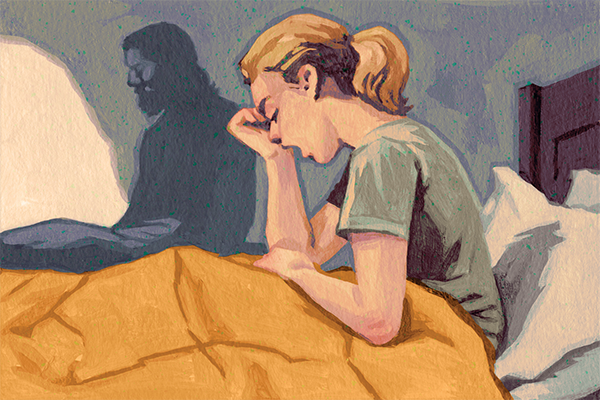
Even a resurrection doesn’t eradicate suffering. People still weep and doubt and worry and fear. Friends still have to say goodbye. There are misunderstandings and missteps. There are valleys full of shadows. There are enemies. There are needs. Life keeps on “life-ing”—a fact that shouldn’t surprise us when we remember that life is alive, not dead.
Even so, in case you were tempted to believe Easter is the “happily ever after” of the Christian story, the texts in this Easter season will remind us that Easter wasn’t an ending but a beginning. There are trials yet to come. These passages aren’t only a reminder that crap will continue to happen. They are also a reminder that God is there with us in it.
Can you imagine a God more thoroughly present than One who was willing to suffer and die, like we do? Who didn’t let divinity be a free ticket out of human pain, but joined us in the fray to feel and experience every sharp edge of life?
The God in these texts does not provide answers or solutions to life’s quandaries or offer much in the way of relief from its trials. But, this God shows up, speaks names, reveals scars, takes walks, breaks bread, guards sheep. Resurrection, it turns out, is not the end of suffering, but the return of presence—divinity choosing to stay with us in every shadowed valley and fearful moment along our way.
Resurrection is not the end of suffering, but the return of presence.
April 5
While It Was Still Dark
Acts 10:34-43; Psalm 118:14-24; Colossians 3:1-4; John 20:1-18
EARLY ON THE first day of the week, while it was still dark, the world’s first preacher of the resurrection arrived at the tomb of Jesus, unaware of who she would find, who she could become, and what she would soon be compelled to proclaim.
This is where calling and purpose are so often born—right in the darkest hour of our distress or grief or despair, a truth meets us there in the fallow garden. There—where we’d come to lay our dreams to rest—a figure arrives to wipe our tears and ask, “Why are you weeping?”
“Isn’t it obvious?” we feel like crying. “It’s all gone to hell, and everything hurts.”
“Woman, friend, beloved, why are you weeping?” the question persists, and we are confused and frustrated and lonely when the voice speaks again. But this time our name is on his lips and recognition dawns. Joy sprouts up from its burial ground.
Wouldn’t we love to stay in the warmth and relief of this moment? Instead, the voice says, “Do not cling to me.”
Mary cannot hold. He must go, and so must she. It’s goodbye all over again, but a farewell of a different flavor. She (we) must pick up the mantle of this ministry and carry it forth into the world, defiantly courageous in the face of violence. She will get knocked down for sure. But she has ingested the resurrection elixir. His very-alive spirit roars within her; she won’t be defeated. Not now. Not after she has witnessed the resilience of love in the flesh.
April 12
Believing Thomas
Acts 2:14-32; Psalm 16; 1 Peter 1:3-9; John 20:19-31
“DOUBTING THOMAS,” THEY call him, as if doubt were a flaw rather than an inescapable feature of faith. They seem to forget that the other (male) disciples scoffed when the women told them the blessed truth (Luke 24:11). That they too ran to the tomb to see for themselves (John 20:3-4). That even when Jesus appeared in the locked room, they did not rejoice until after he showed them his hands and his side (John 20:20). The rest of them were no more ready to be gob-smacked by a miracle than Thomas was. He just happened to be later than they were to the party, though I do wonder where he was.
In John 11, when Lazarus was dying and the disciples tried to talk Jesus out of going to Bethany because of previous threats against him in that region, it was Thomas who spoke up: “Let us also go, that we may die with him” (verse 16). Which makes me think that if Thomas wasn’t around that first night when the disciples hid behind locked doors in fear over repercussions from the crucifixion, it was not because he was a coward but because he wasn’t. Perhaps he was still out doing Jesus’ work or looking for the body rumored to be missing.
I don’t fault Thomas for wanting to touch Jesus’ flesh, for needing to see and experience a miracle for himself. Was there anybody who didn’t want that? Who doesn’t long for it now?
Before long Peter will be out on the streets proclaiming the resurrection boldly (Acts 10:34-43), but let’s not forget how he started this journey—denying Jesus three times before the rooster crowed. He too needed a flesh and blood encounter (Acts 10:41) to jolt him back to belief. No need to pass judgment on doubt or on being human. Faith isn’t about certainty, but the hunger for encounter.
Faith isn’t about certainty, but the hunger for encounter.
April 19
What the Heart Knows
Acts 2:14, 36-41; Psalm 116:1-19; 1 Peter 1:17-23; Luke 24:13-35
“HE WAS DESTINED before the foundation of the world but was revealed at the end of the ages for your sake” (1 Peter 1:20). Throughout history it has taken what can feel like forever for truths to be revealed. For decades, we ignored the mounting evidence of climate change. For ages, the church denied the dignity of LGBTQ+ people.
In these texts, we encounter two late-blooming revelations. When Peter is preaching, he lets the people know that the Jesus they crucified is indeed the Messiah. It is unclear how or why they did not see this before, but this time they were “cut to the heart” (Acts 2:37) and forever changed. In Luke 24, two travelers on the road to Emmaus spend their entire journey talking with Christ without recognizing him. It’s only in the breaking of bread at the end of their time together that it clicks into place, after which they can name the truth of their experience: “Were not our hearts burning within us while he was talking to us on the road?” (verse 32).
In both stories, recognition occurs at the heart level. Revelation happens when something opens in the heart rather than when the mind finally figures it out. I look out at the landscape today in which so many truths are obscured or denied, and I see how hard we try to persuade one another with sharper arguments and louder words. What if we engaged the heart rather than battled the mind? Not ignoring the mind, just entering it from a different portal. What if we blew breath on the heart’s embers—our own and that of our neighbors? Maybe the fire of knowing can be kindled over shared bread? Perhaps it is not too late for the heart to burn with the recognition of truth.
April 26
Tending Pastures
Acts 2:42-47; Psalm 23; 1 Peter 2:19-25; John 10:1-10
I’VE NEVER BEEN a sheep, but it feels cozy to imagine myself as one. In my mind, all that wool is soft and fluffy, rather than itchy and hot. As a sheep, I’m vulnerable to predators, of course. But I don’t have to worry too much because my shepherd is badass and protects me. I don’t have to worry about where I’ll get my food or where to go because someone smart is leading the way.
In real life, I am a full-blown human adult who takes care of herself and her children. But, as a chronically overwhelmed single parent, I sometimes just appreciate a good fantasy in which someone takes care of me, for once. That’s what the image of sheep with a shepherd conjures for me. I get to frolic in a pasture while someone else worries about food and bills and danger.
The way the author of Acts tells it, the people in the early church really were taken care of, but it was because they shepherded each other. No one frolicked 100% of the time. No one was the constant rescuer. And it wasn’t cozy exactly—they sold their possessions! And shared everything, which sounds lovely, but we all know is a recipe for dysfunction to surface. It was work. But I think it was play too. Sacrifice. But also, abundance. Not fantasy or utopia come magically true, but green pastures carefully and lovingly tended.
No one in this life gets to escape walking through the darkest valley or suffering ... but with God as our shepherd and genuine community as our flock, no one walks it alone.

Rev. Kyndall Rae Rothaus is a preacher, spiritual director, co-founder of Nevertheless She Preached, and author of Thy Queendom Come: Breaking Free from the Patriarchy to Save Your Soul.

Did this article have an impact on you? Tell us how! Whether you’re moved to take action, have a question, or want to share a comment (good or bad), we value your feedback!