soul
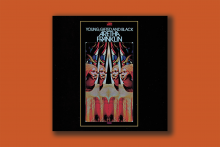
TOWARD THE END of the film documenting the performance of Aretha Franklin’s album Amazing Grace, the singer sits at a church piano. Like so many times in her childhood, she begins playing — gradually, almost tentatively — the opening chords to “Never Grow Old.” It was her first single, released when she was 14. As she sings of “a land where we’ll never grow old,” built by “Jesus on high,” folks in the audience — including gospel pioneer Clara Ward — cannot help but get up and dance. “Never, never never” — and then a Franklin trademark: mmm-mmm-mmm — “never grow old,” she testifies. You believe her.
This year, Aretha’s Amazing Grace turned 50. The album — recorded live at New Temple Missionary Baptist Church in Los Angeles with James Cleveland’s Southern California Community Choir and one of the greatest backing bands in all of pop music history — blends and crosses boundaries of genre, generation, race, and class. In 1972, Amazing Grace was not just a return to Aretha’s roots, but a vision of a future — one rooted in the Black experience in the U.S.
The liner notes credited Gene Paul as “assisting engineer.” Today, he is a legendary producer. Paul traces the genesis of Amazing Grace to Aretha’s 1972 record Young, Gifted and Black. That album’s title track, penned and first sung by Nina Simone, was a breakthrough in the civil rights and Black pride movements. “In the whole world you know / there’s a million boys and girls / who are young, gifted and Black,” the lyrics proclaim. While recording Young, Gifted and Black, Paul told Sojourners, Aretha began to conceptualize the live recording of a gospel album as a follow-up. When she thought of the potential project, Paul said, she “was smiling, captivated.” To Paul, there is a clear through line from Young, Gifted and Black to Amazing Grace: The former spoke to the contemporary Black political moment; the latter looked back in time while pulling her spiritual and cultural roots into the present. Both pointed the way to a Black future that was joyous and free.

Pixar’s latest film Soul, opens to the sound of a Queens, New York, middle school’s band class, led by Joe Gardner, a middle-aged, aspiring jazz musician. As someone who played the trumpet in my Queens middle school’s band, the discordant, yet earnest attempt at music immediately transported me back to Mr. Stier’s classroom in I.S. 109, circa 1992. Just as in Joe’s class, the walls of Mr. Stier’s room were covered with jazz posters; he wore a ponytail and, by my memory, he also had an earring.

This is why the civil rights movement was so impactful. The movement for justice was fueled and sustained by faith. The soul was not considered something separate from the body it was the source, the epicenter, and the driver for non-violent resistance and hope-filled resilience. Dr. King called this soulful way of doing justice “soul force.” Soul force heals the misguided bifurcation between evangelism and social justice by showing the deep connection between our souls and our actions. We must recover the soul of justice, lest we end up cynical, burned out, and reactionary. Soul work sustains both individuals and communities in our justice work. We must not neglect our souls in the work for justice nor neglect justice to tend to our souls. We must commit to both lifestyles and collectives that demand soul care as a non-negotiable act of justice for all.

Resistance is holy work. It is an act of healing. But many clergy and faith leaders (myself included) are either traumatized themselves or so justice-fatigued that it becomes too difficult to sustain resistance.

NIETZCHE GOT SOMETHING RIGHT about the soul: namely, that music is essential to its survival. In reacting to philosophical tendencies to marginalize or ignore the place of music, dance, poetry, and painting, Nietzsche would insist on the central importance of the arts in any philosophical investigation.
In my own discipline of theology, a similar concern is justified: When theology has taken its cue from modern philosophy, it, too, has slighted the role of music in considering the question of God. The result is a portrait of soul in monotone pitches, without color, without polyphony. Instead of a guiding rhythm in one’s reflections, music is often relegated to a footnote or to an echo that reaches one’s ear in barely perceptible, muffled sounds.
The most glaring exception to this general rule is the portrait of soul in black and Latin traditions. As James Baldwin famously noted, it is almost solely through music that black people have been able to tell their story. The same can be said about Latin cultures: Music has been a crucial medium for communicating with the modern world, with one’s ancestors, and with God. It has been a defining feature of black and Latin-American identities—a key ingredient in the stew and spice of these cultures.
Given the storytelling capacity of music in these cases, I believe that any theology worthy of the Christian conviction of incarnation—where God is embodied in the vast rainbow of human cultures—might want to begin by calibrating its body and soul to the frequencies of music. With music booming in our ears, we might get an alternative history of religion and culture, told at a sonic level, in the beats of a drum, a bass line, chant, or grunt. We might learn about cultural styles and struggles left off the written record of modern European accounts of the West, that exist only as oral and folk traditions.

Is David Brooks becoming a Christian?
That’s the question that some people have been asking about The New York Times’ op-ed columnist, especially in the wake of his new book, The Road to Character.
As Jonathan Merritt wrote, “Brooks claims to have written his latest book ‘to save my soul,’ and he told NPR that reading books by authors such as Christian convert C.S. Lewis has ‘produced a lot of religious upsurge in my heart.’”

It's odd that Christians — people who claim to believe that God created the earth, sustains it day by day, and intends to create a new earth — are often so mixed up about sex and food. How long would the earth's inhabitants last without coupling and eating?
And yet most Christian writers right up to the 16th century praised celibacy, sexless marriages, and arduous fasting. Bless Martin Luther for loving his wife (and the beer she brewed), but lots of us still seem to think that good sex and good food — if not actually sinful — are at least pretty low on the religious values hierarchy.
Has it escaped our attention that, according to our most sacred literature, God made a naked male and a naked female, put them in the midst of grain fields and orchards, and told them to multiply?
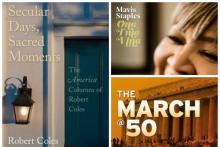
The Dream at 50
This August marks the 50th anniversary of the historic March on Washington for civil rights for African Americans. PBS will feature special broadcast and Web programming, including the premiere of the new documentary The March onTuesday, Aug. 27 (check local listings). pbs.org/black-culture/explore
The Miracle of Meaning
Secular Days, Sacred Moments: The America Columns of Robert Coles, edited by David D. Cooper, collects 31 short essays by the respected child psychiatrist and Pulitzer Prize-winning author. Whatever the topic, Coles offers thoughtful insights on civic life and moral purpose. Michigan State University Press

From the midst of the nether
world I cried for help.
—from the Book of Jonah
A gray whale blows off Cardiff Beach,
just beyond the glamour homes,
boutiques, and drive-thru windows,
valet service and all-u-can-eat sushi.
I want to swim out and be swallowed.
Jonah’s whale wasn’t Ahab’s, all
tripey white and peg-toothed, but
a strainer of phosphorescent shrimp,
which lamped the reeking gut, like
fireflies we swallowed once, in jars.

It's the Monday after Easter, and I couldn't think of a better day to talk about God being with us. Adam Ericksen wrote about the dance of doubt and faith on Good Friday, the challenge and beauty of embracing the fullness of the journey. Rob takes that all one step further in this chapter: With.
There is, I believe, another way to see God, a way in which we see God with us— with us, right here, right now. This isn’t just an idea to me; this is an urgent, passionate, ecstatic invitation to wake up, to see the world as it truly is.
(Kindle Locations 1201-1203)
Suddenly I have “Right Here, Right Now” by Jesus Jones playing in my head. Excuse me for being a child of the 80s.
My take-away? This God doesn't choose sides like we do.

Blindfolded and gagged, tossed in the back
of a car—it's how they gather up young men
and after tire irons and chains, leave some
lying in the road like dirt, rained on all night.
Some are bundled-up, tossed off a bridge
into the river whose muddy swirls warn:
kick, fight, breathe, twist your arms free.
Some do. They rise, spit out the rags
stuffed in their mouths, limp back to town,
and one begins to sing—slow at first— Lord,
I want to be in that number ... Another moans
a low muted tone where words won't go.

As a fiction writer, I tend to think of God as a novelist writing this epic story wherein every bureaucrat, cicada, and horsehead nebula could accurately be described as the main character. As a novelist, it's God's job to bring all things together toward a happy (or at least satisfying) end, but that doesn't mean that we the characters are mere puppets.
Novelists who write about their craft often speak of characters taking on "a life of their own" and thereby taking the novel to different places than the author intended to visit.
So this "soul" that we speak of — this part of our selves that isn't grounded in physical being but is spiritual (whatever that means) that we expect or hope will live on after our mortal coils shuffle off — what if it's simply God's memory of us? What if the afterlife takes place in God's heart?
If God's memory were like human memory, that too would feel like a cheat, but I suspect that God's memories are not dissimilar to God's prose. In other words, as real as spiders. As real as continents.

Funeral services will be held today for the six Sikhs killed at a Wisconsin temple last Sunday. The bodies of the deceased will later be cremated — but their souls will live on, Sikh tradition teaches.
Sikh scriptures don't dwell on what happens after death. Instead, the faith focuses on earthly duties, such as honoring God, performing charity and promoting justice.
"The afterlife is not a primary concern," said Gurinder Singh Mann, a religious studies professor at the University of California-Santa Barbara. "It's a very life-affirming belief system."
Still, like many religions, Sikhism includes intimations of immortality.
Founded in 15th-century India, Sikhism was born in the same cradle as Hinduism and Buddhism, both of which posit reincarnation. Like those faiths, Sikhism teaches that the goal is to escape from the cycle of death and rebirth.
But unlike Hindus and Buddhists, Sikhs believe that humans can't liberate themselves through meditation and virtuous living — only God's grace offers freedom from rebirth.
"We don't think that, 'Well, I've done these wonderful things, I get a ticket to heaven,'" said Mann. "That's a divine decision."

On Proverbs 8
My saints won’t be named by a church.
Their sainthood won’t stand as statues. Listen.
Voices
calm as cooking directions
play continually—
If any thing’s resurrectible, it’s memory:
those eyes,
song-haloed, so full of lightness
nothing could stop their flight;
not a Thomas who peers into pupils’ darkness,
not a ravenous soul left grounded.
We are born, yin-yanged, of lightning
with saints and putti the lightest of all.
But love-rumpled faces, quick limbs, and pierced hearts
are unstable, done only in clay.