palestinian christians
Palestinian Insights
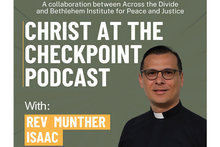
From Bethlehem, Rev. Munther Isaac hosts the Christ at the Checkpoint podcast, talking with theologians, pastors, and leaders to share Palestinian Christian perspectives on Israel, Palestine, and what American Christians misunderstand about the ongoing conflict in the region. Across the Divide
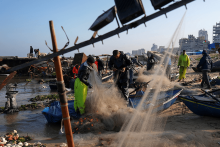
Amid the fragile ceasefire, the exchange of hostages, and the temporary pause in Israel’s genocidal onslaught against Gazans, nearly six hundred Christians huddle together in one of Gaza’s battered churches, their prayers rising above the rubble as a defiant testament to their faith and resilience. Among them, Gazan Christian George Antone boldly declares, “For us, as Christians, we are not leaving Gaza. We will remain in Gaza and help people in Gaza reconstruct their houses, rebuild the streets. Yes, we will stay in Gaza. We are not leaving.”
Antone’s words stand in stark contrast to the explosive press conference at the White House on Feb. 4, when President Donald Trump brazenly suggested that the United States should “effectively own” Gaza, proposing to turn it into a real estate venture while displacing Palestinians from their homeland and relocating them to neighboring countries.
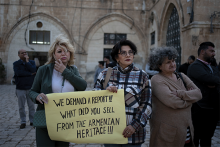
JERUSALEM'S OLD CITY has often been a focal point of the Israeli-Palestinian conflict, but within its walls lies a lesser-known story of occupation and resilience. The Armenian Quarter, a Christian enclave that has endured for centuries, now finds itself under threat.
In the context of occupied East Jerusalem, where Palestinians continually face displacement and erasure of their cultural and physical presence, the Armenian community’s struggle reflects a larger pattern. Though they make up a small portion of the city’s population, Armenians have called Jerusalem home for more than 1,700 years, surviving waves of conflict and colonial powers.
As a critical component of a shared Jerusalem between Jews, Christians, and Muslims, the Armenian Quarter has been a haven for this Christian community since a group of Armenian monks and priests established St. James monastery there in 420 C.E.
The enclave is now fighting to preserve its heritage amid mounting pressures. In April 2023, the community was shaken by plans from an Israeli-Australian developer, Xana Capital, to construct a luxury hotel on land purportedly owned by the Armenian Patriarchate. This development mirrors the land confiscation and settlement expansion that Palestinians know all too well.
Like the rest of the Christian population in the Old City, including the Greek Orthodox, Roman Catholic, and Ethiopian Orthodox, the Armenian community is navigating increased challenges, from economic strain to political pressures and demands to shift the historic status quo. These communities, increasingly pressured by Israeli authorities and settlers, face a myriad of problems, including property disputes, confiscation of church lands, new and prejudicial tax demands, and occasional acts of vandalism against religious sites. All Christian groups are grappling to maintain their historical presence in the face of growing threats in this contested city.

Honestly, I never thought much about Israel before college. Then, during my sophomore year, a prominent New Testament studies scholar had been invited to speak on campus; after it came to light that they were openly critical of the state of Israel, they were summarily disinvited. A few other students and I were still able to meet with the scholar, and we were shocked by the language they were using to describe the conditions in Israel for the Palestinians: “Second-class citizens,” “genocide,” and “apartheid” were the terms that struck me most.
“It can’t be as bad as what Black people have faced in the United States or what they faced in South Africa,” I remember saying to the scholar. “Go and see,” they admonished. And so, one year later, that’s exactly what I did.

THE SCENE APPEARS idyllic: “Golden sand, a vast red horizon, and shards of light scattered across the water.” But on this beach in Gaza, in Palestine, the mood is desperate. One man there describes Palestinian Christians as living artifacts of the 2,000-year-old Christian community in the Holy Land.
With grace and deep reporting, Janine di Giovanni, an acclaimed author and war correspondent, has captured the often overlooked plight of the dwindling Christian communities of the Middle East—specifically in Iraq, Syria, Egypt, and Palestine. The Vanishing is a tender if deeply disturbing travelogue, filled with stories told by Christians about the ferocious politics and desperate economics that shattered their communities. She writes in an elegiac tone while marveling at the resiliency of the few who remain.
Di Giovanni describes the trajectory of collapse, carefully providing the markedly different history of each country that nonetheless has led to similarly tragic outcomes.
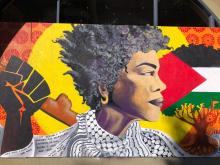
The first time that I visited Palestine was during my senior year at a Christian liberal arts college. It was one of those “Holy Land tours.” You know the type: visit the sacred sites, avoid political chatter, and return with photos of you or someone you know getting baptized in the Jordan River. Hashtag blessed.

Interpretations of Scripture taught throughout the evangelical world, such as dispensationalism and replacement theology, hold that the repatriation of Jews to the Holy Land is a necessary precursor to Armageddon and the Second Coming of Christ. The creation of the Jewish state, and especially Israel’s seemingly miraculous victory in the Six-Day War, seemed to many evangelicals to be the fulfillment of prophesy. The Second Coming, surely, must be right around the corner.
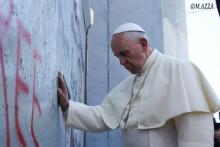
Recently I had the privilege of attending the Mass led by Pope Francis in Bethlehem’s Manger Square. I am not a Catholic – but like many who are not, I have been inspired and touched by Pope Francis. I do not know what is it exactly that draws me to him! Is it his humility? His compassion for the poor? His social justice concern? His true ecumenical spirit ? Maybe all of the above!
Back to Manger Square. It was truly a special day. There were Palestinian Christians from all over Palestine and Israel. There was a sense of euphoria in the air. I have never seen Bethlehem like this before. I have never in my life witnessed Palestinian Christians with so much joy and jubilation. People were excited. Nuns were dancing in the streets. There were hymns, flags, smiles. For few hours we forgot we were occupied.
However, the most iconic moment during the Pope’s visit to Bethlehem did not take place in the Manger Square, nor the Nativity Church. It took place next to the Separation Wall.
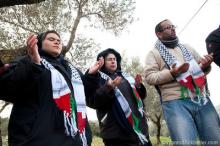
Two weeks ago, the Israeli ambassador to the United States, Michael Oren, claimed in an article in The Wall Street Journal that the exodus of Palestinian Christians from the West Bank and Gaza is the fault of Palestinian Muslims. The article was full of inaccuracies and even lies, and Palestinian Christians responded with anger and disgust. The Wall Street Journal then featured some of these responses.
This is a serious issue for Palestinian Christians. We are not saying that radical Islam is not a threat. We are not denying that there are some struggles that we face as a minority. We are not denying that there are some incidences in which Christians were attacked by radical Muslims, like in the death of Rami Ayyad in Gaza.
What we are saying, is that for us, the real issue and the core of our struggles is the Israeli occupation.
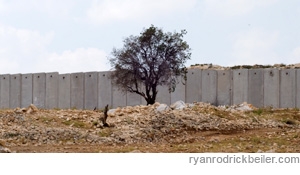 Whenever I give talks on the effects of the Israeli occupation on Palestinian livelihood, the status of nonviolence as a means to resisting the occupation, and how I believe nonviolence is the only way to move forward to resolve the conflict and create a lasting peace between Israelis and Palestinians, one of the first and immediate questions I get from foreign visitors to my office in Bethlehem is, What you said is good, but what about the Muslims? Do they also believe in nonviolence? Do they understand it?" Even if I don't mention religion in my presentation -- and I rarely do -- this question always seems to make its way in our discussions.
Bethlehem, West Bank. Evangelicals have never been keen on political protests. Especially the sort that includes rifles and grenades -- in the hands of your opponents.
National Catholic Reporter has an important article about the Kairos Palestine Document endorsed last month by the leaders of 13 Chr