ocean

Layperson’s Terms
Each week, The Bible for Normal People podcast offers deep cultural and historical context to scripture. Hosts Peter Enns and Jared Byas have challenging and engaging conversations with notable guests, including Richard Rohr and Amy-Jill Levine, on topics like biblical inerrancy and mental health. thebiblefornormalpeople.com
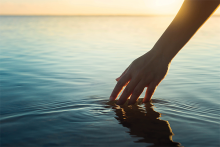
THIS SPRING, I moved to California. Nature, culture, family, and work beckoned my partner and me, and once we arrived, we found ourselves immersed in sweetness: picking roses in our friend’s garden so fresh they smelled like citrus; sharing weekly dinners with my brother; and swimming in the Pacific Ocean. In that water, I’ve felt swallowed by mystery. The airborne salt, the bone-cold temperature, and the wild waves refine my ability to listen to the hum of the earth. In the Christian tradition, the ocean’s role in shaping consciousness is robust. Through their writing on “contemplative ecology” and reflections on the Pacific, contemplative theologian Douglas E. Christie, Lutheran scholar Lisa E. Dahill, and mystic Thomas Merton have helped me embrace the ocean as a healing partner.
Christie, author of The Blue Sapphire of the Mind: Notes for a Contemplative Ecology, describes “contemplative ecology” as dual-natured: a spirituality that centers the natural world and “an approach to ecology” that relies on “contemplative awareness.” He posits that connecting contemplation to the environment helps make us more “porous,” more attentive, and clearer about the world as a “sacred [and beautiful] whole.”
It is especially important, and equally challenging, to see the world as sacred and beautiful amid the global climate crisis.

THERE'S A REFORM JEWISH Sabbath prayer that reads, “Days pass and the years vanish, and we walk sightless among miracles. Lord, fill our eyes with seeing and our minds with knowing; let there be moments when Your Presence, like lightning, illumines the darkness in which we walk. Help us to see, wherever we gaze, that the bush burns unconsumed. And we, clay touched by God, will reach out for holiness, and exclaim in wonder: ‘How filled with awe is this place, and we did not know it!’”
If we want to experience awe or wonder, we need to reach for inputs of wisdom that enliven our ways of seeing. As a person who struggles with overthinking and anxiety, I find visual art, like the work of Latvian American artist Vija Celmins, to be instructive. “The thing I like about painting, of course,” Celmins said in an interview with the Tate museum, “is that it takes just a second for the information to go ‘bam,’ all the way in, and then you can explore it later.” Engaging with Celmins’ work teaches me how to pay close attention to the life in front of me, noticing the beauty that pervades everything.
The sea-surface temperatures were the highest measured in 150 years in 2012. USA Today reports:
"The average temperature in that area hit a record high of 57.2 degrees last year. The previous record was set in 1951, according to NOAA."
The rise in temperature could influence fish and shellfish on the Northeast shell.
Read more here.

A new poem by Sarah Vanderveen...
I pulled on my wetsuit
quick, quick
pausing to take note
of a new hole under the left arm, darnit
and paddled out.
The captain was the first to smell it. He told us that the ocean didn't used to smell this way. Then, we all smelled it.
The current crisis in the Gulf of Mexico is being packaged and sold as a story of blame and gross incompetence, and there's plenty of both to go around.

In the daily grind of life there are few obstacles as irritating as traffic. The opening scene of "Office Space" deftly captures the sentiment. You know it, the neurotic jockeying and ill-fated attempts we make to slip ourselves into the lane that appears to be moving.
Then the Breath of Heaven swept across the waters, blessing the sea with all manner of creatures.