Nuclear Disarmament

WHEN POPE LEO XIV published “Magnifica Humanitas” in May, what struck me most was a verb. The Pope reaches twice for the same words—“to disarm”—as he reflects on artificial intelligence and the civilization we are building. As someone who spent more than a decade working on nuclear disarmament, including helping to build the campaign that produced the Treaty on the Prohibition of Nuclear Weapons, that verb landed differently for me than it might for most readers.
This spring, I signed the “Pro-Human AI Declaration,” a document that calls for centering human dignity and equity at the heart of AI governance. Having worked inside the nuclear disarmament framework, I want to offer an honest accounting: what it can teach us, where the analogy breaks down, and why people of faith may be essential to making any of this operational.

IN NOVEMBER, a stray missile from the Russia-Ukraine war landed in Poland, killing two men in their 60s who worked at a grain warehouse. It took several emergency meetings with NATO officials to determine whether Russia had intentionally escalated the war into the region of the Western military alliance. All parties deemed it an “accident.” (The missile came from Ukraine.)
What if that stray missile had a nuclear warhead?
Russian President Vladimir Putin’s threat to use nuclear weapons in Ukraine must be firmly condemned, as well as his cruel and illegal war with its continued escalation. But accidents happen. Even a limited or regional use of nuclear weapons could have planetary effects, blocking the sun enough to cause a global temperature drop, collapsing crop production, and resulting in massive starvation, according to a report by the International Physicians for the Prevention of Nuclear War.
As the Poland example shows, today we are facing the most serious nuclear threats since the Cuban missile crisis 60 years ago, which then-Secretary of Defense Robert McNamara said we survived only by luck.
Nuclear weapons raise biblical issues. The continuing survival of God’s creation and the human race cannot rely on just “luck” but instead needs providential intervention. A few weeks before the November missile crisis in Poland, Pope Francis said, “Today, in fact, something we dreaded and hoped never to hear of again is threatened outright: the use of atomic weapons, which even after Hiroshima and Nagasaki continued wrongly to be produced and tested.”

Charismatic leaders such as Jean Vanier can inspire and transform us. But when these leaders commit abuse, how do the movements they ignite pick up the pieces?

THE INTERNATIONAL COMMUNITY is scrambling to salvage the 2015 Iran nuclear deal after the United States withdrew from it in 2018 and reimposed harsh sanctions on Iran. At stake is how much sanctions relief to offer in return for robust international oversight of Iran’s nuclear program. Blockchain technology allows us to fundamentally reframe this question: What if countries could offer real-time visibility of their nuclear programs in return for positive financial incentives?
Blockchain is an information management tool for governing large networks in low-trust environments. Uniquely, however, it can both facilitate and financially incentivize cooperation among nontrusting parties. This suggests a potential role for blockchain in normalizing habits of international cooperation, including by helping build trust in nuclear nonproliferation and disarmament agreements.
At least three attributes of blockchain are relevant in that regard.
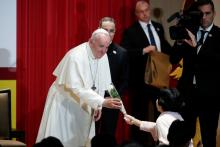
Pope Francis wrapped up a four-day trip to Japan on Tuesday by turning from the anti-nuclear message that was the backbone of his visit to other key campaigns of his, urging students to defend the earth and show greater compassion.

Like many of my millennial peers, I was barely in diapers when the Cold War ended, never practiced fallout drills in school, and only recently learned what those yellow-and-black signs on old buildings meant. As a kid, if I thought about nukes at all, it was in a passive tense, World War II-history sort of way. In other words: not my problem.
But as we mark the 70th anniversary of Hiroshima and Nagasaki — when U.S. aircrafts dropped bombs on two Japanese cities, killing 135,000 people, by conservative estimates — I spent some time in the Sojourners archives trying to fill the gaps in my nuclear education. Here’s what I found.
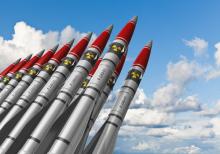
This week, at a conference in Vienna, Austria on the humanitarian impact of nuclear weapons, Pope Francis issued a statement declaring that "nuclear deterrence cannot be the basis for peaceful coexistence between states."
A Vatican official told Sojourners in Vienna that the Holy See is seriously discussing whether the possession of nuclear weapons can be morally justified in our current multipolar world. The official quoted Pope John XXIII, who said "Nuclear weapons should be banned," and said that the time has come to embrace nuclear abolition.
The Vatican statement, titled "Nuclear Disarmament: Time for Abolition," argued that "the structure of nuclear deterrence is less stable and more worrisome than at the height of the Cold War," and said that "the very possession of nuclear weapons, even for purposes of deterrence, is morally problematic."
Since the beginning of the Cold War in the aftermath of World War II, the fundamental moral rationale for the possession of nuclear weapons has been the concept of deterrence. Simply put, the threat of massive annihilation rendered these weapons unusable — the very threat of such unacceptable destruction would, in theory, deter their use.
As the nations of the world review the nuclear Non-Proliferation Treaty (NPT) in May at the United Nations, they gather at a time of unprecedented hope for genuine progress toward disarmament. The new receptivity to nuclear abolition is reflected in the “New START” treaty between the United States and Russia, and was sparked by private initiatives led by former U.S. Secretary of State George Shultz and other senior security experts and officials in many countries.