minnesota
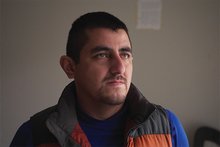
ON JAN. 8, Alberto Castañeda Mondragón was taken to an emergency room in Edina, Minn., with head injuries. It was a few hours after he’d been stopped and detained by Immigration and Custom Enforcement agents. He was then transferred to the Hennepin County Medical Center in Minneapolis. According to the Associated Press, “The officers told nurses Castañeda Mondragón ‘purposefully ran headfirst into a brick wall.’” But AP consulted with a doctor who confirmed that his injuries—including eight skull fractures on the front, back, and both sides of his head and five brain hemorrhages—were inconsistent with walls or falls. Castañeda Mondragón recalled “ICE officers striking him with the same metal rod used to break the windows of the vehicle he was in.”
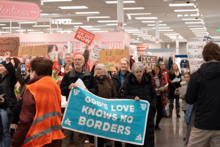
When Mennonite Action formed to oppose the U.S. support for Israel’s occupation of Palestine, they never imagined they’d soon be opposing occupation in their own backyard. As federal immigration forces descended on Minneapolis and other cities across the nation, Mennonite Action worked to defend their neighbors, oppose unjust immigration policy, and educate Anabaptist participants on the connection between Christian Zionism and Christian Nationalism.
Since establishing itself with just seven volunteers meeting virtually, Mennonite Action has grown to five paid staff members, four volunteer leaders, and now holds national leadership retreats annually. After its November 2024 retreat following the presidential election, the group felt that public action against new immigration enforcement would be necessary. Sarah Nahar, the staff supervisor and a member of the Mennonite Action steering committee, said the leadership team and staff worked on solidifying organizational language while remaining steadfast in their commitment to public action in support of Palestinians.
“There are deep, intertwined mechanisms of power and oppression operating in the U.S.-Israeli occupation of Palestine, and many of us in the room knew that,” Nahar said. “One of the things that we worked really hard to do in that meeting was to talk about how this wasn’t a transition or a shift.”
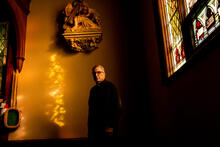
When Father Dale Korogi takes the podium to give the homily to the parishioners of the late morning Mass at Ascension Catholic Church in north Minneapolis, he is used to seeing hundreds of faces watching him—mostly the faces of immigrants from Latin America.
Now, he sees only a few dozen in the pews, as most of the immigrants in his congregation are staying home until the Trump administration withdraws the thousands of immigration agents who have been deployed in Minnesota as part of Operation Metro Surge.
The only time I heard my father speak Spanish was in prayer. Before dinner, he thanked God for the food we received and for our presence to each other in the language of his home country. He still does.
We lived in Minnesota from 1993 to 1999, and on wintry nights, when the wind chill might dip so low that Fahrenheit equaled Celsius, our meal was blessed with words that seemed out of place and yet essential to who we were—as prayer should.
At the time, the infrastructure of immigrant communities in Minnesota was only beginning to develop. The number of families from Southeast Asia and Somalia was just starting to increase; it was still far from the critical mass that would make possible civic and cultural organizations, restaurants, and stores, let alone political power. In my school, I recall no other families from Latin America. The local Mexican restaurant was Taco John’s.
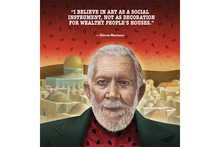
THIS ISSUE GOES to print as the Trump administration wages a massive, deadly attack on Minnesotans under the guise of immigration enforcement. People on the full spectrum of citizenship status, including children, have been violently taken from streets, homes, and businesses. Immigration and Customs Enforcement agents have killed two nonviolent observers. Countless other observers and protestors have been assaulted, tear-gassed, and arrested, including many clergy. Across the country, including Minnesota, people are resisting brutal government overreach by organizing food, rides, protection, and public advocacy. We walk in prayer and solidarity with them.

Chaos fills the streets as families are separated by force, and mothers cry out as their children are taken from them. To exert control and maintain power, a ruler orders agents to detain people off the street. Those the ruler labels as “subversive” are treated as a threat to his reign. The violence is indiscriminate and unrelenting. It does not matter who gets hurt, as long as the ruler stays on the throne.
If your mind went directly to President Donald Trump or the news of Immigration and Customs Enforcement agents shooting and killing two Minnesota residents—mom and poet Renee Nicole Macklin Good, and intensive care nurse Alex Pretti—you are not alone. But in this case, I am talking about Herod and his order to kill the children in Bethlehem and its surrounding region (Matthew 2:16). While the parallels are not identical, the shared logic of unrestrained state power is unmistakable.

As a lifelong resident of Minnesota’s Twin Cities and a minister trained in deescalation, Matt Moberg has spent many of his past mornings at the Whipple Building in Minneapolis alongside those protesting Immigration and Customs Enforcement descending on their cities. He’s spent his nights at the 19,000-seat arena in the Target Center, as a chaplain to the NBA’s Minnesota Timberwolves.
“Sports can be done and sports can be held—and I think the Timberwolves in particular do it well—not as a distraction from real-life unfoldings,” Moberg told Sojourners. “It's a way to go, we’re still going to come together, not in spite of that, but because of that, and figure out how we can move forward together.”
Now, Moberg’s found himself in a small spotlight after his words reflecting on faith and social justice went viral on social media, where he chastised churches for “posting prayers for peace and unity today while my city bleeds in the street.”
“Don’t dress avoidance up as holiness. Don’t call silence ‘peacemaking,’” he wrote. “Don’t light a candle and think it substitutes for showing up.”

Faith-based refugee resettlement organizations are raising alarms that Immigrations and Customs Enforcement is detaining lawfully resettled refugees in Minnesota, in an operation one resettlement official called “shameful and unpatriotic.”
“This is a five-alarm fire,” Myal Greene, president and CEO of World Relief, said in a press release. “These are not the ‘worst of the worst;’ these are innocent children and families who fled the worst wars and persecution imaginable, who were invited by the American people to become Americans under the terms of American law.
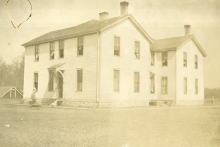
Across the nation, Catholic Church leaders are beginning to reckon with their institution’s role in operating Indigenous residential schools and the lasting consequences these schools left on Native American communities. One state seeing growing momentum to address this history is Minnesota, which had 15 boarding schools; Catholic groups operated at least eight of them.

IT'S ALWAYS AN honor to be invited to help with someone’s good work—to be a guest in their house, especially when that house is as big as all outdoors.
Early in the summer, the Indigenous groups that had been leading the fight against the proposed Line 3 tar sands pipeline in northern Minnesota asked everyone to join them. Freed by the vaccine to travel, many of us took up the offer; it was my first journey since lockdown. And so we gathered on the banks of the Mississippi—so far up the great river that you could, in fact, hop from one bank to the other. There were two big protests on the same June morning; one, at a pumping station, ended in hundreds of arrests of brave activists and real aggression from the police, who buzzed demonstrators repeatedly in a helicopter that kicked up choking clouds of dirt. I was about 20 miles away, and our protest was much more peaceful—indeed, it was mostly spiritual.
Its leaders were a series of Native elders. Along a usually deserted county road, several thousand of us mustered to listen to a water and pipe ceremony led by a pair of Anishinaabe women; it was a hot day, and the drone of their voices against the beat of drums both lulled and emboldened. Soon, a few of us struck out across a marsh, past signs declaring that we were trespassing, aiming for a wooden road that the pipeline company had built across the swamp to carry its equipment. We gained it, and soon there was an occupation underway—tents going up, people making plans for sanitation and food supply and security. But mostly there was prayer and ceremony: Within hours a sacred fire had been lit, and five days of ceremony were underway.
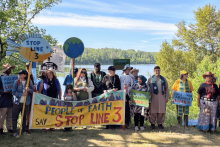
In 1855, the Ojibwe people signed a treaty in Washington, D.C., that retained extensive land use rights in the Great Lakes region for hunting, gathering, fishing, and worship rights for the community. Today, the Ojibwe, who live throughout Minnesota, North Dakota, Wisconsin, Michigan, and Ontario, Canada, still retain these 1855 treaty rights, which are separate from reservation land.
But the Line 3 Replacement Project is seeking to cut through the land, which activists say would directly violate those treaty rights.
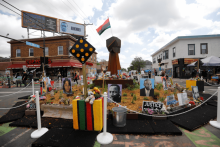
“This solidarity has the potential and the power to propel us into a new future as a community,” Rev. Ingrid Rasmussen, pastor at Holy Trinity Lutheran Church in Minneapolis, told Sojourners.
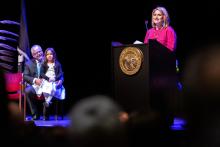
ON JAN. 7, I was in St. Paul, Minn., where Peggy Flanagan was sworn in as Minnesota’s lieutenant governor. Peggy has been a close friend and ally of Sojourners for many years, serving as a member of our board executive committee, and she has been like a daughter to me and my family.
What I saw and heard from Peggy could be a glimpse of the future of American politics. It felt so different from the divisive political situation I had just come from in Washington, D.C. It was a historical moment as Peggy Flanagan was sworn in as the highest-ranking Indigenous woman ever elected to a state’s executive office. I would like to give my space to present her words, adapted from her inaugural speech:
“MY STORY IS a One Minnesota story. It’s about community. We didn’t have much growing up. What little we had, my mom used to make sure we got ahead. But it didn’t always add up. We needed help. I was the kid with the different-colored lunch ticket. We needed those free meals at school. Medicaid saved my life. As a kid with asthma, it’s the reason I’m alive today.
Growing up wasn’t always easy, but it made me strong. I stand before you today because of a loving family, a supportive community, and a great state. My vocation is to create community across Minnesota—a community like mine that lifts people up and provides them a little help when they need it.
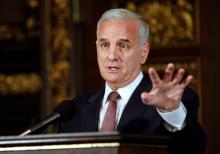
Mohamed Omar, the mosque's executive director, previously said a member of the congregation saw a pickup truck speeding away from the building's parking lot just after the blast.
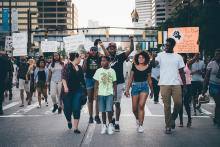
Bills criminalizing peaceful protest have been introduced to state legislatures in five U.S. states, reports The Intercept. The five states are Iowa, Michigan, Minnesota, North Dakota, and Washington. The bills have been proposed by Republican lawmakers.
The bills proposed in Iowa, Minnesota, and North Dakota aim to effect highway protests. The bill introduced in North Dakota, if passed, would give motorists the legal right to kill with their vehicles any protesters standing in the road, if the protester is struck accidentally.
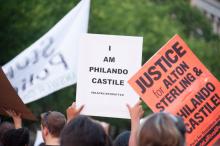
On July 6, Castile was in the car with Reynolds and Reynolds’ daughter in Falcon Heights, Minn., when Yanez pulled Castile over and fatally shot him. Reynolds broadcast the moments immediately after the shooting on Facebook Live.

“I think there’s a moment of great creativity for women leaders in the religious sphere,” said the Rev. Katharine Rhodes Henderson, president of Auburn Theological Seminary, and author of God’s Troublemakers: How Women of Faith Are Changing the World.
“I think that we are seeing, in lots of areas of American life, that some of the traditional structures that served well for a long period of time are no longer doing so. … A time of change means there’s a possibility of new types of leadership and new people doing it.”
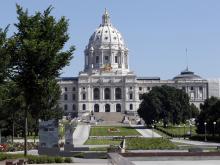
A man who wounded eight people in a knife attack at a mall in central Minnesota before he was shot dead by an off-duty police officer is a “soldier of theIslamic State,” the militant group’s news agency said.
The man, who was wearing a private security uniform, made references to Allah and asked at least one person if they were Muslim before he assaulted them at the Crossroads Center mall in St. Cloud on Sept. 17, the city’s Police Chief William Blair Anderson told reporters.
Reuters was not immediately able to verify the authenticity of the claim made byIslamic State through the group’s affiliated Amaq news agency.
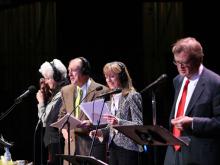
A stalwart liberal, Keillor generally resisted the temptation to intertwine religion and politics, both on the show and in his own life. But when religious conservatives dismayed by the leftward tilt of the mainline denominations wonder what makes those pew dwellers tick, Keillor embodies the answer.
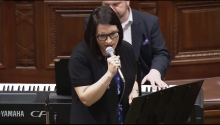
Can your district representative sing? Because Peggy Flanagan sure can.
Flanagan, a representative of District 46A in Minnesota, took Minnesota's house floor with a moving vocal performance on the evening of April 25 to pay her respects to Prince Rogers Nelson, who passed away on April 21.