israel and palestine
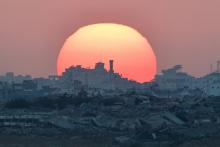
As an editor and journalist, it’s my job to have words for the news of the day. But now and then, the news of the day has a way of robbing me of all my words. This is especially the case when the news of the day revolves around an injustice that is actively harming our world and humanity. What truly leaves me wordless is when we, as people, know that something catastrophic is happening, but we seek to minimize or ignore it. How do I change that? Is there a perfect combination of words and data to prevent that?
A specific example is Israel’s ongoing genocide in Gaza. I’m not sure what else has to be said at this point to help people realize that a genocide is happening right before our very eyes, and it is likely to expand beyond Gaza into the occupied territory of the West Bank. One of Israel’s leading human rights organizations—B’Tselem—is desperately trying to raise the alarm about this very fact.
A SMALL TREE grows near the parking lot at a state park close to my home. I noticed this tree more than a decade ago when our children were very small: A sapling rooted in the crack of a giant boulder.
Over the past 14 years the split in the boulder has widened. As the tree has gotten a little taller and broader, the rock has gradually changed its shape, splitting and cracking. The tree’s bark folds around the rock; the two have become inextricably bound up with one another.
Social transformation can be slow, quiet work, like roots pushing their way through rock. It’s often hard to see the impact your life, your work, your presence, your art, your words are making on the impenetrable forces around you. Ask me to move a two-ton rock and I’ll laugh in your face; it's impossible. And yet, I remember that little tree.
Extremely heavy forces are at work in this world: racism, misogyny, greed, violence. And yet people keep finding ways — like that tree growing down into stone — to stay rooted, find joy, grow, even thrive. What if the response to these very real and very heavy stones threatening to crush our humanity is not a sledgehammer but a sprout?


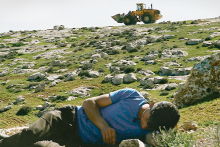
Honestly, I never thought much about Israel before college. Then, during my sophomore year, a prominent New Testament studies scholar had been invited to speak on campus; after it came to light that they were openly critical of the state of Israel, they were summarily disinvited. A few other students and I were still able to meet with the scholar, and we were shocked by the language they were using to describe the conditions in Israel for the Palestinians: “Second-class citizens,” “genocide,” and “apartheid” were the terms that struck me most.
“It can’t be as bad as what Black people have faced in the United States or what they faced in South Africa,” I remember saying to the scholar. “Go and see,” they admonished. And so, one year later, that’s exactly what I did.
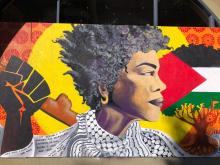
The first time that I visited Palestine was during my senior year at a Christian liberal arts college. It was one of those “Holy Land tours.” You know the type: visit the sacred sites, avoid political chatter, and return with photos of you or someone you know getting baptized in the Jordan River. Hashtag blessed.
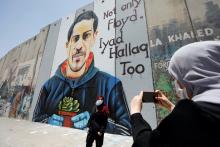
The tangled web of some U.S. and international evangelical and Pentecostal leaders blessing Israel’s expansionist ambitions toward the West Bank and more has a long and complicated history. President Trump has wrapped his political arms around those religious allies today in a craven attempt to preserve his evangelical base. But other Christians – including many prominent evangelicals – have consistently refused to condone Israeli occupation of Palestinian land as a supposedly “biblically sanctioned” real estate plan.

IN JERUSALEM'S OLD CITY, prices are seldom posted. Negotiating is not only welcomed but necessary. It is customary for the merchant to initially ask for a price far in excess of what both parties know to be reasonable. When such an offer is made, it is perfectly valid for the customer to reject the offer; only then does the real negotiation begin. But if the merchant’s counteroffers get progressively higher, it is perfectly justifiable for the customer to question whether the vendor is genuinely interested in selling.
For the past 30 years, the Israeli-Palestinian peace process has often resembled a dysfunctional bazaar transaction. With each round of negotiations, Palestinians have been asked to pay a higher and higher price. The Trump administration plan released in June, called “Peace to Prosperity,” is no exception. But why are its terms so unacceptable to Palestinians?
Palestinian political leadership has consistently expressed its aim to establish a sovereign state in which the Palestinian people can exercise national self-determination. As Israeli-Palestinian peace talks over the past quarter century have demonstrated, the issues of borders, Israeli settlements, and Jerusalem are all negotiable to some extent, but any plan that requires Palestinians to relinquish the fundamental aim of national sovereignty is setting the price too high.
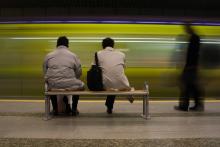
As I write, I'm stuck in the Central Wisconsin Airport (near the bustling metropolis of Wausau, Wis., for those keeping score at home). And, you guessed it, I'm waiting. Fog in Minneapolis prevented our plane from landing there, and now I'm left sitting in a very small regional airport with no restaurant and no coffee and no concrete sense of what the rest of my day will look like as I make my way to California. All I can do is wait.
I do know, barring something entirely unexpected, that I'll eventually make it to San Francisco. Right now I'm living the axiom offered by Tom Petty decades ago: "The Waiting is the Hardest Part."
Advent, a season during which Christians honor and attempt to approximate the longing for a Messiah more than 2,000 years ago, is often described as a chance to exercise our patience muscles. Advent can serve as a season of anticipation and hope and longing, void of desperation. This is Advent for those who already have most of that for which they wait. But for countless people around the globe, every additional day of waiting comes with a heavy price.