Iran
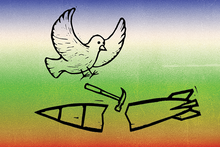
THE UNITED STATES is now engaged in another war. This time with Iran. How might we break out of this horrendous cycle of violence and what moral guidance might we offer, especially as Christians? Predictably, the resort by Israel to a violent “defense” against Gaza in 2023, supported by the U.S., has now metastasized into another major escalation in the region, with Iran, Israel, and the U.S. each claiming “legitimate defense.”
In the first few weeks of lethal engagement this winter, at least 1,230 people were killed in Iran, including more than 100 children at a girls’ primary school after an illegal U.S. air strike. Deaths in Lebanon and Israel continued to rise. The war spread across at least 13 countries in the Middle East. Each destroyed home, livelihood, and life increases the bitterness, trauma, and threat. Destroying military equipment, nuclear sites, or killing key leaders does not address root causes of injustice nor the unmet needs behind perceived or real threats.
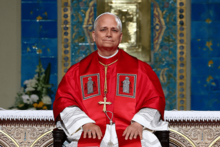
On Monday, Pope Leo XIV responded to ranting criticisms from President Donald Trump, saying in part that he had no interest in being perceived as a politician.
“The message of the church, my message, the message of the gospel: Blessed are the peacemakers,” Leo told journalists as he arrived in Algeria. “I do not look at my role as being political, a politician.”
Trump attacked Leo late Sunday night as “WEAK on Crime, and terrible for Foreign Policy,” at the beginning of a lengthy post on Truth Social.
“I don’t want a Pope who criticizes the President of the United States,” he wrote. “Leo should get his act together as Pope, use Common Sense, stop catering to the Radical Left, and focus on being a Great Pope, not a Politician.” The president also posted an AI-generated image of himself as Jesus, though he later deleted the post and claimed he thought it was him as a “doctor … a Red Cross worker.”
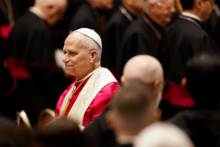
President Donald Trump issued an attack on Pope Leo late on Sunday, calling him “WEAK on Crime” and “terrible” for foreign policy after the religious leader criticized Trump’s foreign and immigration policies.
“Pope Leo is WEAK on Crime and terrible for Foreign Policy,” Trump wrote in a lengthy post on Truth Social.
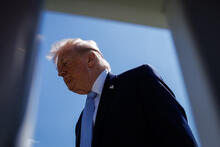
At the beginning of 2026, President Donald Trump said that his New Year’s resolution was to accomplish “peace on earth.” As he asserted last year with his aggressive campaigning for the Nobel Peace Prize, and the White House dubbing him “THE PEACE PRESIDENT” on X, Trump was convinced that he would be the one to fulfill it with “no new wars.” But just two days after issuing this resolution, Trump had Venezuelan President Nicolás Maduro kidnapped.
It is a pattern that has continued deep into 2026—promises of “peace” followed by bloodshed and violence. In January, Trump announced the Board of Peace, an international effort to “stop generations of hatred and bloodshed.” A month later, a joint U.S.-Israeli airstrike hit an Iranian all-girls elementary school as a result of outdated intel, killing at least 168 people, most of whom were children.
On April 7, Trump threatened the people of Iran if the government refused to reopen the contested Strait of Hormuz, a trade route through which about 20% of the world’s oil passes. “A whole civilization will die tonight, never to be brought back again,” Trump threatened on his social media platform.
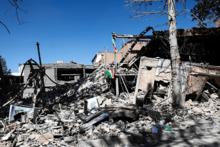
Iran showed no sign of accepting Donald Trump’s ultimatum to open the Strait of Hormuz by the end of Tuesday, while the U.S. president threatened that “a whole civilization will die tonight” unless Tehran reached a last-minute deal.
Trump has given Iran until 8 p.m. in Washington—3:30 a.m. in Tehran—to end its blockade of Gulf oil, or he will destroy every bridge and power plant in Iran. Iran says it would retaliate against U.S. allies in the Gulf, whose desert cities would be uninhabitable without power or water.
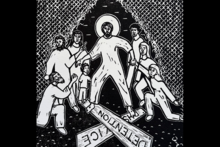
As we journey through Holy Week, I’m meditating less on Jesus on the cross—I see that every day—and am instead meditating on Jesus razing hell.
Israel’s displacement and killing of Palestinians continues; the U.S. continues to escalate the war with Iran; and immigrants are still being hunted down by cowards in masks. Every day we see Christ crucified. What does the hope offered by Jesus, that these forces of evil can be stopped, look like? What are the lessons for us on the road from the crucifixion to the resurrection?
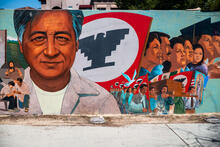
The New York Times’ report on allegations of sexual abuse by labor organizer César Chávez has been devastating to many people, me included. The news reminds me that long before I learned about power, faith, and movements from a church stage or a history book, I learned about them from an abuelita.

In 2002, director Danny Boyle and screenwriter Alex Garland released a post-apocalyptic horror movie that would redefine the zombie genre forever. 28 Days Later was not only ambitious for its experimental cinematography and reliance on relatively obscure actors, but also because of its critical commentary on violence and militarism. Boyle and Garland have partnered up again for the newest installment in the 28 Days Later film series, with the release 28 Years Later (now playing in theaters).
There’s nothing wrong with a gross and scary zombie movie that just stops there, but the 28 Days Later film series offers more than jump scares and blood-barfing, fast-moving zombies, which are called “infected” in the films.
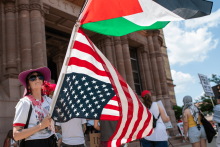
We also need to be clear: Iran did not possess a nuclear weapon. Iran was enriching uranium needed for such a weapon and had recently increased its production, but intelligence assessments concluded they had not made a final decision to produce a bomb. In fact, the assessment said Iran would be more likely to produce a weapon if the U.S. attacked its uranium supply.

THE OPENING SCENE of Holy Spider is brutal. We see a woman — a sex worker — leave her child at home to go to work. Walking through Iran’s holy city of Mashhad, she stops at a public restroom to adjust her headscarf and apply bold lipstick. She goes on her first call of the night and does some opium. As she prepares to go home, a man approaches on a motorcycle. He offers her money. She joins him. Shortly after arriving at their destination, he strangles her.
Writer-director Ali Abbasi’s Holy Spider is a fictionalized account of Saeed Hanaei, known as the Spider Killer, who targeted female sex workers in Mashhad from 2000 to 2001. The film, which premiered at the 2022 Cannes Film Festival, examines the killer’s life and the process of capturing him, led by (fictionalized) female journalist Arezoo Rahimi (Zar Amir Ebrahimi).
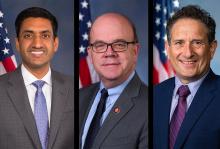
I interviewed Rep. Ro Khanna (D-Calif.) by phone on the same day he voted in favor of the resolution. He spoke about how his faith, "Gandhian Hinduism," informed his anti-war views. I was struck during our interview about the diversity of religious views that informed anti-war activism. I asked Khanna's staff to recommend other members of Congress to interview. Rep. Jim McGovern (D-Mass.), who is Catholic, and Rep. Andy Levin (D-Mich.), who is Jewish, both shared their own thoughts in written responses to the same questions.

IN 2016, CANDIDATE Donald Trump vowed to halt “endless wars.” The Democratic candidates running for president this year have made similar promises.
Yet, following the drone-strike killing of Iran’s senior military commander in early January, more troops are going to the Middle East and military tensions have increased. U.S. forces continue to drop bombs and conduct combat operations in Afghanistan and other countries, as Washington’s propensity for military intervention shows little sign of abating. The power of the Pentagon has increased and will grow further in the years ahead as the 2020 military budget doubles down on money and weapons to wage war across the globe.
When most of us hear the term endless war, we think of Afghanistan. Rightly so, as the war is now in its 19th year, with no end in sight. For years we were told by political leaders, including President Obama, that the Afghanistan conflict was a legal and justified war, as opposed to the illegal invasion and occupation of Iraq. Our persistent efforts, we were told, were paying off in countering terrorism and advancing democracy and human rights.
Now we know this was a lie. The release of the so-called Afghanistan Papers in December revealed systematic deception and failure. Based on 2,000 pages of confidential interviews with those who fought and directed the war, the Afghanistan Papers confirm that Pentagon and White House officials made claims of success they knew to be false and refused to admit the war was unwinnable.

“Here is the world. Beautiful and terrible things will happen. Don't be afraid.” —Frederick Buechner
It’s barely 2020, and we are already reeling, if not personally, collectively. Twitter feeds are full of Iran-related retweets of the president, when just weeks ago we were talking about impeachment.
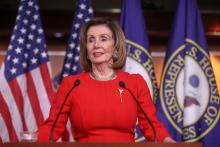
In the aftermath of Vietnam, Congress passed the War Powers Act in 1973, over the veto of President Nixon. It stipulates that the president should inform Congress 48 hours after initiating the military in any hostile action, and then limits the president for 60 days in carrying out such actions before Congress declares war or passes a proper authorizing action. It was an attempt to find a compromise between Congress’ power to declare war and a president’s need to take immediate military action in certain situations. Nearly ever president since, Republican and Democrat, has bristled under its provisions. Further, Congress has largely abdicated its responsibilities to enforce the War Powers Act provisions.

Among the many foreign policy experts, former diplomatic and military leaders, intelligence officers, members of Congress and the Senate, editorial writers, and columnists weighed in on Donald Trump’s killing of Iran’s top general, Qasem Soleimani, most noted a complete lack of strategy. But what they miss is that Trump has only ever had one strategy: doing whatever benefits him and his own political and financial self-interests.
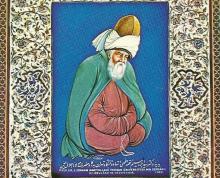
Today, the United States and Iran are two countries on the precipice of war with ruling elites who quote Rumi.

The words of Jesus must now be taken seriously, “Blessed are the peacemakers, for they shall be called the children of God.”
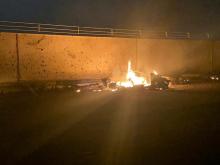
The attack by a U.S. MQ-9 Reaper drone that fired missiles into a convoy carrying Soleimani was neither impulsive nor a retaliatory response. It was not undertaken to protect Americans. It was not an act of patriotism. It was not done to defend the U.S. embassy in Baghdad after the “dramatic but bloodless” siege. If anything, it was in response to Trump’s increasingly untenable situation at home.

In 1981, three years after Iran’s Islamic Revolution, women were banned from entering soccer stadiums in the country.
On October 10, 2019, after 40 years of protest, women in Iran were finally allowed to buy tickets and attend a soccer match. Iran was playing against Cambodia in Azadi Stadium.

American church leaders are saying a clear and emphatic NO to a war with Iran. Diplomacy is the alternative to what would be a disastrous and indefensible war.